• ABOUT – DICK YOUNG
  • YWMF – ARCHIVES

Young's World Money Forecast

Since 1978 With a 32 Year Vacation

  • DICK YOUNG
    • FROM RICHARD C. YOUNG
    • THE FINAL INTELLIGENCE REPORT
  • INVESTING STRATEGIES
    • RETIREMENT COMPOUNDERS®
    • GOLD & SILVER
  • DIVIDENDS & COMPOUNDING
    • MIRACLE OF COMPOUNDING
    • DIVIDENDS
  • GRAHAM & RUSSELL
    • BEN GRAHAM
    • RICHARD RUSSELL
  • THE DOW AND THE LEADERS
    • DOW vs. S&P 500
    • DOW vs. DOW DIVIDEND PER SHARE
  • WELLINGTON MANAGEMENT COMPANY
  • YOUR SURVIVAL GUY
  • BANK CREDIT & MONEY
  • THE PRUDENT MAN

How to Learn About Investing

April 28, 2017 By Richard Young


Investing isn’t one of those tasks that you should learn by doing. That’s not to say that you won’t learn a lesson or two about investing if you dive right in, you will, but the lessons may end up costing you more money than you bargained for.

The Best Way to Learn About Investing

The best way to learn about investing is to do so with books. But which books? You don’t want to just read anything on investing. Ninety percent of what has been published on investing and the stock market isn’t worth your time, effort, or money. You can do more damage than good if you don’t make a diligent effort to select from amongst the best investing books.

So where should you start?

Learn about Investing with Graham & Buffett

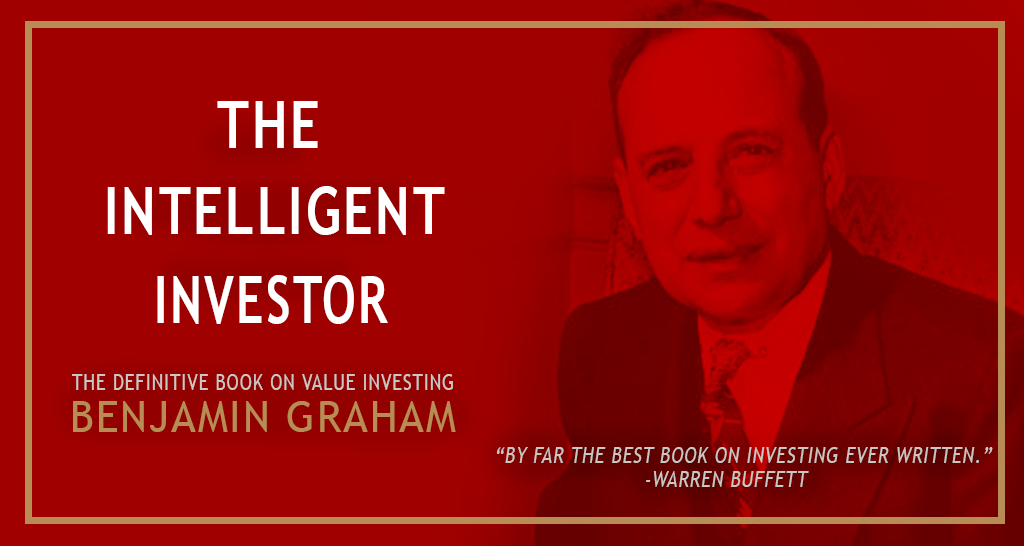
The logical place to start learning about investing is with the best book ever written on investing—Benjamin Graham’s The Intelligent Investor. Graham wrote The Intelligent Investor over six decades ago, and to this day, it remains the best book on investing ever written.

Nothing comes close to the insight Graham offers in The Intelligent Investor. If you aren’t familiar with Graham, don’t sweat it. Many newbie investors have never heard of him.

So who is Ben Graham? Graham is widely acknowledged as the father of value investing and modern security analysis. His most important contribution to investing, among many, is the concept of a Margin of Safety. In the 1973 edition of The Intelligent Investor, Graham wrote the following about a Margin of Safety.

Probably most speculators believe they have the odds in their favor when they take their chances, and therefore they may lay claim to a safety margin in their proceedings. Each one has the feeling that the time is propitious for his purchase, or that his skill is superior to the crowd’s, or that his adviser or system is trustworthy. But such claims are unconvincing. They rest on subjective judgment, unsupported by any body of favorable evidence or any conclusive line of reasoning. We greatly doubt whether the man who stakes money on his view that the market is heading up or down can ever be said to be protected by a margin of safety in any useful sense of the phrase.

A Margin of Safety is a concept you should commit to memory as you begin your investing education. Once you have finished The Intelligent Investor and have internalized the concept of a Margin of Safety, you can turn to one of Graham’s more widely known disciples, renowned investor Warren Buffett.

While few new investors are familiar with Ben Graham, most are familiar with Warren Buffett. Buffet is of course one of the richest men in the world and he earned his fortune in the investment industry using many of the concepts espoused by Graham.

Buffett hasn’t written any investing books himself, but every year of his annual shareholder letters since 1977 can be downloaded here. for free. Buffet’s letters are an investment education in themselves. His homespun writing style and common-sense approach to investing make complicated subject matter easy to read and understand.

What the Wall Street Journal Can Teach you about Investing

Once you have finished Graham and Buffett, you will want to start reading the Wall Street Journal. Read the Journal for a good two months before you lay down any of your own money in the market. You will learn a ton about business, finance, the economy, and investing. And with your background knowledge from Intelligent Investor and Buffett’s annual shareholder letters, you will have the knowledge base to separate fish from fowl.

Learning to Invest with Comfort

Once you are confident that you have a good grasp on investing, you can begin the next phase of your investment education—learning to invest for your own risk tolerance.

You may think you have a high tolerance for risk and maybe you do, but until you lose real money, it is difficult to truly gauge your risk tolerance. You may be surprised how mentally exhausting it can be to see on your statement in big red numbers a $-10,000 figure month after month.

To learn about your tolerance for investment risk, begin investing with a small sum of money and limit your initial purchases to mutual funds and ETFs. The fluctuations in a fund will give you a taste of some of the volatility you can experience in individual common stock positions. The benefit of starting with a fund instead of a single stock is two-fold. First, if you panic and sell out of your fund during a downturn because you didn’t have a good grasp of your risk tolerance, losses will likely be contained.

The second benefit of avoiding a single individual common stock for your first investment is that you avoid overconfidence. The worst thing that can happen when you make your first common stock investment is for it to soar. Why is making money a bad thing? Investors who have success in their first investment can get overconfident in their own ability pick winners when luck may have played a prominent role. Even the best professional investors are only right a little more than half of the time. Those who win on their first investment may be emboldened to invest more on the second try. And if the second investment is a success, the amount wagered on the third investment could be even bigger. You can see the potential for trouble.

Learning to Invest is a Life-Long Journey

If you read Graham and Buffett and pick up a subscription to the WSJ, you will have built a solid foundation of investing knowledge, but learning to invest is a process that is never complete. The investment landscape is constantly evolving. There are new businesses and industries to learn about. New technologies that may be a threat to investments you own. New rules and regulations to understand which could impact your stocks or bonds. New economic developments and releases to evaluate.

If you want to stay ahead of the pack and achieve long-term investment success, you are going to want to read often and read widely.

Filed Under: Ben Graham, Graham & Russell Tagged With: Intelligent Investor

Richard Russell’s Number One Rule

January 7, 2016 By Richard Young

You need to have some will-power to stick to your guns in this stock market. No one said it was going to be easy. But to allow the magic of compound interest to work for you, you have to be patient. Here is one of the great lessons I love to read over and over again from the late Richard Russell. Mr. Russell passed away in November at the age of 91. He wrote daily to his beloved subscribers right to the bitter end. I miss reading his daily thoughts on the market and, even more so, on life in general. RIP Mr. Russell.

Rule 1: Compounding: One of the most important lessons for living in the modern world is that to survive you’ve got to have money. But to live (survive) happily, you must have love, health (mental and physical), freedom, intellectual stimulation — and money. When I taught my kids about money, the first thing I taught them was the use of the “money bible.” What’s the money bible? Simple, it’s a volume of the compounding interest tables.

Compounding is the royal road to riches. Compounding is the safe road, the sure road, and fortunately, anybody can do it. To compound successfully you need the following:perseverance in order to keep you firmly on the savings path. You need intelligence in order to understand what you are doing and why. And you need a knowledge of the mathematics tables in order to comprehend the amazing rewards that will come to you if you faithfully follow the compounding road. And, of course, you need time, time to allow the power of compounding to work for you. Remember, compounding only works through time.

But there are two catches in the compounding process. The first is obvious — compounding may involve sacrifice (you can’t spend it and still save it). Second, compoundingis boring — b-o-r-i-n-g. Or I should say it’s boring until (after seven or eight years) the money starts to pour in. Then, believe me, compounding becomes very interesting. In fact, it becomes downright fascinating!

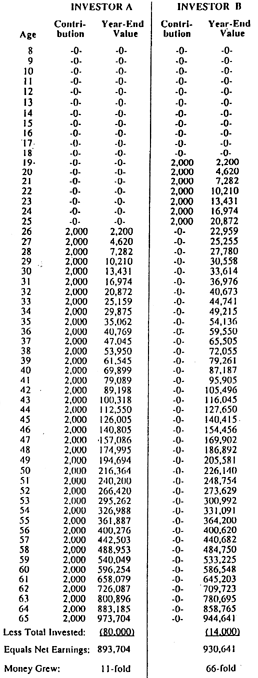
In order to emphasize the power of compounding, I am including this extraordinary study, courtesy of Market Logic, of Ft. Lauderdale, FL 33306. In this study we assume that investor (B) opens an IRA at age 19. For seven consecutive periods he puts $2,000 in his IRA at an average growth rate of 10% (7% interest plus growth). After seven years this fellow makes NO MORE contributions — he’s finished.

A second investor (A) makes no contributions until age 26 (this is the age when investor B was finished with his contributions). Then A continues faithfully to contribute $2,000 every year until he’s 65 (at the same theoretical 10% rate).

Now study the incredible results. B, who made his contributions earlier and who made only seven contributions, ends up with MORE money than A, who made 40 contributions but at a LATER TIME. The difference in the two is that B had seven more early years of compounding than A. Those seven early years were worth more than all of A’s 33 additional contributions.

This is a study that I suggest you show to your kids. It’s a study I’ve lived by, and I can tell you, “It works.” You can work your compounding with muni-bonds, with a good money market fund, with T-bills or say with five-year T-notes.

Filed Under: Graham & Russell, Richard Russell

The Most Impressive Dividend Records

December 30, 2015 By Richard Young


Ben Graham was one of the most successful investors of all-time and the father of value investing. He also wrote the one and only investment book that most investors will ever need to read, The Intelligent Investor. If you’ve read The Intelligent Investor cover-to-cover, you are head and shoulders above the vast majority of the investing public. The amount of investing insight and wisdom packed into this single volume remains unmatched to this day.

The Intelligent Investor’s Most Valuable Advice

Some of Graham’s most valuable advice was to the defensive investor. In Intelligent Investor, Graham wrote, “One of the most persuasive tests of high quality is an uninterrupted record of dividend payments for the last 20 years or more. Indeed the defensive investor might be justified in limiting his purchases to those meeting this test.”

Two decades of uninterrupted dividend payments is indeed a persuasive test of quality. This is especially true with the amount mergers, acquisitions, spin-offs and other corporate restructuring activity today. A minority of U.S. businesses survive for more than two decades in their same form and an even smaller minority manage to make regular dividend payments for the entire period.

According to records from Standard & Poor’s, fewer than 10% of all publicly traded companies have a 20-year record of uninterrupted dividend payments. Below are the 10 U.S. companies with the longest uninterrupted dividend records. If you thought two decades was persuasive, how does two centuries sound?

Top 10 Dividend Records

Error
You are trying to load a table of an unknown type. Probably you did not activate the addon which is required to use this table type.

Filed Under: Ben Graham, Graham & Russell Tagged With: Intelligent Investor

The Power of Compound Interest

April 28, 2015 By Richard Young

Image Credits: ©Steve Schneider – Youngresearch.com

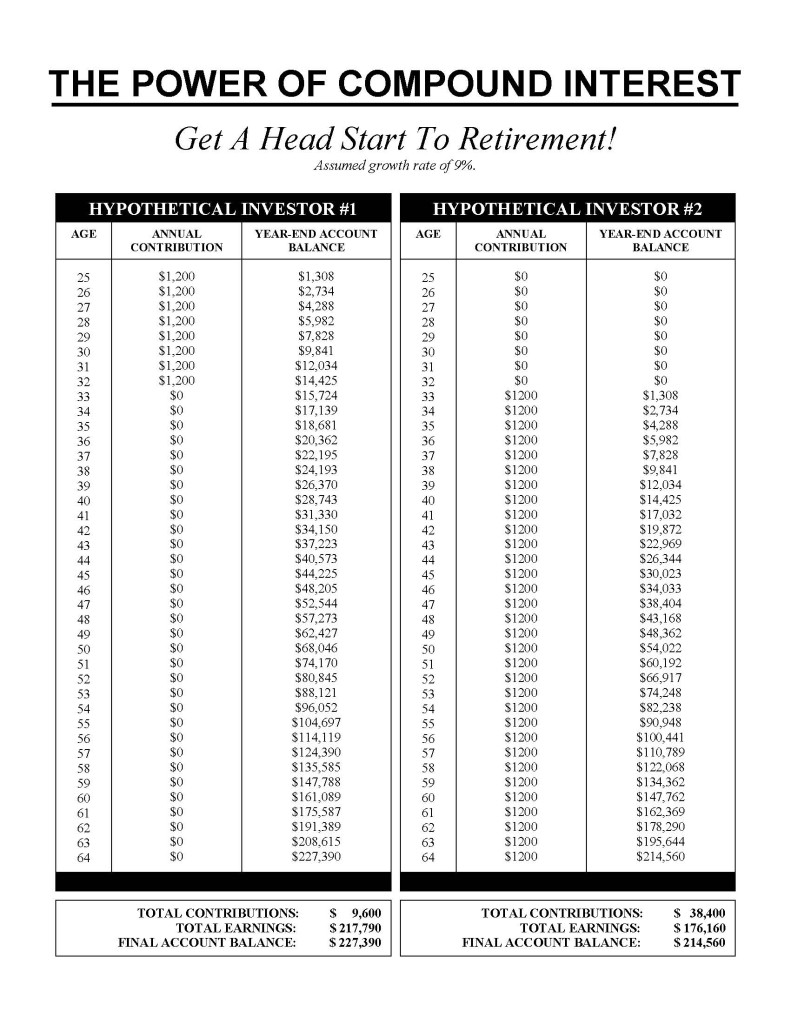
Making money with your money is a no-brainer. Take a look at the difference in returns between two $40 investments in Coca-Cola in 1919. One had dividends put into a piggy bank. The other had dividends reinvested. Without reinvesting, the initial $40 investment grew to $456,273 by 2012. With dividends reinvested, the value increased to $9,876,106. That’s a difference of over 2060%. That’s the power of compound interest.

Filed Under: Dividends & Compounding, Miracle of Compounding Tagged With: Compound Interest

A Sleep Well(esley) at Night Fund

August 30, 2011 By Richard Young

Image Credits: © VadimGuzhva – Adobestock.com

You can be sure that 90% of what you read about retirement investing is either (A) not very helpful or (B) confusing. Yet there are some simple solutions and tools to use that are helpful and easy to understand. One of them is a fund to which I recently made a sizable contribution. But first let’s look at the dismal reality of the 401(k), which most baby boomers will depend on in retirement.

Your 401(k) isn’t worth as much as you think it is. That’s because at age 70½ you need to begin making annual withdrawals based on an IRS life expectancy table and pay taxes at your ordinary income rate, not at the lower capital gains rate. What’s more, there’s a good chance you’ll live longer than the IRS life expectancy, ensuring that your entire balance will have been subjected to income taxes well before you die. Isn’t that uplifting?

How about giving your money to the government today? That’s what you’ll do by converting to a Roth IRA. If you’re in your prime earning years, you’ll pay taxes at your highest tax bracket. What’s scarier is that after conversion, some investors may think it’s time to get even more aggressive since they’ll never owe taxes on the gains. This is retirement money we’re talking about. You’re no longer a teenager. If you lose it, you don’t have forever to make it back.

You should begin investing for retirement the day you’re born. Most investors start way too late. It’s up to parents and grandparents to get involved with educating children about money. Help them start today. Don’t let them grow up believing the way to riches is playing poker on ESPN.

You need to save until it hurts. How about refinancing to a 15-year mortgage? Or if that isn’t an option due to high closing costs or being too far underwater on your existing 30-year, how about making larger payments? The real-estate market as a supplement to your retirement left the station in 2008.

In 1968, it wasn’t out of the realm of possibilities to be able to buy your home for an amount equivalent to your annual income. Nowadays, in Newport, Rhode Island, for example, even after the crash, it’s difficult to find a home for sale for less than $300,000. If you earn $50,000 per year, that’s six times your income. Why not consider renting and see if you can handle the monthly payments before locking yourself into something you may not be able to afford?

Here’s my number one recommendation for do-it-yourself investors. Keep your investments simple: buy two or three mutual funds and call it a day. Don’t listen to your stockbroker. They’re salesmen, and very good ones at that, but they’re not investors. They may be nice people, but they don’t know how to build your wealth.

I recently bought the Vanguard Wellesley fund for my family because it embodies what investing is all about. It is a balanced fund with roughly 60% in bonds and 40% in equities. It was down only 9.8% in 2008, compared to a loss of 38% in the S&P 500. Investing math is simple: if you lose 9.8%, you only need a gain of 10.9% to get back to square one, whereas if you lose 38%, you need a gain of 61.3%.

At the core of Wellesley is compound interest. Anyone who knows anything about investing understands the importance of compound interest. Warren Buffet’s right-hand man, Charlie Munger, sings its praises, and Albert Einstein referred to it as the Eighth Wonder of the World. If you compound $10,000 at 6% for a year, you’ll have $10,600; compound that at 6% and at the end of year two you’ll have $11,236, and after 60 years it will be $300,000. Do this for a loved one and he or she will never forget you.

So where are we today in terms of valuations for bonds and stocks? Add the yield on the three-month T-bill and the Dow Jones Industrial Average yield to find out. Historically, retirees could purchase T-bills with a yield somewhere between 5% and 6% and forget about stocks. They could be comfortable in retirement with the risk-free rate of return and the full-faith-and-credit pledge of the U.S. government. And historically, the Dow yielded between 3% and 4%.

A solid number for the sum of the yields on T-bills and the Dow has been around 9%. Today, with T-bills yielding a pathetic 0.13% and the Dow yielding a measly (post-crash, mind you) 2.41%, you have a sum of 2.54%. Not good at all. Write this number on a stamp and put it on your fridge.

All you need is your postage stamp, the definition of compound interest on a three-by-five card, and the Vanguard Wellesley prospectus. Use the tools I outlined above, open an account for yourself, your kids or your grandkids, and your family will be on the right path to retirement riches.

Filed Under: Dividends & Compounding, Miracle of Compounding Tagged With: Compound Interest

Need Yield?

August 27, 2010 By Richard Young

Do you invest in stocks for income? Is your portfolio focused primarily on U.S. stocks? If so, you might consider diversifying globally. The dividend yield on the U.S. stock market is one of the lowest yields in the world. In the chart below, I show the yields of 23 of the world’s major stock markets. The dividend yield on U.S. stocks is only 2.11%, compared to an average of 3.09% and a high of 5.45% in Spain. The U.S. is the sixth-lowest-yielding stock market in the group. If you invest in stocks for dividends or income, a global approach is advisable.

When you take a global approach to dividend investing it is possible to craft a portfolio that is better diversified across industries than a U.S.-only portfolio. Take the U.S. oil and gas industry as an example. Oil and gas production is a capital-intensive business. In the U.S., the independent oil and gas companies fund their capital expansion projects primarily with internally generated funds. After capital expenditures, there is often not much cash left for dividend payments. But in a country like Canada, there are oil and gas production companies that offer high dividend yields—in some cases yields north of 5%. How do the Canadian oil and gas companies pay such high dividends? Instead of funding capital expansion plans with internally generated funds, they tap the capital markets. For income-oriented investors, the strategy has appeal.

In Young Research’s Global Investment Strategy, we advise high-yielding international stocks that you’re unlikely to find in any other investment strategy report. We also cover special situations, global fixed-income markets, and commodities and currencies. If you are not now a subscriber, please join us.

Filed Under: Dividends & Compounding, Miracle of Compounding Tagged With: Compound Interest

A Simple Strategy for Stock Market Success

July 15, 2010 By Richard Young

For over four decades I have used a simple strategy to successfully invest in the stock market. I invest exclusively in dividend paying stocks. I especially favor those with high yields, a strong balance sheet, and a history of annual dividend hikes. This strategy is simple, but it works.

Historically, high dividend payers have outperformed non-dividend payers. In the chart below I show the growth of $1 in non-dividend paying stocks to the growth of $1 in the highest yielding quintile (top 20%) of U.S. stocks. The difference in performance is profound. $1 invested in non-dividend payers in June of 1927 grew to $696. That same dollar invested in the highest quintile of dividend paying stocks rebalanced each year, grew to over $4,500.

You may study my chart and wonder why any investor would bother with non-dividend payers. This strategy is not complicated. Anybody with access to a financial database and some time can run a few screens and come up with a list of candidates to buy. As I see it, the reason more investors don’t focus exclusively on dividend payers is because they lack patience. Building wealth in dividend paying stocks is a slow process. Most high dividend payers are mature stable businesses with modest growth prospects. They don’t offer the prospect of spectacular short-term gains. With dividend payers, you profit over the long-term through the power of compound growth. That requires patience.

At Young Research my Retirement Compounders list includes only dividend paying equities. Today, the average dividend yield on the RC’s exceeds 5%–more than twice the yield on the S&P 500.  Young Research’s Retirement Compounders forms the basis for the stocks I recommend in Intelligence Report and the equity portfolios we manage at my family-run investment company.

If you are interested in having a portfolio of global dividend paying equities managed check out younginvestments.com.

Filed Under: Miracle of Compounding Tagged With: comp, Retirement Compounders

How to Boost the Yield on Your Portfolio

January 18, 2010 By Richard Young

Image Credits: © fotogestoeber – Adobestock.com

Punishing yields of 0.05% on three-month T-bills and .85% on short-term Treasury notes are devastating to the millions of investors who rely on income from their portfolios to fund living expenses. The temptation for many of these investors is to reach for yield. Some investors are loading up on long bonds. You can pick up an additional 3% in yield by moving into long bonds, but you also add an extraordinary amount of risk. If rates move up, investors in long bonds will get creamed. I’m talking about losses that dwarf what many investors experienced in the recent bear market in stocks. If long rates increase by just 1%, 30-year Treasury zero-coupon bonds would fall by 25%. If rates rise 2%, forget it-your portfolio is toast.

There is a better way to add yield to a fixed-income portfolio. Individual issue selection is the key. The idea here is to move down in rating and up in yield without sacrificing quality. You want to own a portfolio of both highly rated issues and those rated below investment-grade where there is tangible value to protect your principal in the event of default. In Young Research’s Global Investment Strategy, we recently recommended a five-year corporate bond with a yield of close to 7%, or 4% more than comparable treasuries. The bond is backed by a portfolio of some of the most valuable energy resources in North America. If you are retired or soon to be retired and are looking for ways to boost the income on your fixed-income portfolio, please join us.

Filed Under: Dividends & Compounding, Miracle of Compounding

Top 10 Investing Mistakes

November 6, 2009 By Richard Young

The #2 item on my list of the ten most common mistakes investors make is discounting the importance of compound interest. Albert Einstein described compound interest as the greatest mathematical discovery of all time. Charlie Munger, Warren Buffett’s longtime partner, said: “Understanding the power of compound return and the difficulty getting it is the heart and soul of understanding a lot of things.” My son, Matthew Young, puts it this way: “Compound interest is your silent warrior for long-term investing.” The key to compound interest is not interest, but interest on interest. In fixed-income investing over long periods, interest on interest can account for over 60% of your returns. To harness the power of compound interest, you need time and a rate of return. In my monthly strategy reports and at my family-run investment company, I make compound interest a focal point. If you are not already with us, please join us. If you want to study the power of compound interest, spend some time with a compound interest table.

Top 10 Mistakes

#10 Not Recognizing that a Recession is Over
#9 Investors Fail to Make Dividends Their #1 Priority
#8 Overreaching for Yield
#7 Failing to Fortifying Your Financial Future in Turbulent Times
#6 Failing to Focus on the Fed’s Federal Funds Rate Beacon
#5 Focusing on Potential Return Before Risk
#4 Ignoring Cost – A Vital Determinant of Investment Performance
#3 Chasing Performance
#2 Discounting the Importance of Compound Interest
#1 Taking a Casual Go-It-Alone Approach to Investing

Filed Under: Dividends & Compounding, Miracle of Compounding Tagged With: Compount Interest, Retirement Compounders

Stock Valuations are Not Low

July 30, 2009 By Richard Young

Image Credits – © Sergey Nivens – Adobestock.com

How can I say this best? Stock market valuations are not low. If you are retired or saving in hopes of retiring, you must laser focus on having a consistent flow of cold cash to pay the tab for your weekly grass-fed-to-the-end beef, fresh-ground flax, coconut milk loaded with medium-chain fatty acids, and omega-3-loaded Country Hen organic eggs. In other words, you will want to rely on high-dividend yields for compound-interest power. The two most important words in investing are “compound interest.” Please don’t buy into the jive that trying to buy stocks cheap and then trying to dump them on the suckers has anything to do with a conservative compounding story.

The rubber hits the road with a consistent flow of one item – dividends. In my monthly Intelligence Report and at our private investment management company (www.younginvestments.com), I rely on the historical yield range and the DJIA as a conservative investor’s best gauge for assessing dividend value. When the Dow’s yield is between 4.5% and 6.5%, I gauge stocks as cheap. When the Dow’s yield is between 3.5% and 4.5%, it’s neither fish nor fowl. Below 3.5%, I’m not being paid well for investing in stocks. Well, the yield on the Dow, as I write you with ever-increasing concern, is a paltry 3.1%. No, stocks are not cheap, and values are lacking. And while I’m at it, intelligence in Washington is lacking even more!

Filed Under: Dividends & Compounding, Miracle of Compounding Tagged With: Compound Interest, Stocks

  • « Previous Page
  • 1
  • …
  • 26
  • 27
  • 28
  • 29
  • Next Page »

Compensation was paid to utilize rankings. Click here to read full disclosure.

RSS New From Young Research & Publishing

  • Island Hopping: A Campaign for Iran’s Islands
  • Ben Graham: Margin of Safety
  • Netanyahu Suggests Pipelines to Israel to Avoid Iran Threat
  • Wind and Solar Surge to 19% of US Electricity in 2025
  • 2025 Shows Steady US Productivity Amid Shifting Inputs
  • Auto Sector Feels Sting of Hormuz Disruption
  • Choke Point: Strait of Hormuz Strangled by War
  • US Loosens Shipping Law to Address Oil Disruptions
  • US LNG Exports to Caribbean Reach Near-Record Levels
  • USDA WASDE Report Shows Stable Crop Outlook for March 2026

RSS New From Your Survival Guy

  • “How Many Times Have You Heard Me Say…”
  • Choke Point: Strait of Hormuz Strangled by War
  • Idaho National Lab Picking Low Hanging Nuclear Fruit
  • There’s Nothing Wrong with Making Money Slowly (Part 1)
  • Bessent: Government Not Intervening in Futures Markets
  • Don’t Get Locked Out at the Worst of Times
  • States Diverge on Taxes as Competition Heats Up
  • Oil Volatile as U.S. Forces Strike Kharg Island
  • There’s Nothing Wrong with Making Money Slowly (Part 18)
  • Private Equity Is the Next Big Thing Coming for YOU: Part X

Search Our Site

Richard C. Young & Co., Ltd.

–Client Letter Sign Up–

Sign up to receive email alerts when our latest client letter is posted on our website.

Disclaimer:

The information contained here is for informational and educational purposes only. It is not intended nor should it be considered investment advice or a recommendation of securities. Past performance is not a guarantee of future results. It is possible to lose money by investing. You should carefully consider your investment objectives and risk tolerance before investing.

Copyright © 2026 · About Dick Young · Terms & Conditions


Loading Comments...