• ABOUT – DICK YOUNG
  • YWMF – ARCHIVES

Young's World Money Forecast

Since 1978 With a 32 Year Vacation

  • DICK YOUNG
    • FROM RICHARD C. YOUNG
    • THE FINAL INTELLIGENCE REPORT
  • INVESTING STRATEGIES
    • RETIREMENT COMPOUNDERS®
    • GOLD & SILVER
  • DIVIDENDS & COMPOUNDING
    • MIRACLE OF COMPOUNDING
    • DIVIDENDS
  • GRAHAM & RUSSELL
    • BEN GRAHAM
    • RICHARD RUSSELL
  • THE DOW AND THE LEADERS
    • DOW vs. S&P 500
    • DOW vs. DOW DIVIDEND PER SHARE
  • WELLINGTON MANAGEMENT COMPANY
  • YOUR SURVIVAL GUY
  • BANK CREDIT & MONEY
  • THE PRUDENT MAN

Apple Increases Its Dividend by 7% on Record High Profits

April 29, 2021 By Richard Young

Apple Inc. raised its dividend by 7% today to 22 cents a share and increased an existing share repurchase program after results showed record-high profits. Tim Higgins reports in The Wall Street Journal:

Apple Inc. AAPL -0.60% signaled that the historic rise in sales it has achieved during the pandemic is set to continue, addressing a key investor concern as the company reported a profit that more than doubled to a record high for the first three months of the year.

New, more expensive models of the iPhone 12 have been a hit with customers, and revenue from Mac computers and iPads also rose during the quarter on strong demand from employees and students conducting their work at home.

Apple’s fiscal second-quarter results set new highs in what could be a record-setting year for profit and revenue. Analysts predict full-year profit will exceed $70 billion, nearly a third more than last year.

Apple shares jumped 4% in after-hours trading Wednesday in New York.

The Cupertino, Calif. company reported a profit of $23.6 billion in the latest quarter as revenue rose 54% to $89.6 billion, far exceeding Wall Street expectations. The company also announced a 7% increase to its cash dividend to 22 cents a share and that the board had authorized an increase of $90 billion to an existing share-repurchase program.

“We feel very good, given the results we’ve had in the first half of our fiscal year,” Apple finance chief Luca Maestri said in an interview. “And clearly as economies start to reopen, particularly those economies where there are enough vaccines, obviously we think that should be a positive.”

Filed Under: Dividends & Compounding

Thanks to the Pandemic by 2025, America’s Biggest Retailer May Be Online

April 29, 2021 By Richard Young

According to a report by Edge by Ascential, which claims to deliver “one of the industry’s most accurate and actionable sales-driving data, insights and advisory solution sets,” by 2025, Amazon.com will outpace Walmart in retail sales. Bloomberg‘s Spencer Soper reports:

Amazon.com Inc. will supplant Walmart Inc. as the biggest U.S. retailer by 2025, according to a new report, suggesting the e-commerce giant has too much momentum for Walmart to stop despite big investments in its own e-commerce offerings.

By 2025, U.S. shoppers will buy US$632 billion worth of products at Amazon and retail afflilites including Whole Foods Market, surpassing Walmart’s US$523 billion, according to the report by Edge by Ascential, which measured the value of all goods sold by each company online and in stores with the exception of gasoline. Edge by Ascential helps brands sell products online and in stores.

To assess the relative size of Amazon and Walmart, Edge used gross merchandise volume, which measures how much money shoppers spend at each company. Traditionally company size is measured by comparing revenue, but doing so in this case doesn’t capture the full picture because the two companies have different models.

Amazon generates most of its sales from the approximately two million third-party merchants on its site, charging these sellers a commission that is typically 15 per cent of a given product’s price. What the merchants collect doesn’t show up on Amazon’s income statement.

While Walmart has a growing online operation and third-party marketplace, it remains mostly a traditional retailer, buying products from wholesalers and marking them up. Most products Walmart sells show up as revenue, so by that measure Walmart will outstrip Amazon for several years.

The report doesn’t include revenue from Amazon’s cloud computing division or advertising sales. It includes sales from both retailer’s affiliates, including Whole Foods for Amazon and Sam’s Club for Walmart, but doesn’t include fees for subscriptions like Amazon Prime or Sam’s Club.

“The pandemic has permanently shifted consumer habits from in-store to e-commerce,” said Deren Baker, CEO of Edge by Ascential. The main beneficiary is Amazon because Walmart is still playing catch-up even though it’s been spending to add features to its online store, including launching a Prime-style subscription service last year. Amazon, meanwhile, continues to build fulfillment centers around the country in an attempt to speed up delivery and erase the advantage Walmart enjoys with curbside pickup at its more than 5,000 locations.

Filed Under: Investing Strategies

Dick Young’s Safe America Chapter III, Part I.

April 28, 2021 By Richard Young

The People’s Chemist writes, “State -of -the art science methods prove masks fail to block viral spread. Viruses are everywhere – so tiny a grain of salt is 1,000 times larger.” The medical journal Influenza and Other Respiratory Viruses showed “no relationship between mask/respirator and protection against influenza protection.”

The People’s Chemist concludes, “We can rest easy knowing that the best way to avoid illness is to protect and bolster the immune system.”

Over the past two years, I have assembled a package of trusted supplements that appear to be useful in bolstering the immune system.

Originally posted February 1, 2021.

Filed Under: Investing Strategies Tagged With: safe

The Vanguard Wellesley Way

April 16, 2021 By Richard Young

Vanguard Wellesley is a fund we have long admired at Young Research. It was once a go-to fund for clients, readers, close friends, and even dear family members.

What gave Vanguard Wellesley Income so much appeal?

Wellesley is the more conservative and younger cousin of the Vanguard Wellington Fund—the nation’s oldest balanced mutual fund.

Over its almost 51-year history, Wellesley has invested an average of 65% in bonds and 35% in stocks. The bonds are primarily intermediate-term investment-grade corporates; the stocks are dividend-paying blue-chip names.

Wellesley’s Baptism by Fire

Wellesley was started in July of 1970. Not great timing for a fund with a bond-heavy allocation. Over the first 11 years of Wellesley’s life, interest rates more than doubled. Remember, when interest rates rise, bond prices fall.

How did Wellesley do during one of the worst onslaughts on record for bond investors?

It performed like a champ.

Wellesley was down only twice during that 11-year period—a loss of 3.5% and 6.4%.

Wellesley is still managed by Wellington Management, but as the fund has gained heft, its universe of opportunities has dwindled to levels we no longer find appealing.

The Vanguard Wellesley Way of investing in a mix of investment-grade corporate bonds and dividend-paying stocks remains, however a winning strategy. Wellesley’s 65-35 allocation has offered consistency and relative stability for conservative investors, especially those investors in the later stages of retirement.

Vanguard Wellesley Income this Century

The chart below highlights the performance of Vanguard Wellesley’s 65-35 mix so far this century. With two of the worst bear markets on record, one of which saw the over-hyped Nasdaq composite fall by over 80% from its high, Wellesley marched higher with much shallower corrections.

An Open Market Alternative to Wellesley

For clients of our investment counsel firm, we have taken what Wellesley (and Wellington) pioneered and improved upon it (in our humble opinion of course).

We focus not only on blue-chip dividend payers, but also smaller high-quality dividend payers and we especially like companies that have a record of making regular annual dividend increases. We have greatly expanded our universe of available common stocks by investing in both U.S. and international dividend payers. Foreign markets are loaded with higher-yielding names.

Long-time followers and readers of Richard C. Young’s Intelligence Report will know this common stock strategy as Young Research’s Retirement Compounders® strategy.

Protection from U.S. Dollar Debasement

We have further improved on the Wellesley Way in our managed portfolios by building on my over five decades of experience following and analyzing global currency and precious metals markets.

Why? With deficits now measured in the trillions, who wouldn’t want at least some protection from the ever-rising risk of U.S. dollar debasement?

Bond Investing: Opportunity and Flexibility

Our bond strategy is where you may find the most value. Buying individual bonds is not the province of individual investors. Individual investors are left out of the primary market, where new issues can come to market at deep discounts to bonds already trading on the secondary market. We participate in the new issue market on behalf of our investment counsel clients.

Importantly though, we aren’t so big that we are effectively forced to build bond portfolios for clients that mirror an index. We also have free reign to invest across the fixed income markets. If long-bonds look risky or don’t offer enough return, we can favor short-term bonds. If low-grade bonds are being given away, we have the ability to take them. Vanguard Wellesley maintains about the same maturity and quality portfolio regardless of how the fixed income landscape evolves.

Filed Under: Investing Strategies Tagged With: comp

My Key West Garden Office

March 29, 2021 By Richard Young

The view of the garden from my office.

Hard to believe it has been nearly 30 years since I walked away from dealing with investing clients, prospects, or the financial media. I also stopped speaking at capacity-filled investment conferences around the world from New Orleans to Switzerland to Hong Kong.

About that same time, Debbie and I bought two Harley-Davidson motorcycles along with a little pink Conch cottage in Key West, Florida. In the following decades, we racked-up 125,000 miles on the bikes with not a single mishap (or road beer) along the way.

Today, dodging road obstacles and traffic or riding through passing thunderstorms is not as attractive as it once was, so we have put the bikes away. Now that we aren’t riding bikes, we have morphed into more age-appropriate travel especially to Paris and our friend’s hotel/Bistro in Beaune, Burgundy.

When not traveling, I read, research, and post from my garden desk in Key West (just 90 miles from Cuba) or in Newport.

If you have followed me over the many decades, you know how conservative I am. My original Ben Graham focus on dividends, interest, and compounding has not changed a lick since I started Young Research in 1978 in a small 2nd-floor office on Thames Street in Newport, Rhode Island.

Our family was raised in Newport. Matt and Beck graduated from Rogers High School in the 80s (as did Debbie in the 1960s). Today Matt is CEO of Richard C. Young & Co., Ltd., and Becky is CFO and president of Young Research.

Debbie and I still live in Newport during warmer NE months, three blocks from where Debbie grew up. Becky and E.J. (The Survival Guy) with two of our grandchildren, Isabella and Owen, live just a couple of blocks away.

Matt and Allison (Allison also grew up on Aquidneck Island) and our three Naples grandchildren, Emma, Rick, and Jack, spend summers in the next town over.

So as you can see, we haven’t gone far! There has been no need. It is for this reason that I am shocked that a quite modest family business with a small town leafy side street main office (with no sign) can for nine consecutive years make the roster of Barron’s Top 100 (Financial Advisors) (2012-2020) And even named in the top 10 of CNBC‘s Financial Advisor 100 (2019 and 2020). How? It could be as simple as really trying to do what is right every time for conservative thinkers, just like us. I hope so. Disclosure

We think of ourselves as small town, Main Street conservatives who don’t believe in the welfare/warfare state. We are promoters of the Swiss Way. Each member of our family is a gun owner and is properly trained in the use of firearms of all varieties. For our go-to for home protection, our family all own the Henry Repeating Arms Survival Rifle.

Debbie and I feel fortunate to have been able to spend three decades in the privacy of working from home, reading, and researching in Key West and in Newport.

Filed Under: Investing Strategies Tagged With: comp

Marry Compound Interest, Divorce Market Timing

February 23, 2021 By Richard Young

Update 2.22.2021: The Dow Jones Industrial Average Index closed at 31,494.32.

Originally posted August 3, 2018.

This week a long-time reader contacted me looking for some insight he could pass along to his children about the dangers of market timing. I’ve written on the topic many times over the years and wanted to share something he might find compelling. In April of 1996, I wrote about how three of Wall Street’s bright minds had completely failed while attempting to make market timing predictions about the future of the Dow Jones Industrial Index. Back then my advice was—as it is now—marry compound interest, divorce market timing. I wrote:

Market timing is a bankrupt strategy whose time has never come. The following three market predictions will alarm you. (Keep in mind, the Dow is now over 5500!) (1) On 24 February 1995, from the head of a major Wall Street investment management firm, “We won’t materially break 4000 until well into the next millennium.” (2) On the same date, from the head of institutional equities at a major brokerage firm, “Dow 5000 is not going to happen in my lifetime.” He’s still alive as far as I know. (3) On 25 May 1995, from a well-known market cycles technician, “This high (Dow) represents a gift last-chance selling opportunity (Dow 4500) before the big bear growls at the Dow. We expect the largest decline in stock prices since 1990.” Each of these forecasts was a disaster, of course, and cost followers of this advice a bundle in missed opportunity.

I have never in 32 years of investing suffered so much as one significant loss—not one. This is because I invest for the long term keyed to harnessing the awesome power of compound interest. The key to Warren Buffett’s long-term success has been buying easy-to-understand companies with unmatchable franchises and holding for the long term to allow the miracle of compound interest to do its work. If you marry compound interest and divorce market timing, you will find prosperity beyond your wildest dreams. If I can help you in only one way in your personal investing, it is to first and foremost harness the awesome power of compound interest through low-turnover, low-cost, long-term investing.

By the end of 1996 the Dow was trading well above 6400 and has never fallen below 6000 again. The market timers’ predictions were completely wrong. Building a strategy based on compound interest and regular streams of income in your portfolio was absolutely right.

Ken, I hope that helps, and thanks for all the years of loyalty. After over five decades I haven’t changed my investing strategy, and I hope you won’t either if you’re investing along with me.

Filed Under: Miracle of Compounding

Every Investor Must Have a 5/10% Gold Hedge

February 23, 2021 By Richard Young

Originally posted August 11, 2020.

Jeff Deist of LewRockwell.com writes abridged:

Fed Bugs are people with a faith-based belief in the power of central banks (and central bankers) to engineer economic growth using “monetary policy, “despite decades of history and current evidence to the contrary. They believe tinkering with inputs and rates and velocity and flows somehow makes us richer in terms of productivity, goods, and services. They believe in financial alchemy, as economist Nomi Prins puts it, rather than precious metals.

They believe paper has value so long as government issues it and legislates its use.

Central bankers almost by definition are Fed Bugs, but so are most monetary economists, financial journalists, and politicians. And they all hate gold with a passion.

The reasons why are multifarious, but ultimately flow from their fundamental resentment of any money they do not control and cannot design. Central planning requires central money, and gold stands apart by it very decentralized nature. It is indifferent to human conceptions, and can be discovered and summoned from the earth only with tremendous risk and effort. It cannot easily be manipulated or destroyed, and its value cannot be decreed (though they try mightily). It is unchanging, unyielding, and stubbornly at odds with the political visions of Fed Bugs.
And so they hate it.

Gold quietly serves as a lingering rebuke of the entire political fiat money project—even as central banks are forced by circumstances to buy and hold it as collateral, as the ultimate hard currency and liquid asset for their balance sheets. In fact, central banks steadily bought or repatriated huge amounts of physical gold in recent years, despite the supposedly strong world economy prior to the Covid crisis.

Nixon eliminated the right of foreign governments to redeem US dollars for gold in 1971.

Jeff Deist is president of the Mises Institute, a tax attorney, and a former staffer for Ron Paul.

Filed Under: Investing Strategies Tagged With: precious

Dick Young’s Safe America: Chapter II, Part I

January 25, 2021 By Richard Young

After the inauguration of Joe Biden, and the loss of Senate control to Democrats, Republicans may feel like the end has come. It hasn’t.

Politics is cyclical. A party gets elected in a wave of support, it becomes complacent, ignores its mandate, and is replaced by another party that has impressed the people with its promises. Over, and over again.

Not so long ago the GOP was in much worse straits. In 2008, after the election of President Barack Obama and Democrats’ landslide victories in the House and Senate, pundits were saying that the GOP was over for good, and that the party would never win control of anything ever again.

After a short time living under the Obama administration, Americans began to regret their votes of 2008.

As early as 2009 Democrats’ popularity began to crack. A group called the TEA Party was forming all over the nation, and in early 2010 their energy coalesced when Scott Brown, a Republican, won a special election for the Senate seat vacated by the death of Ted Kennedy, in the deep blue state of Massachusetts.

That election was the first of many that would bring Republicans complete control of the government by 2016.

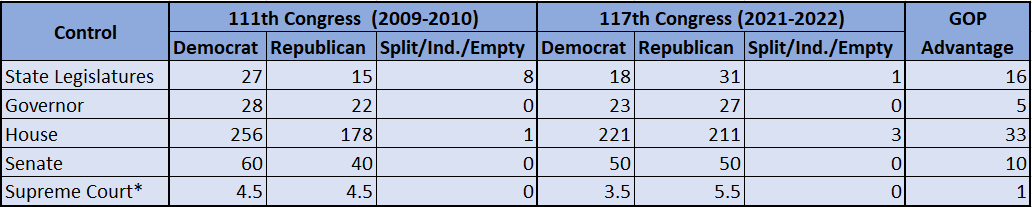
Compared to 2009 when Democrats controlled so many seats, today’s picture is nowhere near as precarious for Republicans. Take a look at the table below comparing the peak of Democrat control during the 111th Congress to the balance of power during today’s 117th Congress.

*Counting swing vote Justice Anthony Kennedy as half Dem half GOP in 2008, and Chief Justice John Roberts as half and half in 2021. Copyright 2021: Young Research & Publishing

Today the GOP owns more legislatures, more governorships, more congressional seats in both houses, and has placed more Supreme Court* picks than in 2008 by far.

The truth is, once Americans see what Democrats have to offer in real life, they no longer want it.

Read Chapter 1 Part I, Part II, Part III, and Part IV.

Filed Under: Investing Strategies Tagged With: safe

Dick Young’s Safe America: Chapter 1, Part I

January 19, 2021 By Richard Young

Debbie and I are neither members of any political party nor contribute to any PAC.

Our research interest is policy rather than politics.

Our methodology, for over four decades, has centered on inference reading and anecdotal evidence gathering.

Read Part II, Part III, and Part IV.

Filed Under: Investing Strategies Tagged With: safe

RCY’s Brand New Investing Program – 100% Swiss: Chapter 1, Part II

January 19, 2021 By Richard Young

Basel, Switzerland. By emperorcosar @ Shutterstock.com

UPDATE 12.15.2020: With America’s debt load soaring, the risk to the dollar today is perhaps greater than ever.

Originally posted on July 30, 2020.

The Fed has created a disastrous asset bubble that will extend for years.

Read my series on Ron Paul to gain the full flavor for what is transpiring.

I devoted a large section of my 1987 book to inflation, gold, and Switzerland. Through the decades, I have been a big investor in both Swiss assets and gold.

In the month of August, 100% of my personal investing will be in Swiss Franc-denominated assets.

The Swiss Way

I have written in the past of the Swiss Confederation and its weak central government form (the presidency is a ceremonial office and rotates). The office has no powers above the other six members of the Swiss Federal Council. The entire Federal Council is considered a collective head of state. Switzerland is a neutral country with a low crime rate and a powerful national defense system. Instead of fielding a large standing army, Switzerland requires every man to undergo military training for a few days or weeks a year throughout most of his life. Each man is required to keep his assigned automatic rifle at home at the ready. The Swiss are powerful believers in individual liberty and freedom. They believe that there is no need for a higher legal authority to check people’s initiatives. In fact, federal court in Switzerland is not allowed to rule on any constitutional matter at the national level. The Swiss are all about keeping things at the cantonal level. Keep it local is the key in Switzerland.

There is a lot to learn for Americans from “the Swiss way.” Switzerland’s model is precisely the weak form of central government intended by our Founders. The best outline of what a constitutionally strong form of federal republic looks like is Ron Paul’s Liberty Defined. The chapter on “Empire” alone will amaze you.

Read more about The Swiss Way here.

Swiss-Charts

Filed Under: Investing Strategies Tagged With: safe

  • « Previous Page
  • 1
  • …
  • 6
  • 7
  • 8
  • 9
  • 10
  • …
  • 29
  • Next Page »

Compensation was paid to utilize rankings. Click here to read full disclosure.


RSS New From Young Research & Publishing

  • When I Think about Fidelity Investments and YOU
  • Inside China’s Race to Catch Up With US AI Chip Technology
  • GE Vernova Sees Strong Demand Despite Weak Wind Business
  • Constitution Pipeline Seeks Long-Term Gas Buyers
  • Mexico’s Energia Costa Azul Begins LNG Exports
  • Your Survival Guy and the Largest Great White
  • Global Energy Supplies Hold Steady Despite Middle East Disruptions
  • US Unemployment Claims Decline as Labor Market Remains Stable
  • Refinery Operations Remain Strong as US Petroleum Inventories Increase
  • US and Saudi Arabia Sign Peaceful Nuclear Cooperation Agreement

RSS New From Your Survival Guy

  • When I Think about Fidelity Investments and YOU
  • Ned Johnson: Passionately Curious
  • More Can Be Done for American Nuclear
  • ZOMBIE FUNDS: Remember When Private Equity was Hot?
  • The Unpredictable Oil Roller Coaster
  • There Are Miracles After You Turn 65
  • Buffett “The Trick Is to Have a Very Long Hill”
  • Free Money: When You’re New to the Workforce
  • Find the Right Match
  • Start Saving Early

Search Our Site

Richard C. Young & Co., Ltd.

–Client Letter Sign Up–

Sign up to receive email alerts when our latest client letter is posted on our website.

Disclaimer:

The information contained here is for informational and educational purposes only. It is not intended nor should it be considered investment advice or a recommendation of securities. Past performance is not a guarantee of future results. It is possible to lose money by investing. You should carefully consider your investment objectives and risk tolerance before investing.

Copyright © 2026 · About Dick Young · Terms & Conditions


Loading Comments...