• ABOUT – DICK YOUNG
  • YWMF – ARCHIVES

Young's World Money Forecast

Since 1978 With a 32 Year Vacation

  • DICK YOUNG
    • FROM RICHARD C. YOUNG
    • THE FINAL INTELLIGENCE REPORT
  • INVESTING STRATEGIES
    • RETIREMENT COMPOUNDERS®
    • GOLD & SILVER
  • DIVIDENDS & COMPOUNDING
    • MIRACLE OF COMPOUNDING
    • DIVIDENDS
  • GRAHAM & RUSSELL
    • BEN GRAHAM
    • RICHARD RUSSELL
  • THE DOW AND THE LEADERS
    • DOW vs. S&P 500
    • DOW vs. DOW DIVIDEND PER SHARE
  • WELLINGTON MANAGEMENT COMPANY
  • YOUR SURVIVAL GUY
  • BANK CREDIT & MONEY
  • THE PRUDENT MAN

How You Should Invest Today: Part II

August 27, 2020 By Richard Young

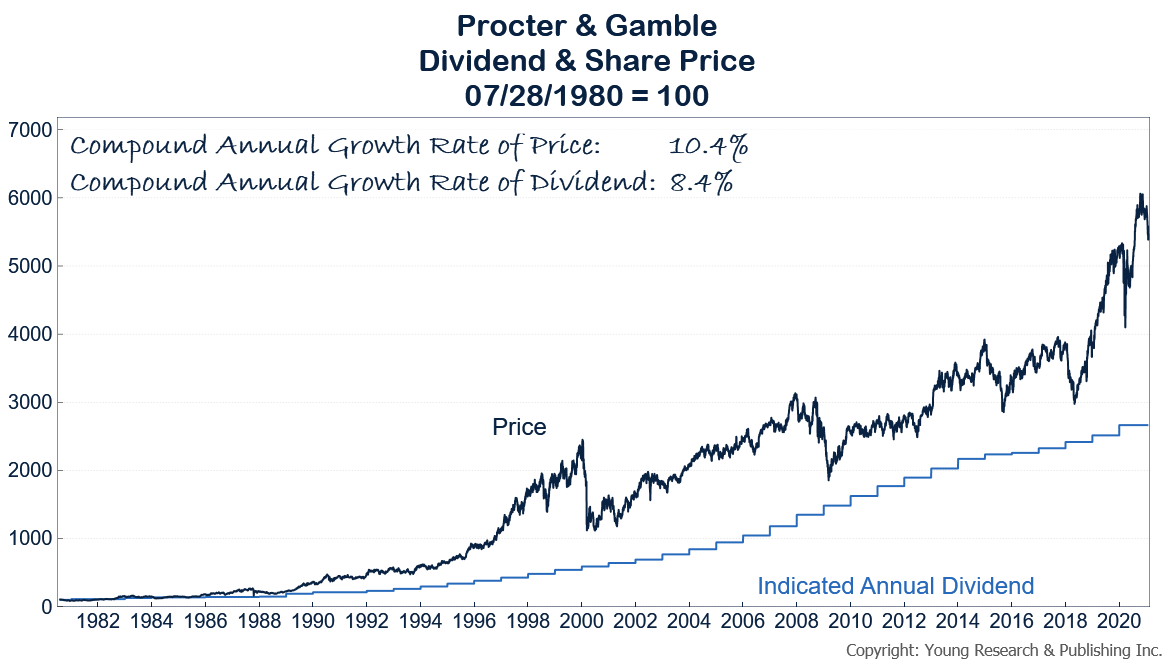
These two charts (below) on Dover Corp. and Procter & Gamble show you long-term compounded dividend and stock price growth for both.

In both cases, the long-term trend shows a pattern of consistent annual dividend growth matched with long-term stock price appreciation.

In Dover’s case, the dividend has compounded at an 8.9% rate of growth and the stock an even stronger and equally consistent 10.9%. For P&G the numbers have been 8.4% and 10.4%.

What you are looking at in both instances is decades of consistency, stability, and comfort for shareholders.

At our family investment counseling company, these are the only kind of companies we invest in for clients. Our master list of potential portfolio companies includes only companies with similar long-term records.

We never even consider companies without long-term records of dividend growth.

I have been writing about consistency, stability, and compound growth for five decades. And underpinning every report has been a foundation of dividends.

When you concentrate on dividend growth and stability, you never have to think about capital appreciation. It will take care of itself as my charts on P&G and Dover Corp. demonstrate, as long as the dividend is growing.

So, the easy lesson in this second part of my “how to invest today” series is to make dividends your password to investing both now and in future years.

Read Part I here.
Filed Under: Investing Strategies

How You Should Invest Today: Part I

August 20, 2020 By Richard Young

Charles Dow created the Dow Jones Industrial Average (DJIA) in 1896.  Originally the Dow had 12 companies:

American Cotton Oil; American Sugar; American Tobacco; Chicago Gas; Distilling & Cattle Feeding; General Electric; Laclede Gas; National Lead; North American; Tennessee Coal and Iron; U.S. Leather; U.S. Rubber

Not one of the original 12 DJIA stocks remain today as DJIA components.

That tells you the first couple of things you need to know in becoming a successful long-term investor.

First to remember, any stock average or index is not static, but is a revolving door. That is why I have never been interested in comparing my own investment record nor that of my clients against any average or index.

Second, most are either market capitalization (S&P 500) or price (Dow 30) weighted. Why would I want to consider my own investing program in comparison to two groups of stocks organized in a format that I would not dream of deploying myself?

So, where do you start? It is quite easy: Concentrate on diversification, dividends, compounding, and, above all, patience.

For something that doesn’t sound too hard, in my experience over five decades in the business of counseling investors, this seemingly easy menu is almost impossible for the individual investor to grasp.

In Part II of my series, I will help you get on just the right track to begin your journey as a comfortable and successful long-term investor.

Filed Under: Investing Strategies

US Dollar Craters vs Swiss Franc

August 13, 2020 By Richard Young

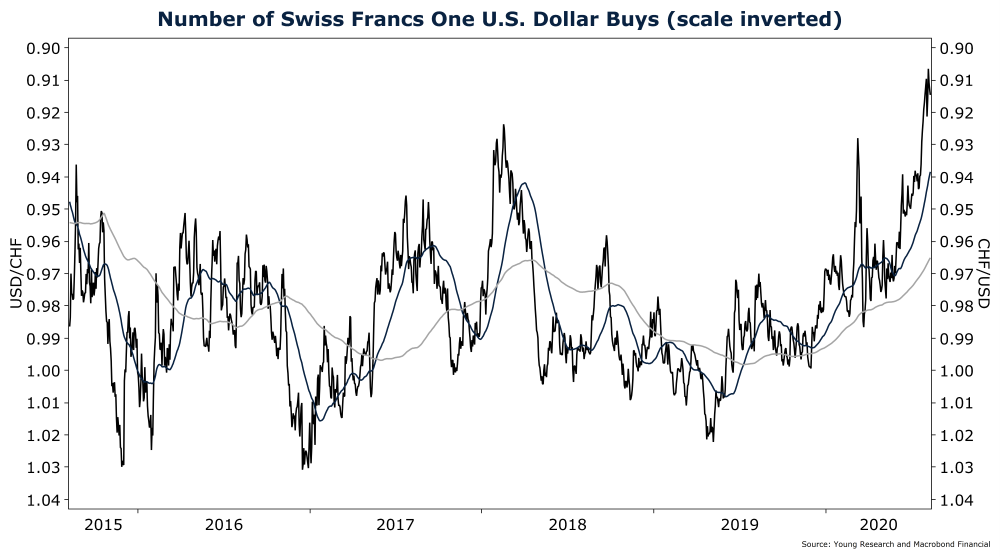
Since last spring, my clients and I have been buying Swiss francs and lately Swiss franc denominated, dividend-paying equities.

What’s behind the dollar’s collapse? Too many dollars relative to Swiss francs are being printed. It’s no more complicated than that.

It is the Fed who is responsible for debasing the currency.

The Fed’s “private club” was introduced by Woodrow Wilson, America’s worst president, in 1913.

Since then, the Fed has increasingly muddled with the economy in total opposition to its original intent.

I have written often that I would return the Fed to its founding principles prior to shuttering it for good.

In the meantime, the dollar will remain on thin ice.

Filed Under: Investing Strategies

Monetary Heart Attacks Likely to Lead to S&P 500 Crash

August 6, 2020 By Richard Young

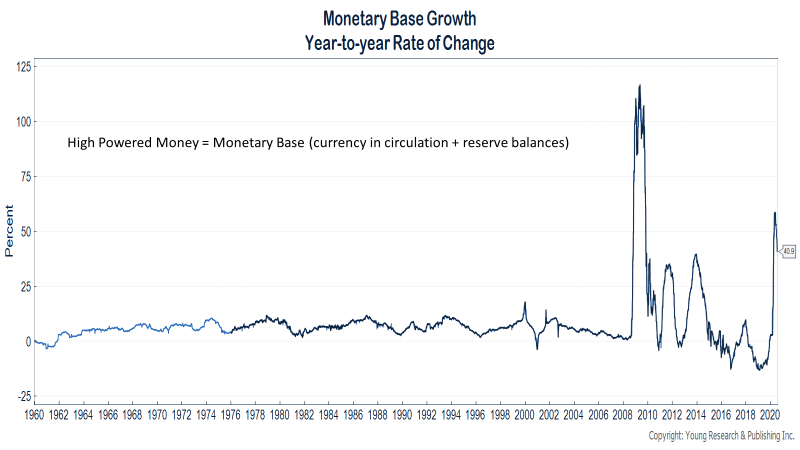
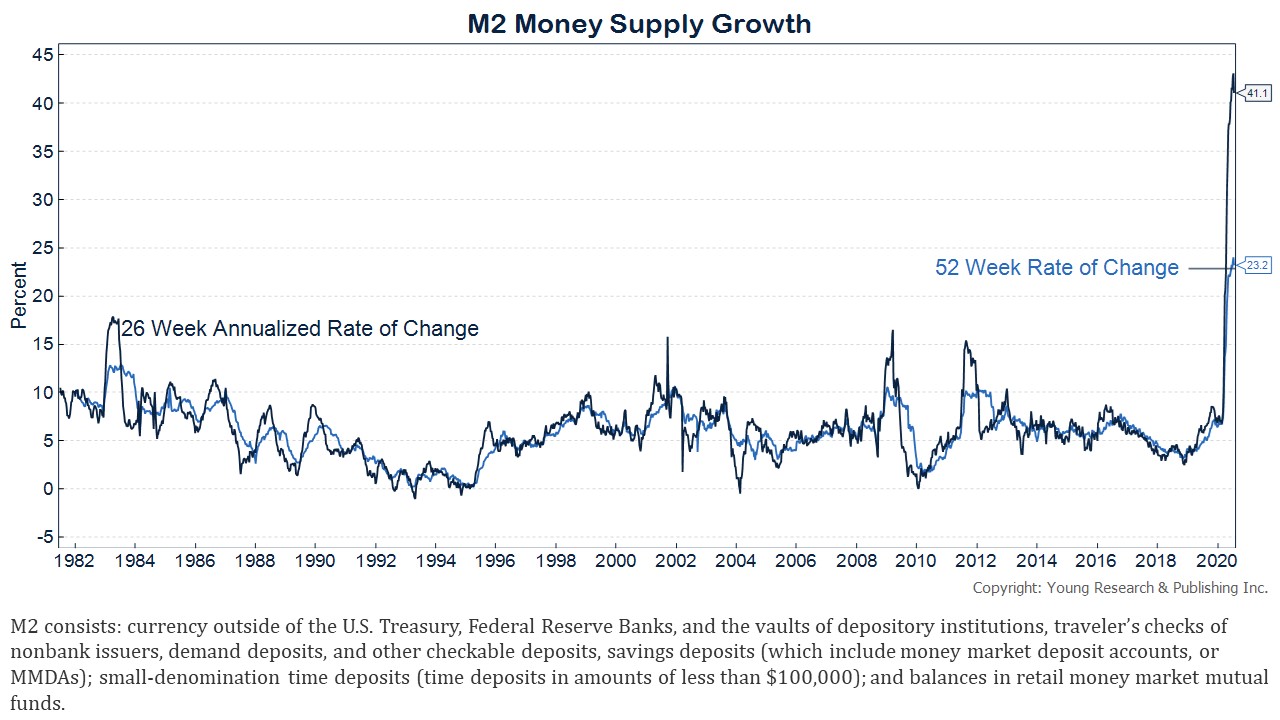
My charts (the Fed’s EKG) on high powered money and M2 growth point clearly to undisciplined chaos at the Fed.

Do you see any instance of such chaos in preceding decades? No!

Indeed, payday will arrive.

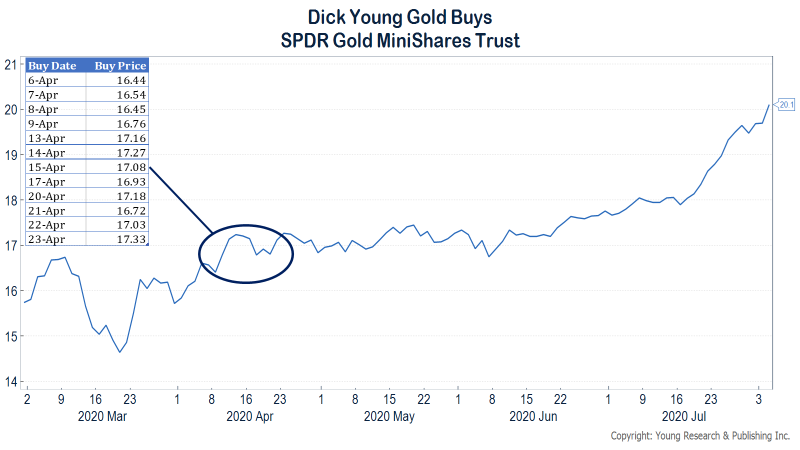
The table indicating my own program of gold buying gives you a look at one of a number of moves I made last spring to balance myself for the inevitable comeuppance.

At our family investment counsel firm, we emphasize ongoing strategy discussion, featuring new issue corporate bonds, dividend-paying Swiss franc denominated stocks, and currency and especially high US dividend-paying blue chips. Our laser-like concentration is on companies that have increased their dividend for decades.


Filed Under: Investing Strategies

Dump All Low Yielding US Treasuries Now

August 5, 2020 By Richard Young

Today we have a situation where the Fed has forced individual investors with life-time savings to subsidize corporate buybacks, acquisitions, and Wall Street banking industry borrowing and speculating. It’s what I call de facto robbing and stealing.

In reality, the Fed is nothing more than a private club to favor corporate and banking elites.

When the Federal Reserve was first established in 1913, Congress directed it to “furnish an elastic currency, to afford means of rediscounting commercial paper” and to establish a more effective supervision of banking in the U.S.

The Fed’s duties should have been left there. But no …

On 27 October 1978, President Jimmy Carter signed into law the Full Employment and Balanced Growth Act. The act requires the chairman of the Federal Reserve to connect the monetary policy with the president’s economic policy.

I would look to nullify the act in its entirety.

If the Fed is retained, its purpose should be confined to the narrow founding definition, and nothing more.

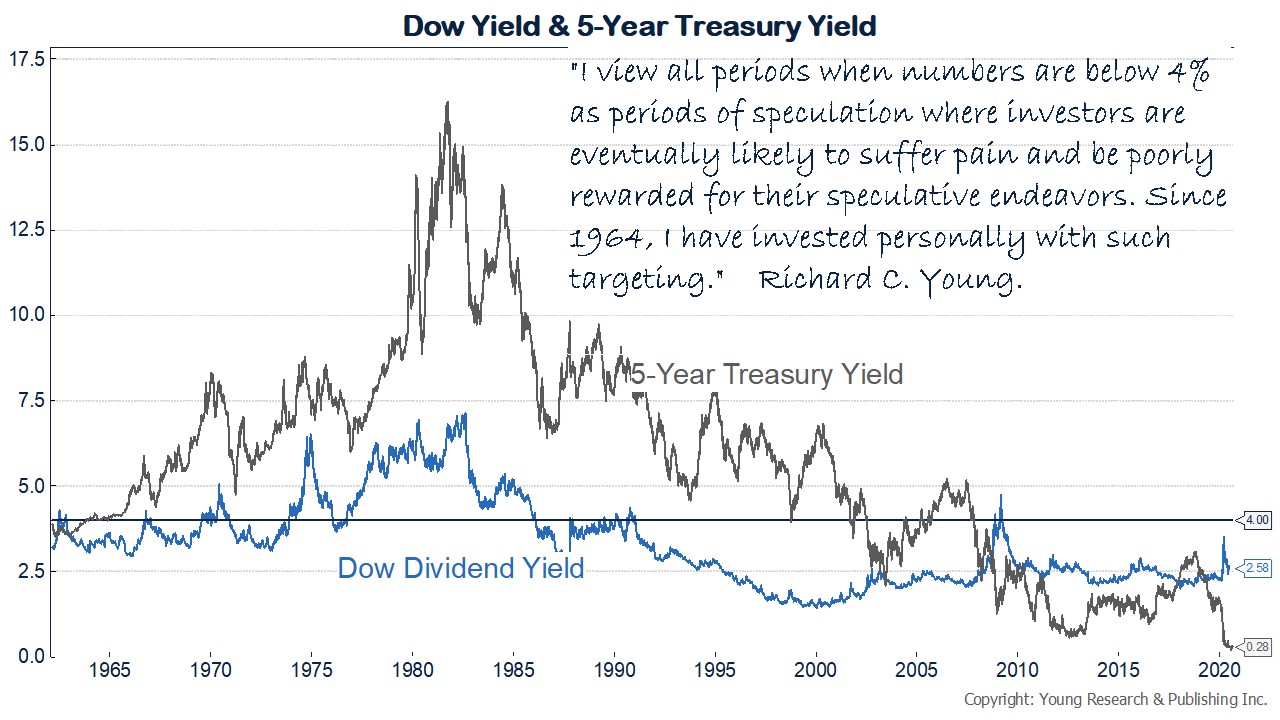
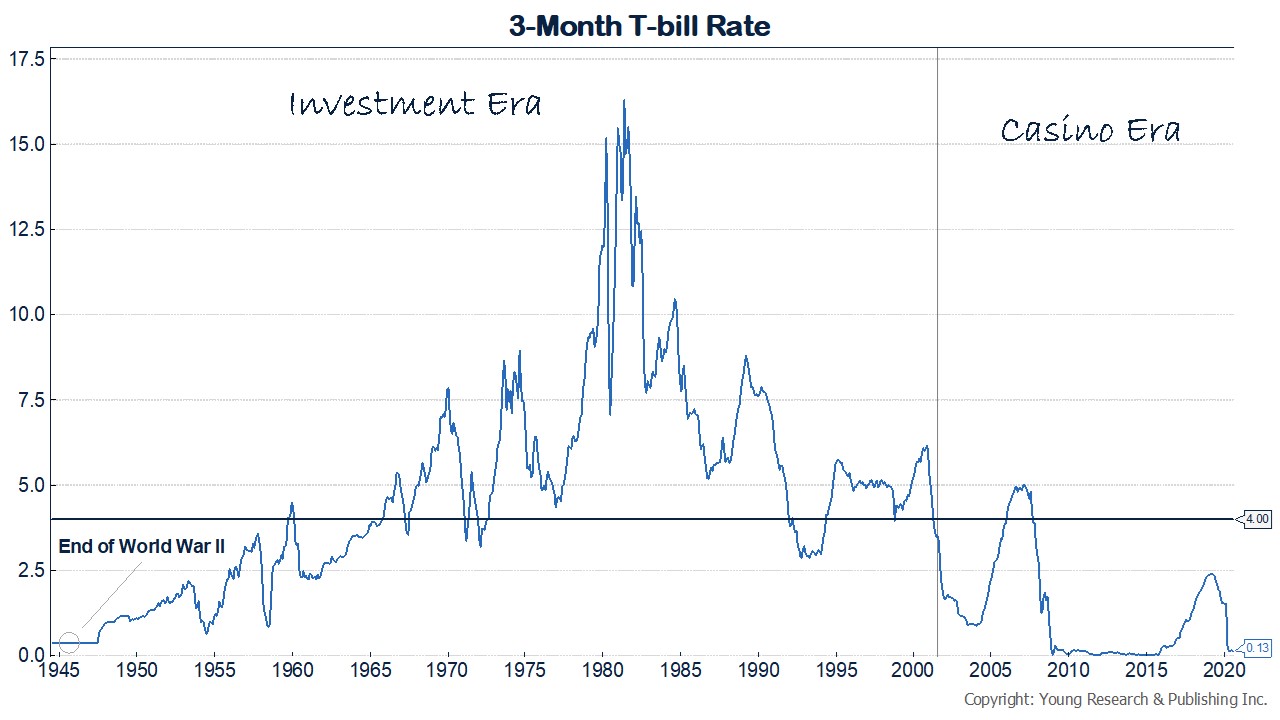
My two charts (below) indicate the circus climate the Fed has promoted today. Whenever interest rates stand below 4%, the economic and monetary system is out of whack.

Twice this century the Fed has allowed rates to sink below 4%. On the second of the two rebounds this century the Fed did not allow rates even to return to a more natural 4%.

Early this spring my family investment counsel firm sold all of our Treasurys. I also sold all of mine.

Today we are laser focusing on new issue corporate bonds, high-yielding blue-chip equities, Swiss franc denominated assets, and gold.

The Fed is attempting to control both the quantity and price of money. Bad things will happen and misguided individual investors will once again pick up the tab as the general stock market crashes in shock.

Filed Under: Investing Strategies

RCY’s Brand New Investing Program – 100% Swiss

July 31, 2020 By Richard Young

The Fed has created a disastrous asset bubble that will extend for years.

Read my series on Ron Paul to gain the full flavor for what is transpiring.

I devoted a large section of my 1987 book to inflation, gold, and Switzerland. Through the decades, I have been a big investor in both Swiss assets and gold.

In the month of August, 100% of my personal investing will be in Swiss Franc-denominated assets.

Click here to view my Swiss chart pack.

The Swiss Way

I have written in the past of the Swiss Confederation and its weak central government form (the presidency is a ceremonial office and rotates). The office has no powers above the other six members of the Swiss Federal Council. The entire Federal Council is considered a collective head of state. Switzerland is a neutral country with a low crime rate and a powerful national defense system. Instead of fielding a large standing army, Switzerland requires every man to undergo military training for a few days or weeks a year throughout most of his life. Each man is required to keep his assigned automatic rifle at home at the ready. The Swiss are powerful believers in individual liberty and freedom. They believe that there is no need for a higher legal authority to check people’s initiatives. In fact, federal court in Switzerland is not allowed to rule on any constitutional matter at the national level. The Swiss are all about keeping things at the cantonal level. Keep it local is the key in Switzerland.

There is a lot to learn for Americans from “the Swiss way.” Switzerland’s model is precisely the weak form of central government intended by our Founders. The best outline of what a constitutionally strong form of federal republic looks like is Ron Paul’s Liberty Defined. The chapter on “Empire” alone will amaze you.

Read more about The Swiss Way here.

Filed Under: Investing Strategies

My 10 Point Investment Plan: Pretty Much the Same as Back in 1990

July 28, 2020 By Richard Young

Back then I offered subscribers to my investment strategy report a ten-point investment guide for the long term.

The basic plan is today, thirty years later, pretty much unchanged.

  1. Make capital preservation your number one target
  2. Make dividends the cornerstone of your core equity portfolio
  3. Never forget the power of compound interest
  4. Make equities, not bonds, your core holdings.
  5. When general market conditions are horrible, and most folks are selling, aggressively buy your dividend stocks
  6. Use automatic withdrawal programs for retirement income
  7. Don’t trade in and out
  8. Remember the words full faith and credit.
  9. Never invest based on predictions. Invest based on relative value only.
  10. Be well organized, always have a plan, practice patience.

Filed Under: Investing Strategies

Your Portfolio Could Use This Investment as a Powerful Insurance Policy

July 23, 2020 By Richard Young

There are very few real counterbalancers available in an asset bubble like the one being blown today by the Fed and other central banks.

One investment I have found to be reasonably reliable as a counterweight insurance policy is precious metals, specifically gold and silver.

Is there downside risk in buying metals? Of course. Here’s how I previously explained that risk:

Relative to gold, silver is cheap. The higher the gold/silver ratio, the cheaper silver is. The historical gold/silver ratio has been 15:1. Today, it is 53:1. Central banks do not own silver, which they could dump on the world market to depress prices. This is a big plus for silver. Silver trades at about $32/oz. The structural low is about $10/oz. There conceivably is a significant downside risk. My strategy is to pick away slowly over the next few years, hoping that I’ll get an average price on my purchase well below $32/oz. Who knows? Silver and gold are insurance policies that I hope I will not need. What I buy, I will not sell. And I am buying with the hope that the price of my insurance will decline, not increase. Year to year, I am a hesitant, reluctant seller of any investment.

Today, the gold/silver ratio is over 90.

I want you to think of the silver and gold in your portfolio as an insurance policy. If it goes down, you may be better off because the prices of your stocks are going up.

If you would like to learn more about how Richard C. Young & Co., Ltd. views precious metals as a portfolio counterbalancer, click here to sign up for our monthly client letter. The letter is written by my son, Matt Young, who has led our family-run investment counsel firm for over twenty years.

Filed Under: Investing Strategies Tagged With: precious

My Biggest Investing Quarter Ever

July 2, 2020 By Richard Young

Due to a convergence in timing, I was able to make by far the biggest commitment to the stock market in my life during late March and into the second quarter of 2020.

On 31 March 2020, I posted My Three Week-Long Investing Program.

It led off, “I am ramping it up over the month of April and into May.”

As reported 30 June in the WSJ, U.S stocks finished their best quarter in 20 years.

I also posted the exact areas I was investing in and why. No way I could have expected such quick and massive returns. Given that Joe Biden is apparently attempting to put a quick end to it all by proclaiming, “we have 120 million dead,” I suppose I should not get too comfortable.

OK, now what?

With Joe Biden now seemingly considering a VP candidate with sympathy for a Marxist-centered group, it is possible his campaign will implode, bringing turbulence to the financial markets?

I will update my investment strategy posts at the end of July.

Filed Under: Investing Strategies

How to Invest Today

June 22, 2020 By Richard Young

It’s time for a change in pace.

Since the end of March, the Dow has exploded from about 18,500 to over 25,000 as June nears an end.

During this period, I steadily added to my equities position as well as to my individual bond positions. I also added to three fund positions (nearly 50% fixed) that I have owned for decades (not index funds) as well as to smaller positions in gold and the Swiss Franc.

In the coming quarter, I plan to increase my focus on fixed income.

My four biggest concerns today are (1) the Fed’s balance sheet and (2) the historically low level of U.S. government bond yields, both of which are unprecedented. (3) Creeping Marxism in America and (4) China.

Filed Under: Investing Strategies

  • « Previous Page
  • 1
  • …
  • 8
  • 9
  • 10
  • 11
  • 12
  • …
  • 29
  • Next Page »

Compensation was paid to utilize rankings. Click here to read full disclosure.


RSS New From Young Research & Publishing

  • Are You Getting Out There: Portugal or PEI?
  • 65 Years of Compounding: No Changes
  • Eroding Production: Russia’s Oil Industry Enters a New Era
  • U.S. Retail Sales Rise 5% From Year Ago Despite July Dip
  • Trump Looks to Squeeze Iran’s Economy Once Again
  • National Laboratories Set for Major Operational Reforms
  • Your Survival Guy’s RAGE Gauge: The Tables Are Full
  • Blue Moon Builds Out in Critical Minerals
  • Falling Energy Prices Keep U.S. Producer Inflation in Check
  • America’s Natural Gas Boom Hits New Record

RSS New From Your Survival Guy

  • Are You Getting Out There: Portugal or PEI?
  • Your Survival Guy’s RAGE Gauge: The Tables Are Full
  • CAUGHT IN A VICE: Private Equity Is the Next Big Thing Coming for YOU: Part XXIII
  • Delinquencies Rising: Concerning but Not Yet an Emergency
  • The Reliability of Nuclear
  • Market Volatility Giving You the Summer Blues?
  • Judge Blocks Mamdani’s Tax, for Now
  • WALK AWAY: Private Equity Is the Next Big Thing Coming for YOU: Part XXII
  • LIQUIDITY: Is Private Credit Liquid Enough for Retirement Investors?
  • The Value of Diversification

Search Our Site

Richard C. Young & Co., Ltd.

–Client Letter Sign Up–

Sign up to receive email alerts when our latest client letter is posted on our website.

Disclaimer:

The information contained here is for informational and educational purposes only. It is not intended nor should it be considered investment advice or a recommendation of securities. Past performance is not a guarantee of future results. It is possible to lose money by investing. You should carefully consider your investment objectives and risk tolerance before investing.

Copyright © 2026 · About Dick Young · Terms & Conditions


Loading Comments...