• ABOUT – DICK YOUNG
  • YWMF – ARCHIVES

Young's World Money Forecast

Since 1978 With a 32 Year Vacation

  • DICK YOUNG
    • FROM RICHARD C. YOUNG
    • THE FINAL INTELLIGENCE REPORT
  • INVESTING STRATEGIES
    • RETIREMENT COMPOUNDERS®
    • GOLD & SILVER
  • DIVIDENDS & COMPOUNDING
    • MIRACLE OF COMPOUNDING
    • DIVIDENDS
  • GRAHAM & RUSSELL
    • BEN GRAHAM
    • RICHARD RUSSELL
  • THE DOW AND THE LEADERS
    • DOW vs. S&P 500
    • DOW vs. DOW DIVIDEND PER SHARE
  • WELLINGTON MANAGEMENT COMPANY
  • YOUR SURVIVAL GUY
  • BANK CREDIT & MONEY
  • THE PRUDENT MAN

Here’s How Tiny Sweden Beat China

June 4, 2020 By Richard Young

Tiny remote Sweden, partially sitting in the polar region, is home to only a little over 10 million souls. China, meanwhile, is a massive country, home to nearly 1.4 billion. You may not think Sweden would have the wherewithal to defeat China in any theater of competition, but in one growing industry, Sweden is prepared to dominate its Chinese rival.

In the race for 5G technology leadership, Sweden’s Ericsson may be about to best China’s Huawei. Or, more accurately, Huawei’s ties to China’s Communist Party government are about to blow the technology company’s chances of a worldwide 5G expansion.

Stu Woo reports for the Wall Street Journal:

The Trump administration’s increasingly aggressive effort to cripple China’s Huawei Technologies Co. has presented Ericsson AB the opportunity to lead the rollout of 5G technology around the world.

The Swedish company is emerging as the steadiest player in the $80-billion-a-year cellular-equipment industry, telecommunications executives and analysts say, because it makes a technically advanced product that one rival, Nokia Corp., was late to develop and that Huawei may not be able to make in the future because of recent U.S. measures.

While its competitors try to recover, Ericsson is moving forward after a costly years-long restructuring has returned it to profitability. “The first step is for sure accomplished,” Chief Executive Börje Ekholm said. “The next step is to find longer-term growth for the company.”

The question for Ericsson is figuring out which technologies of tomorrow to bet on. Ericsson is testing equipment in several fields that 5G’s superfast wireless speeds promise to unlock, such as driverless cars and remote-control mining machinery.

Washington is lobbying foreign countries to ban Huawei, saying Beijing could direct the company to spy on or sabotage communications. 

I have followed Ericsson on and off for decades. I wrote in late 2011:

Sweden is a global telecommunications giant. EWD owns shares of Ericsson and TeliaSonera, both telecom powerhouses in their own right. Ericsson’s networks are the conduit for 40% of the world’s mobile traffic, serving over two billion subscriptions. Ericsson has built a technology portfolio of over 27,000 patents.

Today Ericsson has the largest portfolio of patents in the industry, with 54,000 granted patents. It is a global 5G competitor with or without sanctions on Huawei. But with the U.S. campaign against Huawei, Ericsson is set for much easier expansion.

I’m not suggesting you invest in Ericsson today, but I am suggesting that you pay attention to the geopolitical risks an investment in a company like Huawei might produce. Companies wrapped up in the affairs of their country’s government are often affected by the political dramas surrounding them. That’s why, in this case, Ericsson, from tiny, mostly neutral Sweden, can compete with Huawei, which hails from the world’s most populous and second-largest economy.

At Richard C. Young & Co., Ltd., my family-run investment counseling firm, preference is given to investments in companies from countries with free markets and governments that help business by getting out of the way, not by trying to control it.

If you would like to learn more about our investment philosophy, please sign up for our monthly client letter by clicking here or schedule a free no-obligation appointment with an investment specialist by clicking here. We look forward to speaking with you.

Filed Under: Investing Strategies

Harley-Davidson in Transition, Probably a Takeover Target

June 1, 2020 By Richard Young

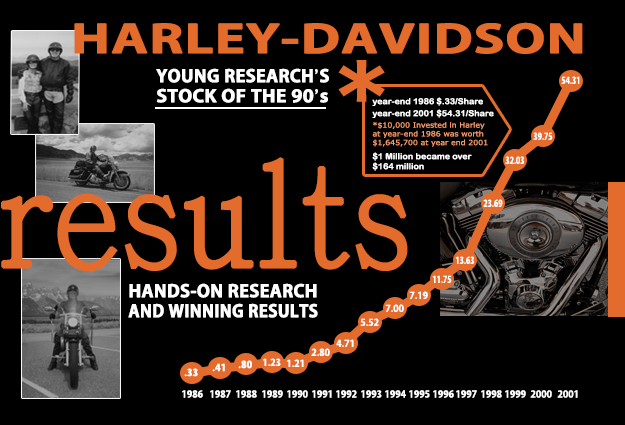
Debbie and I have put over 100,000 miles on our Harleys riding across the United States and Canada. My riding days are behind me, but as a devotee, I keep an eye on Harley’s business, as I have for years. If you’re one of my long-time readers, you know Harley was Young Research’s stock of the decade in the 1990s.

In June 1998, I and millions of Harley-Davidson fans celebrated the company’s 95tht anniversary. I wrote then:

For about $18,000, you can be astride a classic American cruiser, the Harley-Davidson Road King—if you can get one. This summer Debbie and I will ride our Harleys from Key West to Nova Scotia before our trip to Glacier National Park and back to Sturgis, South Dakota, for the world’s biggest annual gathering of the Harley faithful. At Milwaukee’s Summerfest grounds on June 13, Harley-Davidson (NYSE: HDI) will have its 95th anniversary celebration reunion. Once again, there is a lot to celebrate. Over the last year, Harley’s stock has nearly doubled. Over the last five years, as my most recommended stock, Harley-Davidson has provided an average annual total return of nearly 30% per year.

As both an investor and rider, I have a long history with Harley-Davidson. Harley’s core market peaked years ago, and so did bike shipments, but management continued to chase the prospect of growth.

That strategy failed.

Harley is now scaling back production and focusing on its bestselling models.

 The WSJ reports:

On an earnings call last month, Mr. Zeitz said expanding the motorcycle lineup and chasing new markets diverted attention from Harley’s more profitable models and made factories too complex. He said the production revamp is warranted by deteriorating demand for motorcycles. New models that would have made their debut this summer will roll out early next year instead, he said, on a new schedule of releases before the peak spring buying season begins.

By having fewer motorcycles in the market, Harley said it is trying to appeal to customers of premium-priced brands with limited availability. That approach is common among makers of sports cars and some luxury products that keep manufacturing volumes well below demand for them.

“Our strategy to limit motorcycle product in the showroom is purposefully designed to drive exclusivity,” Ms. Truett said in her memo.

Harley is reopening its plants in Wisconsin and Pennsylvania this week and said it would accelerate production in phases. The motorcycles that Harley will start making again this month will be limited to bestselling models in a limited palette of colors and without customizable features for the remainder of the year, Ms. Truett wrote.

The future for Harley is as a niche player with a shrinking but dedicated consumer base. That strategy may work in the public markets, but would be much more suited as a subsidiary of another firm. Polaris seems like a natural fit.

Filed Under: Investing Strategies

The Fed Has a 100% Error Rate

April 27, 2020 By Richard Young

Much like the terrorist attacks of September 11, 2001, the coronavirus has revealed an overvalued market to investors. The blame for this overvaluation lies with a Federal Reserve that has so distorted interest rates, the view of risk has become clouded. A few years ago, I wrote:

In End the Fed, Ron Paul writes, “The essence of the Federal Reserve Act was largely unchanged from when it was first hatched years earlier. With a vote by Congress, the government would confer legal legitimacy on a cartel of the largest bankers and permit them to inflate the money supply at will, providing for themselves and the financial system liquidity in times of need, while insulating themselves against the consequences of bad loans and overextension of credit.”

Congress’ Most Tragic Blunder

Paul continues, “Hans Sennholz [Money and Freedom] has called the creation of the Fed ‘the most tragic blunder ever committed by Congress. The day it was passed, old America died and a new era began. A new institution was born that was to cause, or greatly contribute to, the unprecedented economic instability in the decades to come.’…

“In 1912, Ludwig von Mises wrote a book called The Theory of Money and Credit that was widely acclaimed all over Europe. In it he warned that the creation of central banks would worsen and spread business cycles rather than eliminate them.”

The Fed Has a 100% Error Rate

John A. Allison is president and CEO of the Cato Institute and former chairman and CEO of BB&T. During his BB&T tenure, John was the longest-serving CEO of a top-25 financial institution. In The Financial Crisis and the Free Market Cure, John explains that the primary sources of the massive misallocations of resources regarding the recent financial crisis are (1) the Federal Reserve, (2) FDIC, (3) Government housing policy, and (4) the SEC. As John points out, “In 1913, the monetary system of the United States was nationalized. The federal government owns the monetary system. We do not have a private monetary system in the United States.” John Allison continues, “In my career, the Fed has a 100% error rate in predicting and reacting to important economic turns.”

My friend John Allison’s words carry a special urgency today. The Fed has a “100% error rate.” It’s true. Every time the Fed sees a problem, it ladles out more monetary stimulus, driving asset prices upward and exaggerating the next meltdown.

The Fed’s wild responses to the slightest declines in stock market prices have become a real risk for which investors must account.

My family-run investment counsel firm has developed its own strategy for responding to the Federal Reserve’s recent actions. To read about them in detail, click here for the latest monthly client letter written by my son Matt, President and CEO of Richard C. Young & Co., Ltd.

Each month, Matt covers the strategies we employ at Richard C. Young & Co., Ltd. If you would like to be alerted each time a new letter is released, please click here to sign up. The letter is free, even for non-clients.

Filed Under: Investing Strategies

How to Deal with a Crisis You Can’t Predict

April 17, 2020 By Richard Young

Do you consider yourself well-prepared? There’s no predicting some scenarios— the so-called Black Swans. Below is a troubling illustration I wrote some time ago of just how bad facing the unexpected can feel:

Knock, Knock

It’s 1:30 a.m.—pitch black on your suburban porch. A woman whom you do not recognize is at your front door, while an unfamiliar car idles in your driveway. Peeking out, you talk through a side window to the interloper, who explains that you had called her, and here she is.

Your 1911 Handgun

You, of course, had not called her, and, as a phone call goes into the police, you—somewhat dazed and alarmed—consider the feasibility of reaching for your 1911 handgun. Not long back, in broad daylight and only a couple of miles from your house, there had been a raft of break-ins featuring families immobilized withduct tape (while robbers searched through belongings). Residents of the general area are on heightened alert.

Sweaty Palms

I don’t know about you, and I consider myself well-prepared and well-defended, but this type of “awakened out of a sound sleep” early a.m. door-knocking scenario makes my palms sweat. This is a true story relayed to me just days ago.

Is This Your Blueprint?

So we are looking at risk preparation here—no advance prep, no handy 1911, no nothing. Kids asleep upstairs, a terrified wife nearby, and you, with a blank stare, have a big goose egg on your preparation ledger. Is this the blueprint for you and your family? I know for a fact that this condition exists for a lot more families than not.

Black Swans

I write to you about financial and personal security, with the emphasis on risk analysis for both. For any given scenario, the first step is a complete understanding of all the elements of risk. Unfortunately, the game breakers are all Black Swan events that you cannot time accurately in advance. Nonetheless, preparation is warranted to cover the unexpected.

A home invasion is one of the most frightening and surprising events a family can endure. Also on the list of the terrifying and unexpected is the current global pandemic.

Few, if any, could have predicted today’s coronavirus and the economic turmoil it would cause.  But that doesn’t mean nothing could be done to prepare.

Investors especially had the chance to prepare themselves for the unexpected. Minimizing risk in portfolios with diversification is the best way to prepare your investments for uncertain times.

Each month at my family-run investment counseling firm, Richard C. Young & Co., Ltd., my son Matt explains our strategies for diversification and minimizing investment risk in our client letter. If you want to understand the methods used by one of America’s top-ranked investment advisors to address risk, sign up for a monthly alert for the client letter by clicking here. It’s free, even for non-clients, and loaded with information you can use to help achieve your investing goals.

Prepare, even for those crises you can’t predict.

Filed Under: Investing Strategies

My Three-Week-Long Investing Program

April 1, 2020 By Richard Young

In my personal portfolio, I am ramping it up over the month of April into May.

My own largest fixed income holding (individual bonds, while clearly a superior option are not ideal for me as I am on the road and out of touch at annoying times) a full-faith-and-credit-pledge GNMA’s-centric fund is ahead by 3.0%, or an annualized 12.0%. I am happy with this.

GLD, one of my gold proxies is ahead by 6.5%, or an annualized 26%.

My Swiss currency proxy (I have been investing in Switzerland since the early seventies. Click to the Swiss Way) is up 1.4% YTD. Encouraging.

All in all, I am pleased and have recently been concentrating on the energy sector where Russia, Iran and the Saudi’s are getting killed and American shale assets and big energy dividend payers are a steal.

Let’s see where prices are in just five years and who the proven winners will have been.

My own buying program will continue at least into the summer.

Filed Under: Investing Strategies Tagged With: comp

Coronavirus Snapped the Cord on the Market Elevator

March 26, 2020 By Richard Young

For the past ten years, the stock market has been an elevator that has only gone up. Now the cord has snapped. What floor are you falling from? Here’s how I explained what I call “elevator investing” some years back. I wrote:

Elevator Investing

Where do you want to be when the cord snaps? I often think of risk management with a simple elevator analogy. In the investment process, I quantify risk first. Then I evaluate potential gains. Just envision, if you were in an elevator and the cord snapped, where would you be better off? Dropping from the second floor or the 10th floor? Makes your palms sweat. You sure would not fare well plummeting from floor 10. Today’s level of risk in the financial markets is at the 10th floor, moving ever higher. Many investors will not survive the coming collapse. Collapse? Is this appropriate wording? Sure is. America is now in the late stages of the business cycle. The government is out of control. And the Fed continues to manipulate interest rates in favor of Wall Street and against American savers. I lay out the late business cycle details for you later. When you read the evidence, you’ll agree that the potential for game-changing, black-swan-initiated losses accelerates monthly.

The rapid pace of recent declines in market indices is neck-snapping for anyone. For investors who ignored risk, they are positively devastating.

If you want to understand how a top-ranked investment advisor attempts to minimize risk in clients’ portfolios, please sign up for the monthly client letter from my family-run firm, Richard C. Young Co., Ltd. by clicking here (free even for non-clients).

Filed Under: Investing Strategies

Here is Your Family’s Guide to the Coronavirus

March 20, 2020 By Richard Young

I visit Dr. Ward at least once a week when Debbie and I are in Newport for the Summer. — Dick Young.

Dear Patient,

As promised, I am sending this email to share some useful information that I have found over the last week. As one of your healthcare providers, it is my intention to provide you with knowledge to keep you calm and healthy. I am lucky enough to have access to information coming out of Wuhan, China where this disease began. The treatments used on the front lines were a combination of western pharmaceuticals along with Chinese Herbal Medicine and shown to be quite effective. Therefore, I have been able to understand this disease through the eyes of Chinese Medicine and gain access to the most useful treatments used for it in my medicine. I have been studying case studies and trying to stock my herbal pharmacy in case I need to treat anyone.

In this email, I’d like to share information to help you identify the virus more easily for yourselves and your loved ones. I’d also like to share useful tips on keeping your immune system strong.

About the COVID 19  virus:

COVID 19 is an RNA virus (much like the flu) that can develop into pneumonia as it becomes more severe. The coronavirus pneumonia is seen as “damp pestilence” in our medicine meaning that the dampness obstructs the normal functioning of the lungs. The dampness is very heavy and congests any Qi movement up or down. It is the amount of dampness that differs this virus from typical pneumonia. What the doctors noted in China for early symptoms of the virus was that…

All persons displayed a thick white sticky tongue coating

Patients had either a dry cough or no cough at all

Patients complained of SEVERE nasal congestion (runny nose and sputum are not a typical presentation for COVID19 but rather indicates the common cold or flu instead)

Patients complained of a sore throat lasting for 3-4 days

The above symptoms could last for approximately 1 week. If the disease was to progress to Coronavirus Pneumonia, the doctors noted it would be earlier after 2-3 days of dealing with the above symptoms. Once the virus has reached the lungs and/or trachea, the patients exhibited these symptoms:

1)90% of Patients developed a high fever

2)80% of Patients developed a dry cough (aggravated or initiated)

3)30% of patients had shortness of breath and fatigue

It is important to note that it is rare this virus will develop into the second stage of symptoms. Data from the largest study in China showed 80% of positive patients had mild symptoms and did not require any hospitalization, while 15% showed severe symptoms and 5% were critical. Those patients at risk for the virus developing into severe or critical symptoms are patients who are immunocompromised, elderly, have cardiovascular disease, diabetes, hepatitis B, chronic obstructive pulmonary disease, chronic kidney disease, and cancer. China’s CDC analysis found that out of 44,672 patients the fatality rate in patients who reported no other previous health conditions was 0.9%.

For those of you that are dealing with any of these diseases, I urge you to be cautious but not fearful. Our advantage of having so many others deal with this disease ahead of us can keep us strong and keep the virus from escalating.

Prevention:

*This virus is transmitted through droplets in the air. The airborne route is between 6 and 10 feet. If the virus drops onto a metal surface, it can survive for 12 hours. So wipe all public metal surfaces and wash hands after touching them. If it drops onto fabric, it will survive for 6-12 hours. Normal laundry detergent will kill it.The virus can live on your hands for 5-10 minutes. It is during this time that we often will touch somewhere in our face area and become compromised. Therefore, wash hands regularly, carry hand sanitizer with you when you leave your home, and avoid touching your face.

*The virus will enter through the mucosa of the throat or nasal passages. Therefore, it is helpful to keep these areas clean and efficient by either gargling with warm salt or suck on Zinc lozenges. I find doing the zinc and salt water after being in public is a smart preventative.

Being sure to keep the nasal passages working effectively and moist with a salinenasal spray will also prevent the virus from entering as easily. Therefore, I’d suggest spraying before going out.

*Of course, don’t forget the basics like drinking plenty of water, getting regular exercise, fresh air, sufficient sleep, and good nutrients via food and supplements. Specific focus should be on Vitamins A, D, and C. Also, avoid cold, greasy, and heavy foods. Eat light. Have soups and cooked veggies, less spicy, oil and salty foods, less pickled foods, avoid alcohol, and avoid too much sweet (desserts and fruit juices).

*Because this is an RNA virus, Elderberry extract is extremely effective for prevention. You can take this in lozenge form, gummy form, or syrup form.

*N-Acetyl Cysteine (NAC) is also a good antioxidant supplement to consider since it is helpful with treating immunity, respiratory diseases, improving mood, and decreasing the effects of stress.

*Lastly, Chinese herbal formulas such as Yu Ping Feng San are well known for keeping the body strong and protected. This was one of the formulas used in China by the healthcare workers in the hospitals to keep themselves healthy. If you are interested in this one, please contact me since online sources aren’t always safe.

I am continuing to navigate through this time as a practitioner and striving to provide you as much care as I can while we are isolating ourselves. Please don’t hesitate to contact me with any questions or concerns.

Best in Health,

Dr. Ward

Filed Under: Investing Strategies

Never Bet the House

March 18, 2020 By Richard Young

Investing is not betting. There are people who buy stocks to invest in them, and people who buy stocks to bet on them. Never be the latter. After the crash of 1987, I compared that to the surprise defeat of “sure thing” Sonny Liston by Muhammed Ali. I wrote:

“Bet the house on Liston…it’s a sure thing.”

Once again, what could never happen, happened. Once again, the underdog defeated the favorite. And once again, people learned — many the hard way — that there are few “sure things” in life.

The lead quote appeared in a provocative Wall Street Journal ad run by FGIC (municipal bond insurance). The headline, of course, looks back at the astounding boxing victory of a brash Louisville fighter, Muhammed Ali, over the seemingly invincible world heavyweight champ Sonny Liston.

It seems to me that many investors look at today’s stock market as the Sonny Liston of the financial market place. The unbeatable surge in stock prices appears to have no end. Future gains are being written off as a sure thing. Could be, but I doubt it. I doubt it very much. This is not to say that there aren’t ways to scalp some profits out of the markets and hold down your risks at the same time.

In the past two weeks, shareholders have faced market declines with gut-wrenching volatility similar to the 1987 crash. Many were unprepared, both in terms of portfolio balance and mental fortitude, to weather such a rollercoaster ride.

It is on rare occasions like these that having an investment counsel firm in your corner can make all the difference to your success. Like a coach in the ring, the right advisor can protect you from emotionally-driven decisions.

If you would like to speak to a seasoned member of the investment team at my family-run investment counsel firm, Richard C. Young & Co., Ltd., please click here to request a free, no-obligation portfolio review.

Filed Under: Investing Strategies

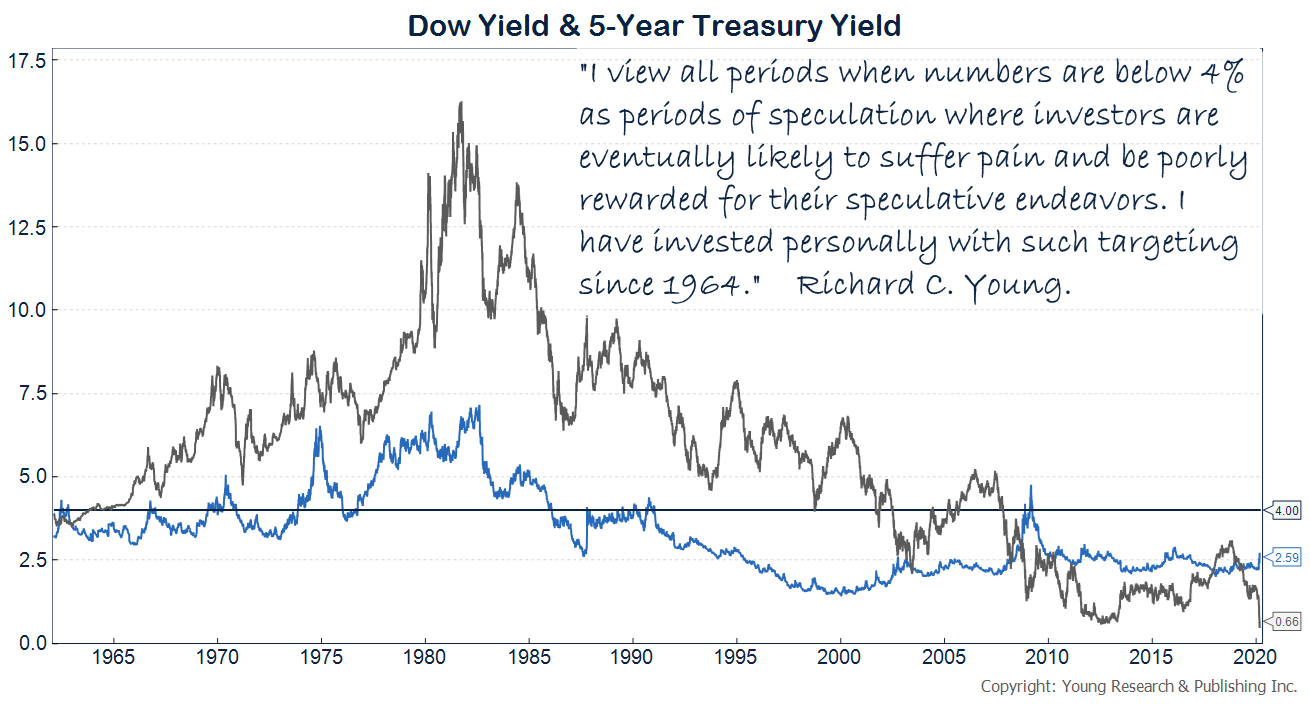
Richard C.Young’s Old Line “4% Rule”

March 12, 2020 By Richard Young

Filed Under: Investing Strategies

There Are No Second Chances at Retirement

March 3, 2020 By Richard Young

There are no second chances at living a full and happy retirement. You enter retirement only with what you bring with you, and you leave behind whatever remains. You don’t get another try, but there is a way to make your investment plan pay you to retire. The only catch is, many of you will have to make a 180° degree change in how you approach retirement. Here’s how I explain my plan:

You Need to Make a 180° Switch in Your Approach to Common Stock Investing

In the past you have probably looked on common stock investing as a program of (1) buying a stock and (2) selling it to someone else at a profit. Most likely you have not given dividends any thought at all. I want you to make a 180° turn. In the future I want you to invest to capture a long-term stream of dividends.

If you require current income, you will want a high current yield from your core stocks as well as bigger and bigger quarterly dividend checks in the future. If you do not require current income, you will look for 10% or better dividend growth and reinvest your dividends to allow the miracle of compounding to work for you year after year.

If you need help building a portfolio of dividend-paying stocks that can pay you during your retirement, please click here to request a no-obligation portfolio review from a seasoned member of the investment team at Richard C. Young & Co., Ltd., my family-run investment counseling firm. We can help you get your retirement right on the first try.

Filed Under: Investing Strategies

  • « Previous Page
  • 1
  • …
  • 6
  • 7
  • 8
  • 9
  • 10
  • …
  • 20
  • Next Page »

Compensation was paid to utilize rankings. Click here to read full disclosure.

RSS New From Young Research & Publishing

  • Are You Doing What’s Right for Your Situation?
  • Oil Markets Face a New Supply Crisis as Emergency Buffers Fade
  • US Producer Prices Post Largest Monthly Drop Since 2022
  • US Treasury Expands Sanctions on Alleged Iranian Shipping Network
  • How Golden Goose Rewrote the Rules of the Sneaker Market
  • INFLATION: We’re Going to Fix That
  • America Becomes the Engine of Global LNG Growth
  • Guardian of the Strait: The US Plan to Fund Hormuz Protection
  • Middle East Tensions and High Prices Slow Asia’s LNG Market
  • Small Businesses Drive New England’s Economy

RSS New From Your Survival Guy

  • Are You Doing What’s Right for Your Situation?
  • Are Americans Giving Up on Mortgages?
  • INFLATION: We’re Going to Fix That
  • The Save ‘Til It Hurts Hall of Fame: Dale Schroeder
  • More Oil Volatility as U.S.-Iran Ceasefire Breaks Down
  • Avoid Some Big Retirement Mistakes, Ask for Help
  • Putting Some Power Away in the Pantry: Part 6
  • Is It Finally Time to Retire?
  • “Honey, I Think It’s Time I Retire:” Part 9
  • “The Committee Will Deliver Price Stability”

Search Our Site

Richard C. Young & Co., Ltd.

–Client Letter Sign Up–

Sign up to receive email alerts when our latest client letter is posted on our website.

Disclaimer:

The information contained here is for informational and educational purposes only. It is not intended nor should it be considered investment advice or a recommendation of securities. Past performance is not a guarantee of future results. It is possible to lose money by investing. You should carefully consider your investment objectives and risk tolerance before investing.

Copyright © 2026 · About Dick Young · Terms & Conditions


Loading Comments...