• ABOUT – DICK YOUNG
  • YWMF – ARCHIVES

Young's World Money Forecast

Since 1978 With a 32 Year Vacation

  • DICK YOUNG
    • FROM RICHARD C. YOUNG
    • THE FINAL INTELLIGENCE REPORT
  • INVESTING STRATEGIES
    • RETIREMENT COMPOUNDERS®
    • GOLD & SILVER
  • DIVIDENDS & COMPOUNDING
    • MIRACLE OF COMPOUNDING
    • DIVIDENDS
  • GRAHAM & RUSSELL
    • BEN GRAHAM
    • RICHARD RUSSELL
  • THE DOW AND THE LEADERS
    • DOW vs. S&P 500
    • DOW vs. DOW DIVIDEND PER SHARE
  • WELLINGTON MANAGEMENT COMPANY
  • YOUR SURVIVAL GUY
  • BANK CREDIT & MONEY
  • THE PRUDENT MAN

The Swiss Way, Chapter 1, Part III

January 19, 2021 By Richard Young

By RastoS @ Shutterstock.com

I have written in the past of the Swiss Confederation and its weak central government form (the presidency is a ceremonial office and rotates). The office has no powers above the other six members of the Swiss Federal Council. The entire Federal Council is considered a collective head of state. Switzerland is a neutral country with a low crime rate and a powerful national defense system. Instead of fielding a large standing army, Switzerland requires every man to undergo military training for a few days or weeks a year throughout most of his life. Each man is required to keep his assigned automatic rifle at home at the ready. The Swiss are powerful believers in individual liberty and freedom. They believe that there is no need for a higher legal authority to check people’s initiatives. In fact, federal court in Switzerland is not allowed to rule on any constitutional matter at the national level. The Swiss are all about keeping things at the cantonal level. Keep it local is the key in Switzerland.

There is a lot to learn for Americans from “the Swiss way.” Switzerland’s model is precisely the weak form of central government intended by our Founders. The best outline of what a constitutionally strong form of federal republic looks like is Ron Paul’s Liberty Defined. The chapter on “Empire” alone will amaze you.

Originally posted May 26th, 2016

For supportive reading, click below:

  • Foundation Principles
  • How We Are Different
  • Richardcyoung.com – Supporting The American Conservative’s “Main Street” Conservatism
  • Strong Families, Resilient Faith, Thriving Middle Class

Filed Under: Investing Strategies Tagged With: safe

Swiss Francs, a Store of Value, Chapter 1, Part IV

January 19, 2021 By Richard Young

Read all of my posts on the Swiss Way here.

swiss franc

Filed Under: Investing Strategies Tagged With: safe

The Stock Market Is About Money Flows Not Politics.

January 14, 2021 By Richard Young

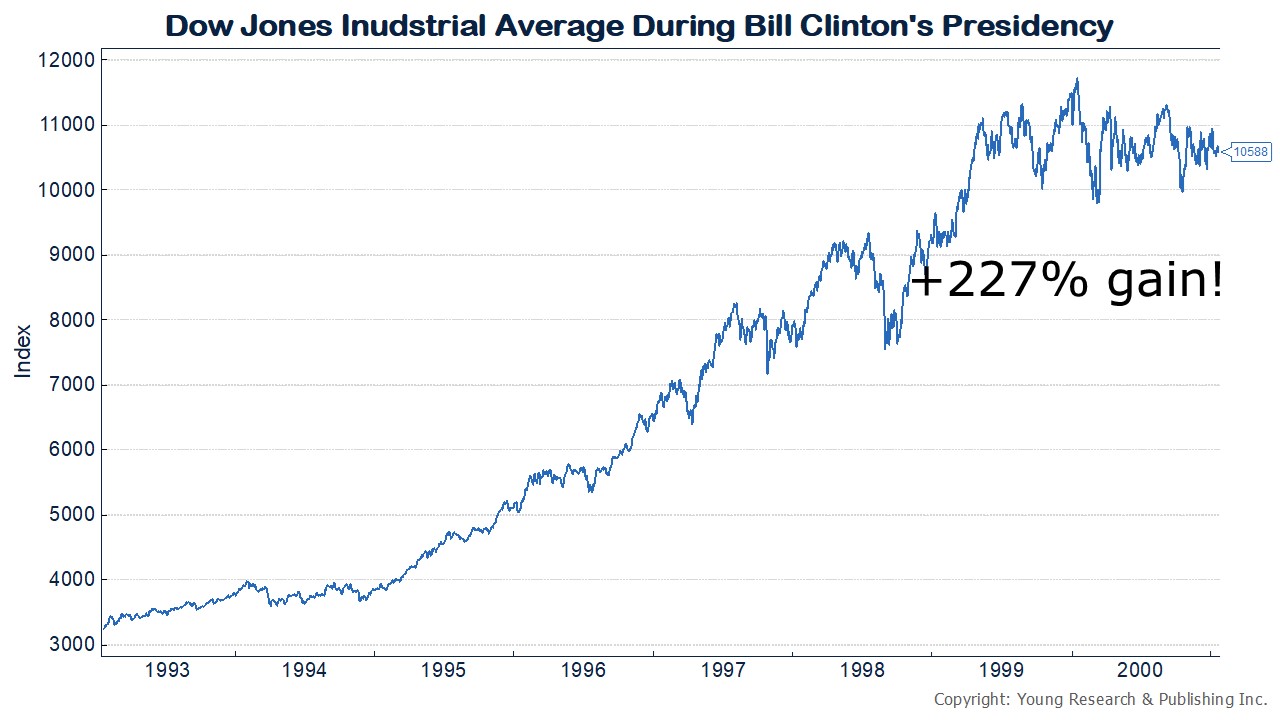
Has America endured a more disgraced sitting president than Democrat Bill Clinton or first family than Bill and Hillary? Perhaps not.

Well you might be surprised to know that your IRA sprouted like fresh green weeds during the disgraceful decade of the nineties. Check out my chart below.

Americans have a great history of remaining optimistic, even though the Washington elite can and do act, for extended periods, like thorough fools.

Filed Under: Investing Strategies

Investment Risk: Greatest in My Lifetime

January 4, 2021 By Richard Young

As we enter 2021 we start out with the most (potentially) incompetent, incoming president and vice president, and cabinet in history. Was the election digitally stolen? There should be jail time here over a broad landscape. Who is going to kick off the ball?

  • Interest rates are criminally low.
  • The Fed needs to be shuttered.
  • The West Coast digital industry needs to be hit with anti-trust and racketeering.

A wide swathe of the stock market has more of a casino look than a respite for retirement savings. I stick exclusively with dividend-paying blue chips of solid pedigree.

And I am not a market timer.

Filed Under: Investing Strategies

Exactly When Did the US Economy Hit Bottom?

December 4, 2020 By Richard Young

There is no doubt that the exact low for our economy was April 2020.

Since April, and thanks to the series of measures Donald Trump has taken to rebuild the hamstrung economy he inherited from an off-track Obama team, the US economy has had an exciting rebound.

Let me show you.

Four macro-economic series give you all you need to know.

  • Manufacturers’ New Orders for Consumer Goods and Materials bottomed in April 2020 at 109,714,000,000. It has since rallied all the way back to 137,131,000,000, just a hair below the pre-bust peak reading of 137,809,000,000.
  • Construction Contracts bottomed one month later in May at 41,860,000. CCs have since rallied back to 59,430,000.
  • New Private Housing Units Started also bottomed in April at 1,066,000. The powerful post-crash rally has now produced a new major cycle peak reading at 1,545,000.
  • Residential Private Fixed Investment also bottomed in April and at 571,270,000,000. The strong post-crash rally has produced a new major cycle peak at 641,783,000,000.

Donald Trump delivered Americans the greatest job gains in history and a resilient, foundationally strong economy in the bargain. Trump needs to continue his work. And as has already been proven, all Americans will be the beneficiary. This can happen!

Filed Under: Investing Strategies

The Case for Individual Stocks: Now More than Ever

November 20, 2020 By Richard Young

UPDATE 11.18.2020 from E.J. Smith: Has there been a company better positioned for the pandemic than the Home Depot? If your fire pit is more like your new outdoor living room, you know exactly what I’m saying. It’s almost impossible to find those neat outdoor heaters. The same goes for pressure-treated wood. We’re all trying to make our involuntary staycation one worth remembering.

During a talk with Dick Young yesterday, he recalled graduating from Babson in 1963. Home Depot co-founder Arthur Blank also graduated from Babson that year. Their class has, as a whole, been most active in giving back to the school.

Mr. Blank recently announced a $50 million gift to Babson. It will go towards entrepreneurship. For as long as I can remember, Babson has been ranked #1 by U.S. News & World Report for entrepreneurship. I expect that to continue now for 50 million more reasons.

No one can predict the future of the Home Depot, but when it comes to companies well-positioned for America’s current conditions, it’s hard to think of a better one.

Below read more from Dick Young on why now, more than ever, you should be looking at individual stocks.

UPDATE 9.28.2020: I have outlined further my current strategy for investing in individual stocks here. 

Originally posted March 27, 2020.

I subscribe to both Value Line and VL’s conclusion on stocks.

Two weeks ago I began a formula-based buying program that I plan to continue throughout 2020.

My formula is devoted 100% to stocks. I continue to build my counter-weighting fixed-income portfolio and continue to add to three fund positions.

I first started buying the funds in the early 1970s. (about 50% fixed income).

Today, I avoid most funds and all index funds.

THE CASE FOR INDIVIDUAL STOCKS HAS NEVER BEEN STRONGER

The battle with the coronavirus is having an incredible impact on daily life, the global economy, and on the stock market. In regard to the latter specifically, volatility has been off the charts, punctuated by the near-3,000 point drop on The Dow Jones Industrial Average on Monday, March 16th and the 2,112 point (12%) spike up on March 24th. The other major U.S. stock indexes have also experienced exaggerated volatility and large net losses of late. This has hurt a huge percentage of the investment community, which has trillions of dollars in assets allocated to broad index mutual funds and ETFs. This asset class has exploded in popularity over the past couple of decades. However, when the overall market falls so far so fast, these securities incur the full brunt of the downturn.

Value Line, on the other hand, with more than 87 years of experience in both bull and bear markets, has long preached the benefits of owning a collection of good-quality individual stocks, rather than the ordinary index fund. In our flagship service, The Value Line Investment Survey®, and its digital counterparts, we track approximately 1,700 stocks across more than 95 industries. Our independent, expert analysis, which includes a research staff of more than 70 professionals and a number of battle-tested proprietary ranks & ratings, has helped investors get the most out of the decade-long bull market, and will aid investors in navigating this troubling time, and the eventual market recovery that will follow.

Filed Under: Investing Strategies

Richard C. Young Helped ME Get Re-Centered

November 16, 2020 By Richard Young

Dick Young

The latest from my son-in-law, E.J. Smith at YourSurvivalGuy.com:

I had a great talk yesterday with a prospective client who is ready to come aboard. He’s a successful entrepreneur and triathlete coach. He said he doesn’t just stand on the side and coach. He’s in the pool, figuring things out with his athletes. I like that.

For example, if he sees a problem with an athlete’s swim stroke, he gets in the pool to copy the problem, and then he works on drills to correct it. It’s a hands-on approach that puts him in the shoes of his customers.

“I miss Richard C. Young’s Intelligence Report,” he said. “It’s the reason I have the savings that I do.”

“I never get tired of hearing that,” I replied.

“One of the things that helped me,” he said, “Is that Richard Young’s report helped me get re-centered with my finances every month. Every month it was a reminder. And I needed that to take action.”

And that means a lot coming from a coach.

Action Line: We all need to be re-centered. It’s one of my goals for these posts. To help you beat inertia and “Get re-centered.”

Originally posted November 13, 2020.

Originally posted on Your Survival Guy. 

Filed Under: Investing Strategies

Stock Market Investing for a Secure Retirement

September 25, 2020 By Richard Young

Here’s why I don’t follow the meaningless price or market capitalization stock market averages, especially the likes of the Dow and S&P 500.

  • The S&P 500 Index: only 50 of the biggest cap names account for more than 50% of the total S&P500 Index.
  • The Dow 30: only 10 of the highest priced stocks account for more than 50% of the total Dow Jones Industrial Average.

No thanks to index investing in either the Dow or the S&P.

Dick Young’s Investment Rules

Why savvy investors saving for a long and comfortable retirement should always follow RCY’s guide in crafting balanced portfolios:

  1. RCY: I rarely invest in stocks that (1) pay no dividend or (2) have not increased shareholder payout for years.
  2. RCY: I don’t like companies with high P/E ratios. In fact, stocks with single-digit P/Es are most appealing.
  3. RCY: Consumer expenditures account for $7 out of every $10 of real GDP, so I use Vanguard’s broad Consumer Staples ETF portfolio as a handy shopping list for many of my individual stock purchases. This allows me to craft portfolios with an average yield of nearly 3%
  4. RCY: I also insist on long-term annual dividend growth.

Over the long term, stock prices most often follow dividend increases upward.

Once you construct a conservative portfolio in a low interest rate environment like the one we face today, cash flow can be readily enhanced with a modest, replaceable draw from principal. By example, a client wanting a 4% annual portfolio draw can withdraw temporarily an additional 1% from principal annually.

Don’t forget, each year your portfolio receives more cash from increasing dividends, your yield on initial investment goes up. Talk about a winning hand.

Filed Under: Investing Strategies

How You Should Invest Today: Part II

August 27, 2020 By Richard Young

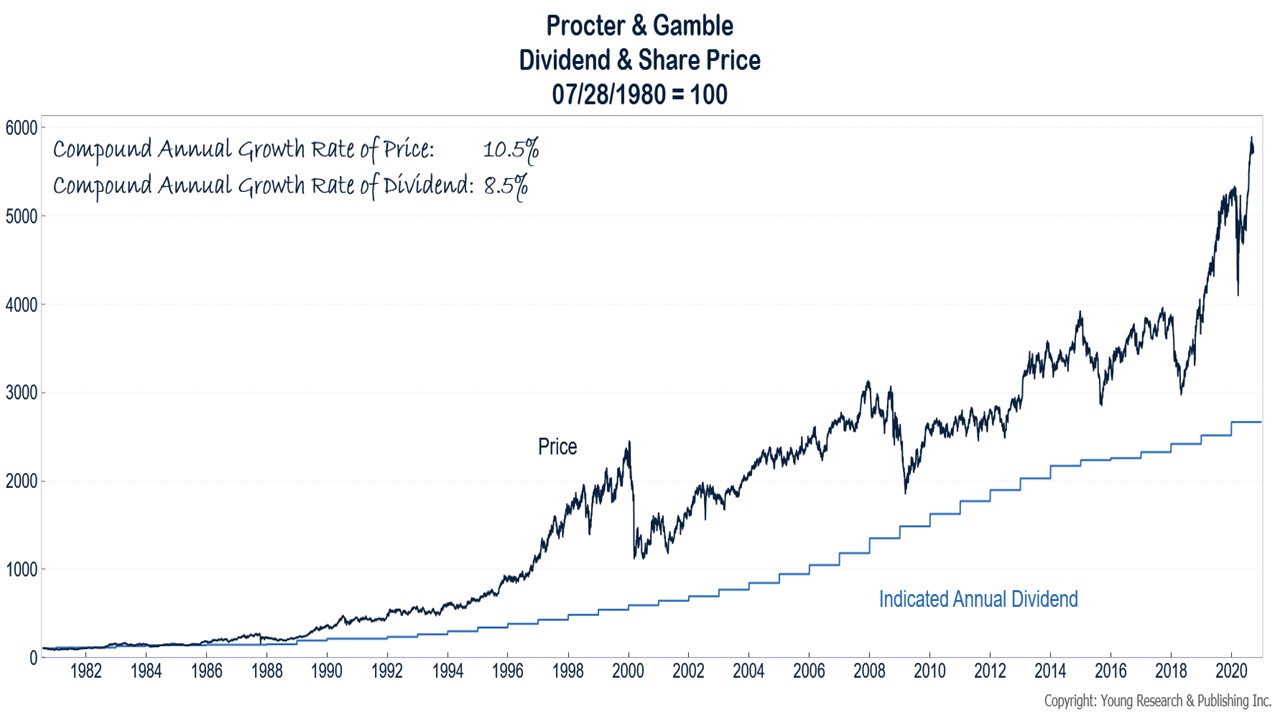
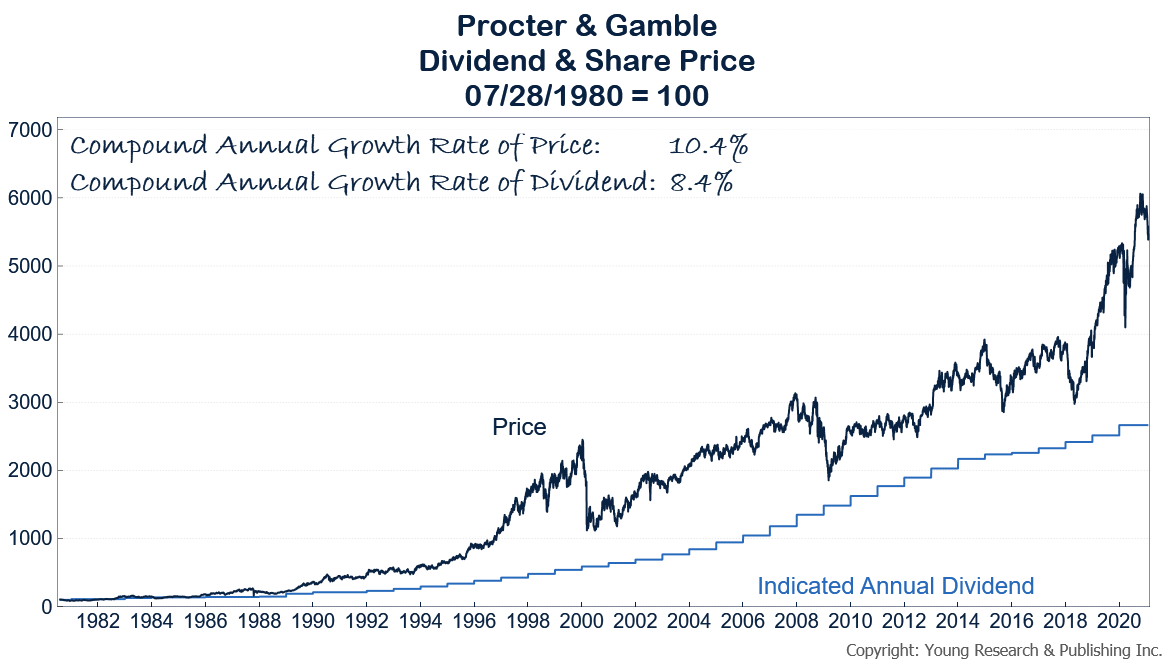
These two charts (below) on Dover Corp. and Procter & Gamble show you long-term compounded dividend and stock price growth for both.

In both cases, the long-term trend shows a pattern of consistent annual dividend growth matched with long-term stock price appreciation.

In Dover’s case, the dividend has compounded at an 8.9% rate of growth and the stock an even stronger and equally consistent 10.9%. For P&G the numbers have been 8.4% and 10.4%.

What you are looking at in both instances is decades of consistency, stability, and comfort for shareholders.

At our family investment counseling company, these are the only kind of companies we invest in for clients. Our master list of potential portfolio companies includes only companies with similar long-term records.

We never even consider companies without long-term records of dividend growth.

I have been writing about consistency, stability, and compound growth for five decades. And underpinning every report has been a foundation of dividends.

When you concentrate on dividend growth and stability, you never have to think about capital appreciation. It will take care of itself as my charts on P&G and Dover Corp. demonstrate, as long as the dividend is growing.

So, the easy lesson in this second part of my “how to invest today” series is to make dividends your password to investing both now and in future years.

Read Part I here.

Filed Under: Investing Strategies

How You Should Invest Today: Part I

August 20, 2020 By Richard Young

Charles Dow created the Dow Jones Industrial Average (DJIA) in 1896.  Originally the Dow had 12 companies:

American Cotton Oil; American Sugar; American Tobacco; Chicago Gas; Distilling & Cattle Feeding; General Electric; Laclede Gas; National Lead; North American; Tennessee Coal and Iron; U.S. Leather; U.S. Rubber

Not one of the original 12 DJIA stocks remain today as DJIA components.

That tells you the first couple of things you need to know in becoming a successful long-term investor.

First to remember, any stock average or index is not static, but is a revolving door. That is why I have never been interested in comparing my own investment record nor that of my clients against any average or index.

Second, most are either market capitalization (S&P 500) or price (Dow 30) weighted. Why would I want to consider my own investing program in comparison to two groups of stocks organized in a format that I would not dream of deploying myself?

So, where do you start? It is quite easy: Concentrate on diversification, dividends, compounding, and, above all, patience.

For something that doesn’t sound too hard, in my experience over five decades in the business of counseling investors, this seemingly easy menu is almost impossible for the individual investor to grasp.

In Part II of my series, I will help you get on just the right track to begin your journey as a comfortable and successful long-term investor.

Filed Under: Investing Strategies

  • « Previous Page
  • 1
  • …
  • 4
  • 5
  • 6
  • 7
  • 8
  • …
  • 20
  • Next Page »

Compensation was paid to utilize rankings. Click here to read full disclosure.

RSS New From Young Research & Publishing

  • Are You Spending Your Money Foolishly? (Part 6)
  • Brent Spot Prices Surge as Supply Crunch Deepens
  • Chokepoints and Control: The Future of Economic War
  • US Eyes Tighter Rules as China Expands in Mexico Supply Chain
  • Are You Spending Your Money Foolishly? (Part 5)
  • New US LNG Terminal Comes Online Amid Global Supply Tensions
  • Investment Floods Into US Industry
  • EU Unveils AccelerateEU Energy Security Plan
  • Rhode Island, Massachusetts Lead US Affordability Crunch
  • Are You Spending Your Money Foolishly? (Part 4)

RSS New From Your Survival Guy

  • Are You Spending Your Money Foolishly? (Part 6)
  • Send a Package of Cash? Major Red Flag
  • Are You Spending Your Money Foolishly? (Part 5)
  • Warsh to Reform the Fed?
  • Are You Spending Your Money Foolishly? (Part 4)
  • Are You Spending Your Money Foolishly? (Part 3)
  • Are You Spending Your Money Foolishly? (Part 2)
  • Going to Paris? Spending Your Money Somewhat Foolishly
  • Is Crypto about to Get an Ally at the Fed?
  • Your Survival Guy’s RAGE Gauge: A Change in Latitude

Search Our Site

Richard C. Young & Co., Ltd.

–Client Letter Sign Up–

Sign up to receive email alerts when our latest client letter is posted on our website.

Disclaimer:

The information contained here is for informational and educational purposes only. It is not intended nor should it be considered investment advice or a recommendation of securities. Past performance is not a guarantee of future results. It is possible to lose money by investing. You should carefully consider your investment objectives and risk tolerance before investing.

Copyright © 2026 · About Dick Young · Terms & Conditions


Loading Comments...