• ABOUT – DICK YOUNG
  • YWMF – ARCHIVES

Young's World Money Forecast

Since 1978 With a 32 Year Vacation

  • DICK YOUNG
    • FROM RICHARD C. YOUNG
    • THE FINAL INTELLIGENCE REPORT
  • INVESTING STRATEGIES
    • RETIREMENT COMPOUNDERS®
    • GOLD & SILVER
  • DIVIDENDS & COMPOUNDING
    • MIRACLE OF COMPOUNDING
    • DIVIDENDS
  • GRAHAM & RUSSELL
    • BEN GRAHAM
    • RICHARD RUSSELL
  • THE DOW AND THE LEADERS
    • DOW vs. S&P 500
    • DOW vs. DOW DIVIDEND PER SHARE
  • WELLINGTON MANAGEMENT COMPANY
  • YOUR SURVIVAL GUY
  • BANK CREDIT & MONEY
  • THE PRUDENT MAN

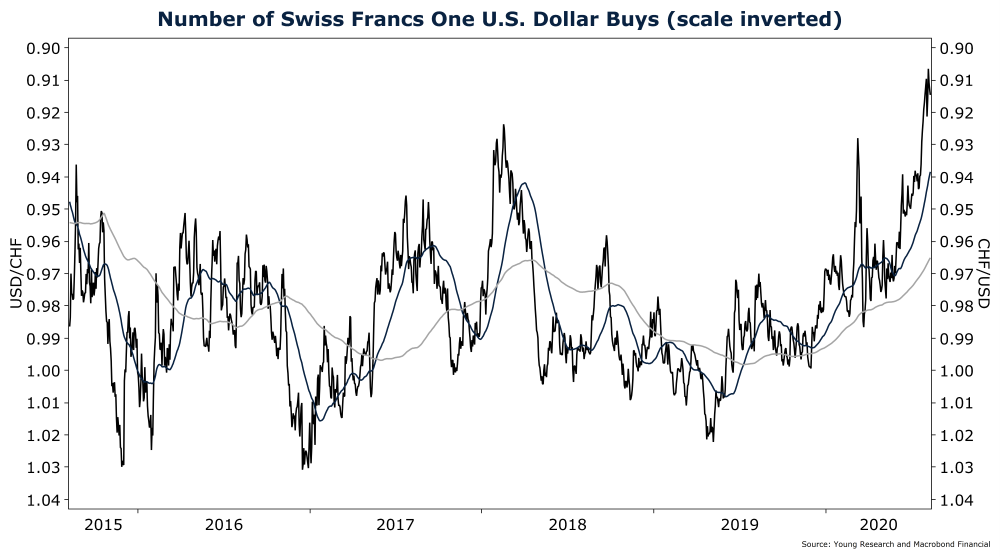
US Dollar Craters vs Swiss Franc

August 13, 2020 By Richard Young

Since last spring, my clients and I have been buying Swiss francs and lately Swiss franc denominated, dividend-paying equities.

What’s behind the dollar’s collapse? Too many dollars relative to Swiss francs are being printed. It’s no more complicated than that.

It is the Fed who is responsible for debasing the currency.

The Fed’s “private club” was introduced by Woodrow Wilson, America’s worst president, in 1913.

Since then, the Fed has increasingly muddled with the economy in total opposition to its original intent.

I have written often that I would return the Fed to its founding principles prior to shuttering it for good.

In the meantime, the dollar will remain on thin ice.

Filed Under: Investing Strategies

Monetary Heart Attacks Likely to Lead to S&P 500 Crash

August 6, 2020 By Richard Young

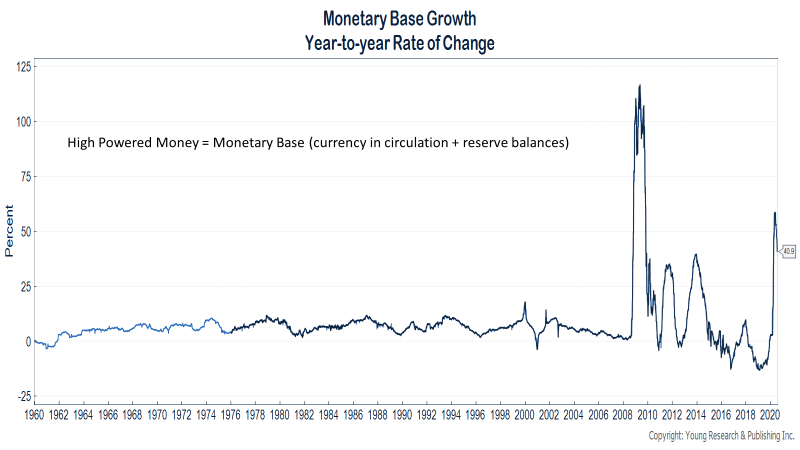
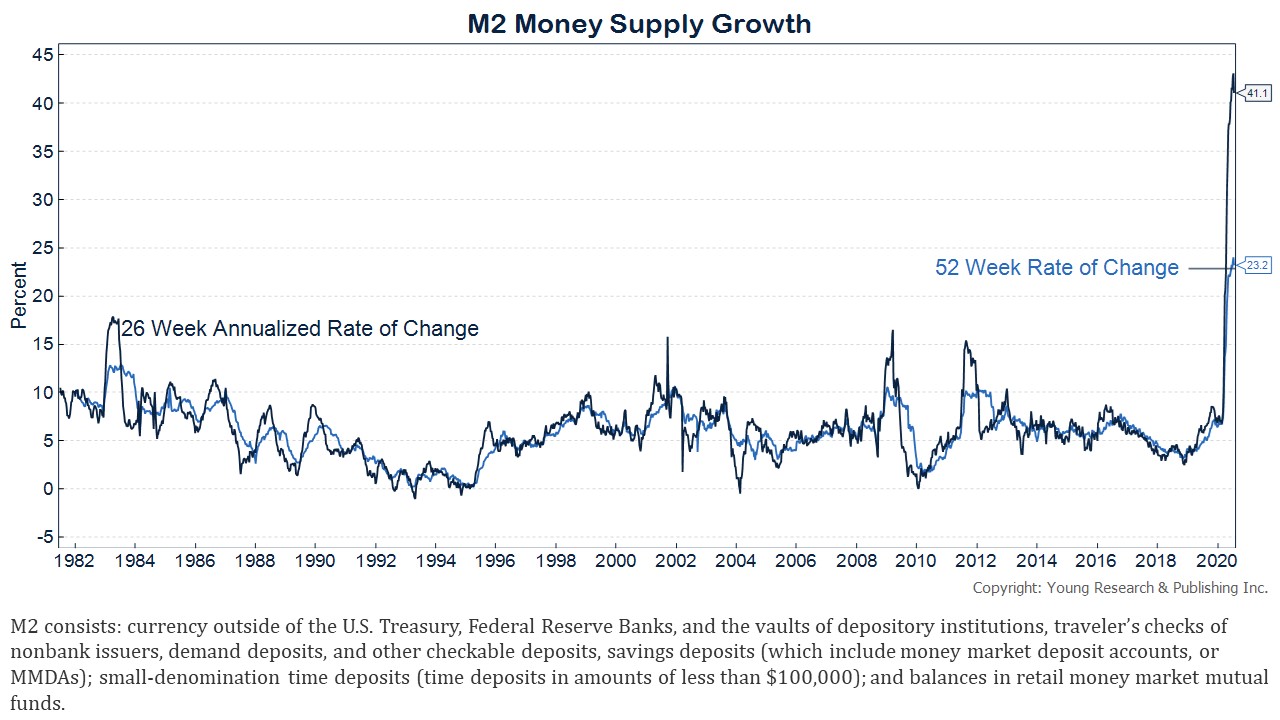
My charts (the Fed’s EKG) on high powered money and M2 growth point clearly to undisciplined chaos at the Fed.

Do you see any instance of such chaos in preceding decades? No!

Indeed, payday will arrive.

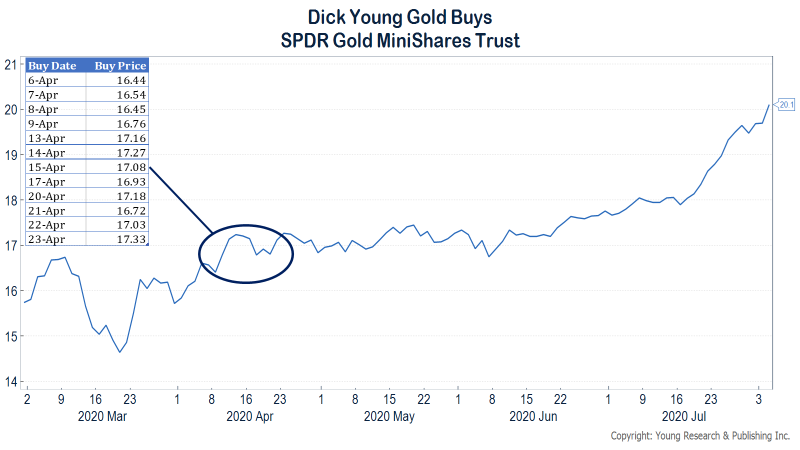
The table indicating my own program of gold buying gives you a look at one of a number of moves I made last spring to balance myself for the inevitable comeuppance.

At our family investment counsel firm, we emphasize ongoing strategy discussion, featuring new issue corporate bonds, dividend-paying Swiss franc denominated stocks, and currency and especially high US dividend-paying blue chips. Our laser-like concentration is on companies that have increased their dividend for decades.


Filed Under: Investing Strategies

Dump All Low Yielding US Treasuries Now

August 5, 2020 By Richard Young

Today we have a situation where the Fed has forced individual investors with life-time savings to subsidize corporate buybacks, acquisitions, and Wall Street banking industry borrowing and speculating. It’s what I call de facto robbing and stealing.

In reality, the Fed is nothing more than a private club to favor corporate and banking elites.

When the Federal Reserve was first established in 1913, Congress directed it to “furnish an elastic currency, to afford means of rediscounting commercial paper” and to establish a more effective supervision of banking in the U.S.

The Fed’s duties should have been left there. But no …

On 27 October 1978, President Jimmy Carter signed into law the Full Employment and Balanced Growth Act. The act requires the chairman of the Federal Reserve to connect the monetary policy with the president’s economic policy.

I would look to nullify the act in its entirety.

If the Fed is retained, its purpose should be confined to the narrow founding definition, and nothing more.

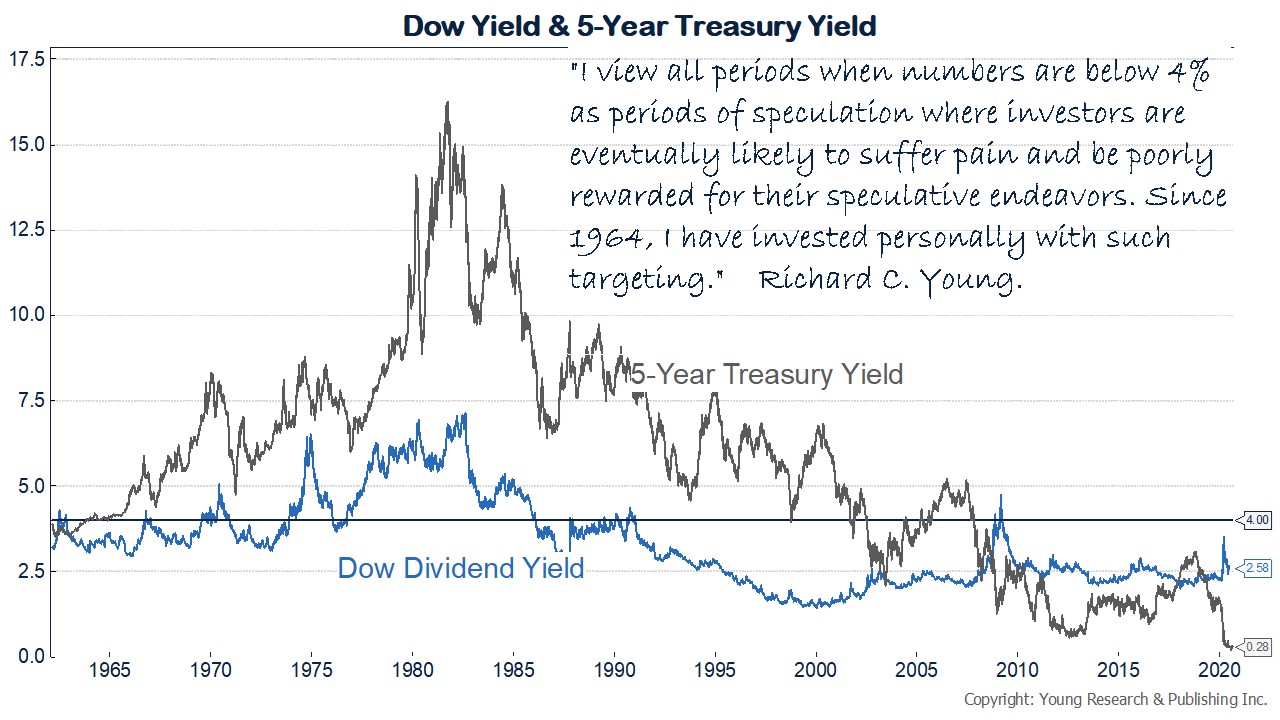
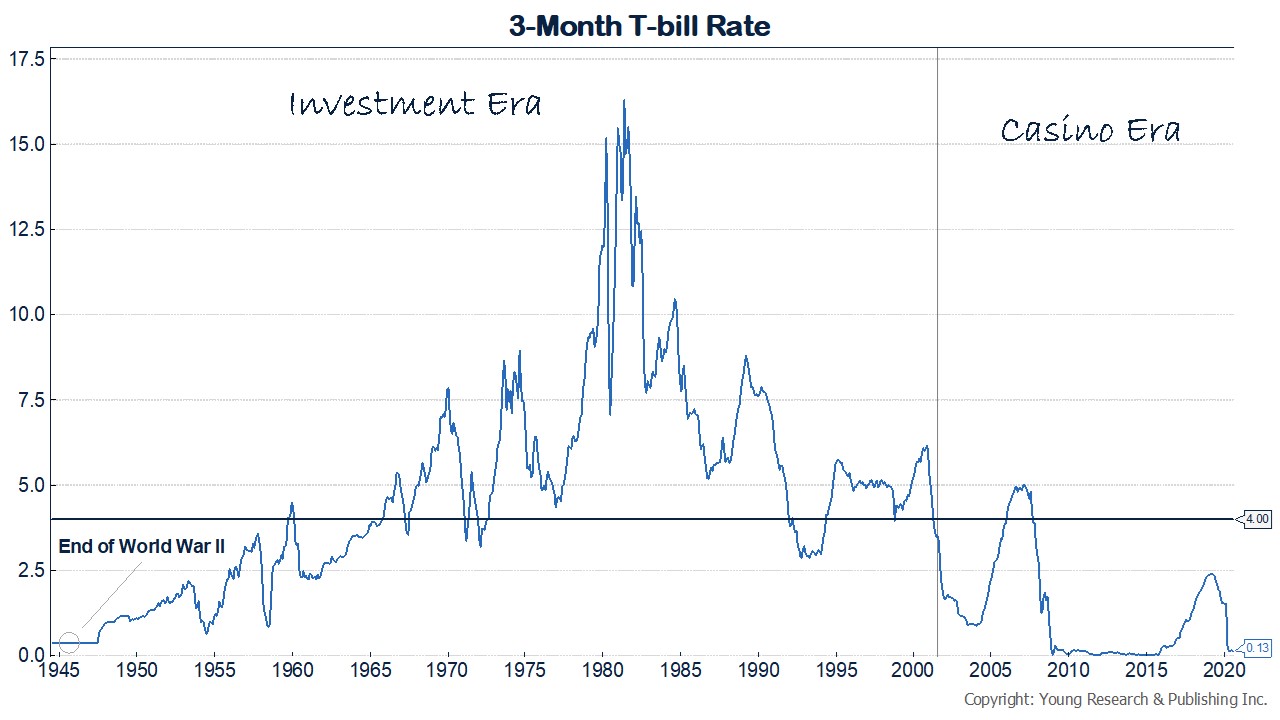
My two charts (below) indicate the circus climate the Fed has promoted today. Whenever interest rates stand below 4%, the economic and monetary system is out of whack.

Twice this century the Fed has allowed rates to sink below 4%. On the second of the two rebounds this century the Fed did not allow rates even to return to a more natural 4%.

Early this spring my family investment counsel firm sold all of our Treasurys. I also sold all of mine.

Today we are laser focusing on new issue corporate bonds, high-yielding blue-chip equities, Swiss franc denominated assets, and gold.

The Fed is attempting to control both the quantity and price of money. Bad things will happen and misguided individual investors will once again pick up the tab as the general stock market crashes in shock.

Filed Under: Investing Strategies

RCY’s Brand New Investing Program – 100% Swiss

July 31, 2020 By Richard Young

The Fed has created a disastrous asset bubble that will extend for years.

Read my series on Ron Paul to gain the full flavor for what is transpiring.

I devoted a large section of my 1987 book to inflation, gold, and Switzerland. Through the decades, I have been a big investor in both Swiss assets and gold.

In the month of August, 100% of my personal investing will be in Swiss Franc-denominated assets.

Click here to view my Swiss chart pack.

The Swiss Way

I have written in the past of the Swiss Confederation and its weak central government form (the presidency is a ceremonial office and rotates). The office has no powers above the other six members of the Swiss Federal Council. The entire Federal Council is considered a collective head of state. Switzerland is a neutral country with a low crime rate and a powerful national defense system. Instead of fielding a large standing army, Switzerland requires every man to undergo military training for a few days or weeks a year throughout most of his life. Each man is required to keep his assigned automatic rifle at home at the ready. The Swiss are powerful believers in individual liberty and freedom. They believe that there is no need for a higher legal authority to check people’s initiatives. In fact, federal court in Switzerland is not allowed to rule on any constitutional matter at the national level. The Swiss are all about keeping things at the cantonal level. Keep it local is the key in Switzerland.

There is a lot to learn for Americans from “the Swiss way.” Switzerland’s model is precisely the weak form of central government intended by our Founders. The best outline of what a constitutionally strong form of federal republic looks like is Ron Paul’s Liberty Defined. The chapter on “Empire” alone will amaze you.

Read more about The Swiss Way here.

Filed Under: Investing Strategies

My 10 Point Investment Plan: Pretty Much the Same as Back in 1990

July 28, 2020 By Richard Young

Back then I offered subscribers to my investment strategy report a ten-point investment guide for the long term.

The basic plan is today, thirty years later, pretty much unchanged.

  1. Make capital preservation your number one target
  2. Make dividends the cornerstone of your core equity portfolio
  3. Never forget the power of compound interest
  4. Make equities, not bonds, your core holdings.
  5. When general market conditions are horrible, and most folks are selling, aggressively buy your dividend stocks
  6. Use automatic withdrawal programs for retirement income
  7. Don’t trade in and out
  8. Remember the words full faith and credit.
  9. Never invest based on predictions. Invest based on relative value only.
  10. Be well organized, always have a plan, practice patience.

Filed Under: Investing Strategies

Your Portfolio Could Use This Investment as a Powerful Insurance Policy

July 23, 2020 By Richard Young

There are very few real counterbalancers available in an asset bubble like the one being blown today by the Fed and other central banks.

One investment I have found to be reasonably reliable as a counterweight insurance policy is precious metals, specifically gold and silver.

Is there downside risk in buying metals? Of course. Here’s how I previously explained that risk:

Relative to gold, silver is cheap. The higher the gold/silver ratio, the cheaper silver is. The historical gold/silver ratio has been 15:1. Today, it is 53:1. Central banks do not own silver, which they could dump on the world market to depress prices. This is a big plus for silver. Silver trades at about $32/oz. The structural low is about $10/oz. There conceivably is a significant downside risk. My strategy is to pick away slowly over the next few years, hoping that I’ll get an average price on my purchase well below $32/oz. Who knows? Silver and gold are insurance policies that I hope I will not need. What I buy, I will not sell. And I am buying with the hope that the price of my insurance will decline, not increase. Year to year, I am a hesitant, reluctant seller of any investment.

Today, the gold/silver ratio is over 90.

I want you to think of the silver and gold in your portfolio as an insurance policy. If it goes down, you may be better off because the prices of your stocks are going up.

If you would like to learn more about how Richard C. Young & Co., Ltd. views precious metals as a portfolio counterbalancer, click here to sign up for our monthly client letter. The letter is written by my son, Matt Young, who has led our family-run investment counsel firm for over twenty years.

Filed Under: Investing Strategies Tagged With: precious

My Biggest Investing Quarter Ever

July 2, 2020 By Richard Young

Due to a convergence in timing, I was able to make by far the biggest commitment to the stock market in my life during late March and into the second quarter of 2020.

On 31 March 2020, I posted My Three Week-Long Investing Program.

It led off, “I am ramping it up over the month of April and into May.”

As reported 30 June in the WSJ, U.S stocks finished their best quarter in 20 years.

I also posted the exact areas I was investing in and why. No way I could have expected such quick and massive returns. Given that Joe Biden is apparently attempting to put a quick end to it all by proclaiming, “we have 120 million dead,” I suppose I should not get too comfortable.

OK, now what?

With Joe Biden now seemingly considering a VP candidate with sympathy for a Marxist-centered group, it is possible his campaign will implode, bringing turbulence to the financial markets?

I will update my investment strategy posts at the end of July.

Filed Under: Investing Strategies

How to Invest Today

June 22, 2020 By Richard Young

It’s time for a change in pace.

Since the end of March, the Dow has exploded from about 18,500 to over 25,000 as June nears an end.

During this period, I steadily added to my equities position as well as to my individual bond positions. I also added to three fund positions (nearly 50% fixed) that I have owned for decades (not index funds) as well as to smaller positions in gold and the Swiss Franc.

In the coming quarter, I plan to increase my focus on fixed income.

My four biggest concerns today are (1) the Fed’s balance sheet and (2) the historically low level of U.S. government bond yields, both of which are unprecedented. (3) Creeping Marxism in America and (4) China.

Filed Under: Investing Strategies

You Want the Limo, Not the Public Bus

June 12, 2020 By Richard Young

Dick Young, Paris, France

Your investing future does not have to be relegated to a public transportation type of experience. You have a choice. And you can go in first class comfort or, instead, take a seat in the back of the bus. Here’s what I mean.

To start, don’t spring for yesterday’s investments – stock index funds or most equities centric funds. Don’t settle for government bonds that pay virtually nothing today, or for casino-like big S&P 500 stocks that pay no dividends but often sell for criminal market cap-to-sales ratios.

By now you undoubtedly realize that robo-advisors, whatever they are, offer zero value.  “Advisors” manning the phone desks at massive fund groups are often kids about your grandkids’ ages. And you sure don’t want the investment products larded with sales charges from planners and wirehouses. That’s sure no way to travel.

At our family owned investment counsel firm, we offer a blue-chip option where you can find comfort amongst kindred spirits. We have decades of experience in personally consulting with conservative families and small business owners planning for a secure retirement or perhaps already in retirement.

Our family owned counsel business, unlike industry behemoths, offers the maximum in flexibility in dealing with, for example, bonds. Being nimble is the last thing you’d say about enormous mutual funds. Our company’s size and expertise allow us to capture opportunities in a wide range of fixed-income markets – municipals, treasuries, corporates, high-yield, loans, mortgage-backed securities, and, should the opportunity arise, even foreign currency denominated bonds.

Investing in a bond mutual fund today is akin to commuting to work on the bus.

The Good and Bad News

The good news:

  • Someone else drives.

The bad news:

  • The bus won’t be leaving when you want to leave.
  • The bus is on its inflexible schedule, not on yours.
  • The bus won’t pick you up at your doorstep or avoid traffic jams.
  • The bus won’t be swinging by the pharmacy after work so you can pick up your prescription.

The bus rules. Bus rules are for the benefit of all riders. Period.

Mutual funds offer a similar experience. For example, fund managers are often restricted in what they can buy. This means, when you invest in a fund with a medium-term maturities mandate, you will get exactly that – medium-term maturities. It doesn’t matter if short-term corporates are more attractive, if high-yield bonds are offering the opportunity of a lifetime, or if there is simply too much risk in medium-term corporates for a given level of return. You signed up for medium term maturities corporates and that’s what you’re going to get.

The burden of specific decision making is on your shoulders.

At RCY, Ltd., we are not burdened by fund constraints. Let me give you an example. Early this year almost half the assets of our bond portfolios were in Treasurys. In February and March, as the economy ground to a halt and yields on corporate bonds soared, we shifted gears moving en masse out of lower yielding Treasurys and into much higher yielding corporates. Our clients think of us as the black car limo service of bond investing, rather than one-for-all public transportation.

In April I made my initial individual bond purchase under my new buying program.  I bought the new issue Weyerhaeuser bonds. Weyerhaeuser, a large forest products company, owns 12-million acres of Timberland, making it one of the largest private landowners in America. Weyerhaeuser bought my old favorite Plum Creek, which you probably remember from my strategy reports.

The Weyerhaeuser bonds I purchased have a 4% coupon and mature in 10 years. The individual investor is a babe lost in the wilderness when it comes to hunting down individual bonds for a bond portfolio.

How about new issues? Forget it. I have been involved in this market since 1971, and I can assure you that individuals have no place even considering entering that fray.

As of the end of March, Weyerhaeuser had $5 billion in net debt (debt after deducting cash). If you divide the $5 billion debt by the firm’s 12 million acres of timberland, there is $400 in debt held against each acre of Timberland. Assuming no other assets or liabilities, as long as Weyerhaeuser’s land is worth more than $400 per acre, bondholders likely would be made whole in the event of default. This, of course, is a back-of-the-envelope calculation, but we like the margin of safety the company’s land provides.

I have always remained fully invested in a counter-balanced, widely diversified portfolio.  I don’t jump in and out of the market. The word I emphasize here is balance. Here’s why, along with my firsthand experience of what happens when counterbalancing (balance plus) is not in force.

Back in the old days, most Harley engines were bolted directly to the frame. Talk about vibration and calamity. With constant vibration, nuts and bolts tend to loosen and fall off on an all too regular basis. On long-distance road trips, breakdowns in, say, the Canadian Rockies, are cause for concern. Today’s Harleys feature counterbalanced engines offering both a smooth ride and a minimum of road-trip calamities.

To enjoy a smooth ride in the financial markets without the constant threat of financial calamity/vibration, I have long-advised Wellesley (65/35 bond) and Wellington (65/35 stocks) funds. Sadly, both have exploded in size. turning into far less attractive options for new money.

Not a Single Double-Digit Down Year

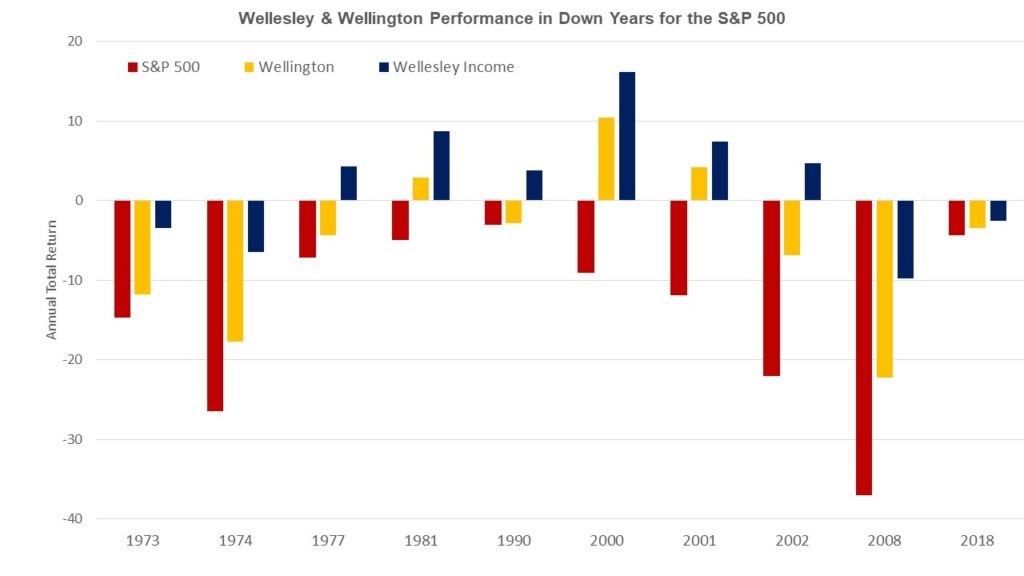
Since bond-heavy Wellesley first opened in 1971, it has not suffered one double-digit down year. Not a single one.

The chart below shows the return of the balanced Wellesley (as well as Wellington) in each down-market year since 1970 (Wellesley’s inception year).

During this same period, the S&P 500 stock index experienced 10 down years

(As a side note: I no longer advise most index funds, and certainly not funds indexed to the S&P 500.)

Wellesley declined in only four of those years. And with the exception of 2018, balanced Wellesley’s declines were only a quarter of the decline in the S&P 500 stock index.

Since the balanced Wellesley’s first full year in operation, the 65/35 (bonds/stocks) fund declined in only seven years. That’s a .857 batting average. The best hitters in major league baseball rarely hit .400.

With the exception of 1973, in each year following a Wellesley annual decline, balanced Wellesley has been up double digits.

Here is a scary Wellington liquidity fact. In order to maintain a passive stake in a purchased stock of no more than 3% of the outstanding shares, Wellington today is confined to stocks with a market value of at least $73 billion. That’s a minuscule field. Formerly suitable funds have today become too big for their own good.

Today, in 2020, there are just 80 U.S. companies with a market value of $73 billion or more. This mini group compares to the more than 5,000 U.S. companies with a market value over $100 million.

I am retired from the newsletter writing business. As chairman of our 100% family-owned Investment counseling firm, Richard C. Young & Co, Ltd., I now work full time (yup) on global investment strategies. Ltd. has been in business for over three decades and our company works personally with families and small businesses across America.

Today I concentrate on individual stocks and bonds as building blocks for my own portfolio, as well as for clients. During the coronavirus disruptions, I am fast on the trail of investing in exactly the type of big blue chips I have advised through the decades for my strategy report subscribers. Looking to the future, these individual blue chips will be the focus of my own personal investing, as well as that of our company.

I’d like you to join me and my family. Balance, patience, and compounding (BPC) offer so much.

Investment counseling is as deeply personal as it is private. And solid relationships, as you probably know from your life’s endeavors, count for much. Why not let us take the load of day to day investing decision making off your shoulders.

Richard C. Young & Co, Ltd. is but a phone call away. Call (888) 456-5444 today while the matter is fresh on your mind. You’ll be glad you did.

Warm regards,

Dick Young

Filed Under: Investing Strategies

Trump Cavalcade Drives America Back to Business

June 8, 2020 By Richard Young

Debbie and I have traveled up the East Coast countless times over the last many decades. On every trip, we take inventory of the health of America’s small-town Main Streets, pedestrian activity in towns, and truck activity on the highways, among many other inference reading signals.

Last Friday we were traveling again. That day, news dropped of the record-setting job gains in May. The stock market soared, with the Dow Jones Industrial Average closing up 829.16 points.

While liberal economists like Paul Krugman wrote the report off as a conspiracy theory, the evidence of America’s jobs resurgence was right in front of Debbie and me. As we drove on the highway, we witnessed far more truck traffic than on any trip we had ever taken. It was the Trump cavalcade, driving America back to business. Especially noticeable was the vast number of trucks carrying lumber to mills and job sites.

The pictures below represent a fraction of the trucking activity we witnessed through Pennsylvania and beyond.


This slideshow requires JavaScript.


Kate Andrews reported on the record-breaking numbers for Spectator USA, writing:

The US economy created 2.5 million jobs last month — the biggest monthly jobs gain since records began a century ago, albeit only a partial recovery from 22 million jobs lost during lockdown. These figures have blown expectations out of the water. Economists were expecting yet more unemployment: the consensus was an 8.3 million rise in unemployment hitting 20 percent in May, up from 14.7 percent in April. Defying the odds, unemployment actually fell to 13 percent, signaling an unexpectedly early start of the rebound of the US economy. The biggest winners were workers in hospitality, who made up almost half of the new jobs, followed by construction. ‘This is a mind-blowing number and shows that the economy is improving,’ said Naeem Aslam, chief market strategist at AvaTrade.

US unemployment still stands at 13 percent, but a recovery of this scale had not been expected. ‘It seems the damage to the nationwide lockdown was not as severe or as lasting as we feared a month ago,’ said Scott Clemons, chief investment strategist at Brown Brothers Harriman. For some time now, the stock market has looked as if it was expecting a V-shaped recovery, the likes of which started today with the FTSE100 up 100 points. Its future looks brighter still, as the new jobs data has indicated an ‘open of nearly 600 points higher for the Dow Jones Industrial Average’. It seems in America, the jobs recovery could be V-shaped too.

For more on the COVID-19 economic crisis and recovery, read here:

  • Dividend “Suspensions” Not Dividend Cuts Coming Fast
  • Working Seven Days a Week in Sunny Key West

Filed Under: Investing Strategies

  • « Previous Page
  • 1
  • …
  • 5
  • 6
  • 7
  • 8
  • 9
  • …
  • 20
  • Next Page »

Compensation was paid to utilize rankings. Click here to read full disclosure.

RSS New From Young Research & Publishing

  • Are You Spending Your Money Foolishly? (Part 7)
  • U.S. Energy Exports Hit Record Highs
  • Small Modular Reactors Aim to Revive US Nuclear Power
  • Gulf Aluminium Disruptions Shake Global Metals Market
  • AI-Generated Fraud Exposes New Returns Crisis in Retail
  • Are You Spending Your Money Foolishly? (Part 6)
  • Brent Spot Prices Surge as Supply Crunch Deepens
  • Chokepoints and Control: The Future of Economic War
  • US Eyes Tighter Rules as China Expands in Mexico Supply Chain
  • Are You Spending Your Money Foolishly? (Part 5)

RSS New From Your Survival Guy

  • Are You Spending Your Money Foolishly? (Part 7)
  • A Path Is Cleared for Kevin Warsh as Next Fed Chair
  • Are You Spending Your Money Foolishly? (Part 6)
  • Send a Package of Cash? Major Red Flag
  • Are You Spending Your Money Foolishly? (Part 5)
  • Warsh to Reform the Fed?
  • Are You Spending Your Money Foolishly? (Part 4)
  • Are You Spending Your Money Foolishly? (Part 3)
  • Are You Spending Your Money Foolishly? (Part 2)
  • Going to Paris? Spending Your Money Somewhat Foolishly

Search Our Site

Richard C. Young & Co., Ltd.

–Client Letter Sign Up–

Sign up to receive email alerts when our latest client letter is posted on our website.

Disclaimer:

The information contained here is for informational and educational purposes only. It is not intended nor should it be considered investment advice or a recommendation of securities. Past performance is not a guarantee of future results. It is possible to lose money by investing. You should carefully consider your investment objectives and risk tolerance before investing.

Copyright © 2026 · About Dick Young · Terms & Conditions


Loading Comments...