• ABOUT – DICK YOUNG
  • YWMF – ARCHIVES

Young's World Money Forecast

Since 1978 With a 32 Year Vacation

  • DICK YOUNG
    • FROM RICHARD C. YOUNG
    • THE FINAL INTELLIGENCE REPORT
  • INVESTING STRATEGIES
    • RETIREMENT COMPOUNDERS®
    • GOLD & SILVER
  • DIVIDENDS & COMPOUNDING
    • MIRACLE OF COMPOUNDING
    • DIVIDENDS
  • GRAHAM & RUSSELL
    • BEN GRAHAM
    • RICHARD RUSSELL
  • THE DOW AND THE LEADERS
    • DOW vs. S&P 500
    • DOW vs. DOW DIVIDEND PER SHARE
  • WELLINGTON MANAGEMENT COMPANY
  • YOUR SURVIVAL GUY
  • BANK CREDIT & MONEY
  • THE PRUDENT MAN

This is the Most Persuasive Test of High-Quality Investing: Does Your Portfolio Pass?

October 4, 2019 By Richard Young

Of all the ways you can test the holdings in your portfolio, Ben Graham codified what he called the most persuasive in his book Intelligent Investor. Companies paying dividends for 20 consecutive years were first on Graham’s list of high quality. I explained high quality to readers in August 2007, writing:

Laurent & Villchur…

Back in 1967, Acoustic Research’s demonstration room on Mount Auburn Street in Cambridge, Massachusetts, was ground zero for state-of-the-art high fidelity. My experiences in Cambridge led me to buy the Acoustic Research AR3 speakers and AR turntable that I am playing today, four decades later, as I write to you. And I am also using the same Dynaco PAT-4 preamplifier and Dyna Stereo 120 power amplifier that first powered my AR3s 40 years ago. AR’s founder Edgar Villchur and Dynaco designer Ed Laurent were the legendary forces behind this ground-breaking equipment. Today, as I play Johnny Lytle’s The Loop, Jack McDuff’s Tough ’Duff and The Beatles’ Sgt. Peppers, the sound from vinyl is every bit as warm and enjoyable as it was with my earliest AR/Dynaco experiences back in the 1960s.

Vinyl for Warmth

CDs were never collectible and never matched vinyl for warmth. I own a number of high-fidelity systems, including a dearly priced and excellent Conrad Johnson-based reference system. But for day-to-day listening, I turn on my AR/Dynaco system and records—no question about it.

45-RPM Tops

All of this, of course, flies in the face of music industry hype for CDs and downloads, the ultimate in a low-fidelity music experience for the masses. While perfect for jogging and the Wal-Mart experience, this is not high fidelity. And the cherry on the cake of my musical high-fidelity experience for you is the revelation that sound from a properly mastered 45-RPM record is best of all. If you ever saw the classic 1982 movie Diner, you may remember the scene in which Shrevie utters, “Every one of my records means something.” Vinyl was and remains the way to go. What I find most encouraging is that young listeners are coming into the vinyl market every day.

Treasured Since 1934

As I write to you today, the single investment book on my desk is the same book that was on my desk when I began in the investment business at Clayton Securities in 1963. Graham, Dodd & Cottles’ Security Analysis is as treasured as it was since its first edition in 1934. Like high fidelity, the guts of investing have really not changed so much through the decades. Compound interest, value, and patience are still the key. Ben Graham was fond of saying, “One of the most persuasive tests of high quality is an uninterrupted record of dividend payments for the last 20 years or more.” In his Intelligent Investor, Graham followed up with, “Indeed, the defensive investor might be justified in limiting purchases to those meeting this test.” Nothing has changed.

Dividends Since 1893

Coke began paying a dividend in 1893, Exxon in 1882, GE in 1899. Things sure have gotten different, haven’t they?

Uninterrupted streams of dividends can lead to a cascade of compounding in your portfolio. Click here to learn more about the value of compound interest, and in particular the powerful Coca-Cola Story.

Filed Under: Investing Strategies

Are You Confused by the Investment Hype?

September 27, 2019 By Richard Young

As an individual investor, you may be confused by the hype and pressure aimed at you by the media and securities salesmen. The constant drumbeat of news, both good and bad, can create an emotional response from even the most stoic of investors. Couple that with many investors’ lack of experience, and trouble can erupt from portfolios during tough market times. In July 1993 I wrote:

You’re on the 15th Tee.

At the Four Seasons golf course in Nevis, West Indies, high in the lush green hills of this remote Caribbean island, you are overlooking the yawning expanse of a many hundred foot deep gorge. Where’s the pin? Where do you hit? You hit over the gorge to some unseen and distant manicured green. For novices, it would take small-arms fire to hit the other side of the gorge. But for you, the seasoned pro, it’s but a well-timed whack with your Wilson #3 wood. No problem, you’re on the green.

The challenge of this extraordinary hole on one of the world’s most beautiful golf courses is nothing to you, because you are disciplined and practiced, and you concentrate on your game.

Investing is much like golf. Discipline concentration and a practiced stroke are paramount to winning investors as well as to steady golfers. Think about it. Do you apply the same level of concentration to your every investment move as you would on a tricky 20-foot putt? Have you mastered a practiced, mechanical, unemotional approach to your investment program?

Discipline, confidence and a mechanical approach work every time and make sense in many avenues of life. One of my regular monthly goals here is to logically convince you of the value of these vital traits.

Invest With the Slow Ebb and Flow of the Tides

Like many investors, you may often be confused by events of the moment. Media hype and sales pressure are difficult hurdles to overcome. Here, you learn how to overcome emotion in investing. You learn how to harness the awesome long-term power of compound interest and to invest with the slow ebb and flow of the tides. Do not invest on each crashing wave of headline news. If it’s a good idea today, it will be a good idea tomorrow and the next day. Take it easy, relax and do not be an in-and-out trader or market timer. Be ruthlessly organized using the principles found here each month.

Invest with the comfort and knowledge that you have a disciplined, long-term strategy. I help you plot your investment map monthly. If you’ve been with me for many years, you know the consistent approach used month to month to month. Over my three decades of investing, I’ve developed a series of disciplines that work well for me, with high odds of success. Each month I stick to these and emphasize their long-term success for you.

You don’t have to face the emotional task of investing alone. You should seek the guidance of a trusted fiduciary advisor, who will guide you through the construction of an investment plan, and give you the confidence to stick with that plan when times get tough.

If you’d like a glimpse at what a trusted advisor offers investors, signup for the monthly client letter alerts from my family run investment counsel firm. Each month in the letter my son Matt, President and CEO of Richard C. Young & Co., Ltd., explains the ongoing strategies we employ on our clients’ behalf. The letter is free, even for non-clients, and you will receive an alert each month when the newest is available. Click here to sign up.

Filed Under: Investing Strategies

How to Build 37% of Your Wealth in Just Ten Days

September 20, 2019 By Richard Young

In the Spring of 1996, I explained how important just ten days of a 31-year period were to building 37% of their wealth. I wrote that March:

Market Timing Strategy—Bankrupt

Before I tell you what other funds I have bought this month and which funds I have on my short list for the next few months, I want to startle you, shock you, and convince you beyond any doubt that market timing is a bankrupt strategy whose time has never come.

Here’s the only example you’ll ever need to never market time again. T. Rowe Price put these numbers out a year or so ago. The original research was done by Towneley Capital Management.

If you invested $1 for a 31-year period (1963-1993), your $1 grew to $24.30 at year-end 1993. But if you missed just the 10 best trading days out of the 7,802 trading days, your $1 investment grew to only $15.40. That’s right, by missing just 10 days, your return was slashed by 37%. Do you know what percentage of the trading days we are talking about here? Less than one-quarter of one percent (0.128%).

Now then, if instead of only 10 days you missed the best 40 days of 7,802 trading days, your $1 grew to only $6.50. By missing just 0.51% of the total trading period, your return was slashed by an unimaginable 73%. How’s that for missing the boat?

OK, what if you missed out on just 1.15% of the trading days? Well, by missing just 90 of the total 7,802 trading days, your $1 made a glacier-like advance to $2.10. You would have been head-faked out of 91.4% of your long-term profits.

Still with me? The news gets worse—a lot worse. In-and-out trading necessitates not one, but two correct buy/sell decisions. It does no good to get out of the market advantageously unless you can also get back in advantageously—and both are low odds, big “ifs.” Furthermore, there is a substantial transaction penalty to pay on each and every buy and sell. You find commissions extracted from your hide. And you do not see the bid/ask spread that is also lost on each transaction.

Finally, in all non-tax-deferred accounts, a tax penalty will be extracted. And depending on your location, the onerous nature of state and local taxes along with federal taxes may be a back snapper.

Market timing is akin to trying to draw an inside straight in poker or to yank the mask off the Lone Ranger. Not good ideas—not good ideas at all.

You won’t be able to pick which days you earn your 37%, but if you remain invested with a balanced portfolio and a strong investment plan created with your advisor, you won’t need to. The market will do the work for you.

Filed Under: Investing Strategies

This Decision Could Lead You to Financial Disaster

September 18, 2019 By Richard Young

Odd things are happening in the economy right now. The most obvious is the recent destruction of oil facilities in Saudi Arabia. But there are also subtler, less obvious warning signs, including the first injections of liquidity into markets by the Fed in 10 years on Tuesday and Wednesday.

Couple that with the Fed’s lowering of the Fed Funds rate despite economic growth and low unemployment, and things appear uneasy. These are the times at which it would be easy to make an investment mistake. I wrote in July 1995:

“My name’s Marlow. General Sternwood wanted to see me.”

Devotees of the classic black-and-white Hollywood films now hear original wording from Raymond Chandler’s 1939 movie, The Big Sleep, introducing a new CD produced by Charlie Haden.

Haden, viewed by many as today’s dominant voice in jazz bass, recently integrated to stunning effect a lead using the nostalgic Warner Bros.’ Fanfare theme music and the Marlow spoken word line as preludes to his own original composition Always Say Goodbye.

Always Say Goodbye was inspired by the few times Charlie felt he had not properly said goodbye to friends or family who, unknown to him at the time, he would never see again.

Haden’s thoughtful weave of Hollywood movie, theme music nostalgia and his own original composition reflecting his agony over failing to say goodbye built an emotionally charged piece of music that has rewarded him with the Down Beat International Critic’s Award for jazz album of the year.

In Always Say Goodbye, it was emotion that helped Charlie Haden win success. Unfortunately, in the world of investing, unlike musical composition and execution, emotion can be the trigger to financial disaster not success.

Responding to market movements emotionally or irrationally is possibly the worst mistake an investor can make with his money.

To give you an indication of how emotional a bad day in the market can get, imagine two scenarios. In both scenarios, you’re a 67-year-old who has $1,000,000 saved for retirement.

In the first scenario, imagine you have put $50,000 cash in a briefcase, and you’re headed along a crowded street to your bank to deposit it. Suddenly someone grabs the briefcase and runs off, never to be seen again. You never even had a chance to say goodbye. How emotional would you be? If you’re like most Americans your heart is pumping, you’re breathing heavily, you’re scared, and you want your money back.

In the second scenario, imagine your $1,000,000 is invested in the stock market, which drops 5% in a day. On paper, you’ve lost $50,000. On average since 1928, the S&P 500 has fallen by over 5% in a single day about once every year-and-three-months. If you panic, get emotional and sell everything in the face of this loss, you’re no better off than when the thief stole your briefcase. That money is gone forever.

The difference between scenario one and scenario two is that in the second scenario if you have confidence in your investment plan and an advisor to guide you through the turbulence of markets, you have the opportunity to avoid an emotional mistake, to avoid financial disaster, and even to get your money back.

Filed Under: Investing Strategies

Witness the Raw Power of Diversification

September 13, 2019 By Richard Young

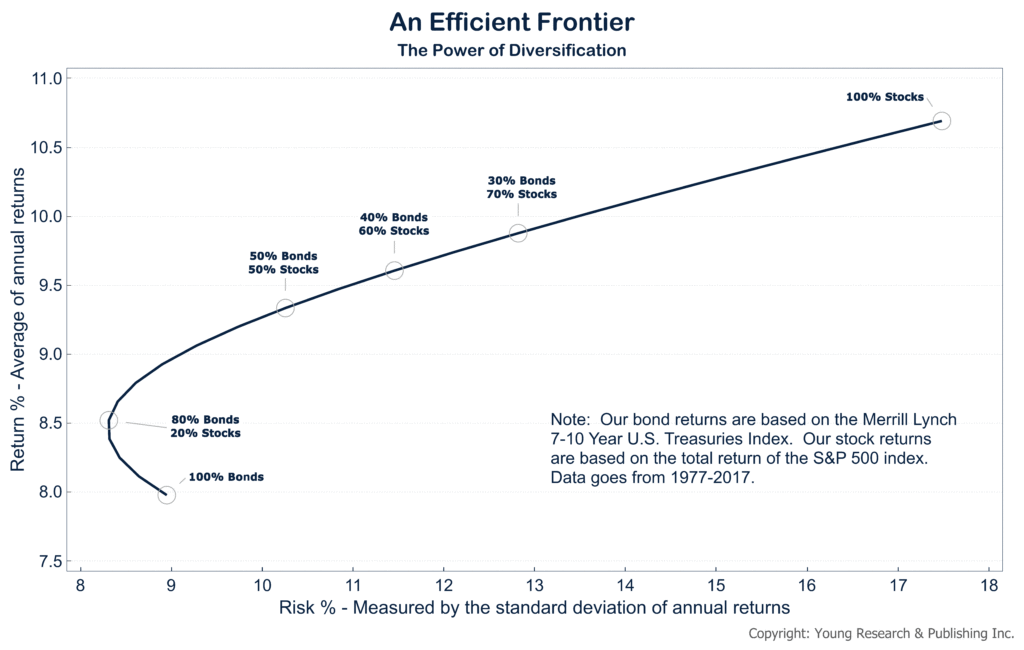
Diversification isn’t only a tool to minimize losses when assets fall in value, it has the power to actually increase your return while lowering risk. Here’s how I explained it in December of 2015 (with the chart and associated text updated to 2017):

Calculating the Efficient Frontier

You need to look at your asset deployment from the top down, focusing on diversification between stocks and bonds. My Efficient Frontier display shows you the power of diversification. Note the left-to-right uphill slanting curve that initiates with a position of 100% bonds and terminates with a position of 100% stocks. We have made our calculations using the Merrill Lynch 7-10 Year U.S. Treasuries Index and the S&P 500 total return index from Young Research for the period of 1977– 2017. We calculate the Efficient Frontier by using annual returns and assuming annual rebalancing.

Draw 1% per Quarter

Where is your best fit along an Efficient Frontier? To answer, you must first establish your ability to absorb risk in the hunt for returns. For decades I have written that in retirement, your target should be a 1% per quarter draw from your portfolio, and not a penny more. This does not mean, however, that you should not position yourself to potentially exceed 1% per quarter returns. Your actual return over any quarter will be controlled largely by the climate of the financial markets at the time, which neither you nor I control. And the climate itself will be determined by the stage of the economic and monetary cycles. I have studied these cycles over five decades and keep you updated regularly. The winter stage of the upside economic and monetary cycle is here, to be followed by a period of discomfort in the economy and the financial markets.

If you need help creating a well-diversified portfolio, fill out the form below. If you do, a trusted senior member of my family run investment counsel team will contact you. You will be offered a free, no-obligation portfolio review and an explanation of how we can help you achieve your investing goals.

Filed Under: Investing Strategies

With This Plan You Can Save More in 8 Years than in 32 Without It

September 6, 2019 By Richard Young

In October of 1999 I explained why there is only one right way to save; early and often. I wrote:

Compound Interest: Your Key to Wealth

Here’s an example of the power of compound interest that I hope you will pass on to your children and grandchildren.

We have two hypothetical investors, Chad and Tad. Chad starts right out of his MBA program investing $1,200 a year starting at age 25 through the time he is 32-years old. He makes eight $1,200 investments. Chad then oddly becomes a monk, ending his savings days. Assume just a modest 9% annual return through age 64, just pre Chad’s 65-year age retirement from monkdom. Chad’s eight years of savings ($9,600) and 40 years of compounded interest provide a final balance of $227,390.

Tad, on the other hand, spends his early years as a ski bum in Telluride and doesn’t start saving until he is 33. But from age 33 until age 65, Tad is able to save $1,200 a year from his job as wildlife conservationist in the remote reaches of Montana. He puts away $1,200 a year for 32 years, giving him a total savings of $38,400—four times the contributions Chad made in only eight years of savings before monkdom. Tad’s balance at the same 9% assumed growth rate is $214,560. Even though Chad invested $1,200 a year for only eight years early in his “career,” because of 40 years of compound interest, Chad’s final savings total beat Tad’s, who diligently socked away the same $1,200 a year, but for a long 32 years.

Such is the power of compound interest. Save early. Save often. And do not compromise your capital. When you lose 50%, you must make 100% on your next investment just to get even. And at that, you have a zero return. That’s stinko math in my book.

So after just eight years of early saving, Chad used compounding to save himself more than Tad could in 32 years of trying to play catch up. Put the power of compounding to work in your portfolio. Investing in companies with generous dividends, and records of regularly increasing those dividends is a bedrock strategy of my family run investment counsel firm.

If you would like to discuss how a dividend-centric investment plan could work for your retirement, please fill out the form below. You will be contacted by a seasoned advisor from Richard C. Young & Co., Ltd. and given a free, no-obligation portfolio review.

Filed Under: Dividends & Compounding

Don’t Be Shaken Out of the Market on Bad News

August 30, 2019 By Richard Young

There are many investment maxims worth repeating, but one especially important today is don’t be shaken out of the market on bad news. Those are the ten words of advice I gave to investors back in June of 1991 in the midst of a recession, and I haven’t found a reason yet to doubt their value.

I told readers then:

The best time to make money in the business cycle is when recession is in place. Interest rates always decline during a recession, just as they have in the present one. And the stock market always explodes with its biggest cyclical gains during the heart of recession.

When was the low for the Dow in the current business cycle? It was last October with the Dow reading below 2400. Many investors busily sold common stocks last August as military hostilities broke out in the Middle East. That, of course, is the kind of move that kills nervous investors in every cycle. You don’t want to be a seller on bad news, and you certainly don’t want to trade out of stocks in a weakening business environment. Open your history book and you’ll find that every recorded bull market started in the teeth of recession.

Recently I began a monthly business cycle review asking “Is America on the Doorstep of Recession?” My answer today is no, but I hope you will follow along with me as I examine the evidence each month.

Don’t be shaken out of the market on bad news. Remain invested or you’ll miss the market’s best performance.

Filed Under: Investing Strategies

Can You Double Your Money in a Year? Fail at this, and You May Need To

August 28, 2019 By Richard Young

Can you double your money in a year? Not many people can. But if you lost 50% of the value of your portfolio, that’s exactly what you would need to do just to make it back to even.

If the prospect of trying to double your money sounds unappealing, I suggest you try not to lose that much in the first place. On this topic, I wrote in November 1994:

Unchanged Since the Twenties

According to BBC television, the Classic Coke bottle, the VW Beetle and AGA Cooker are the three finest industrial design achievements of the 20th century. You know the Classic coke bottle, you know the VW Beetle, but the AGA Cooker?

Contemporary stoves pale by comparison to this handcrafted, cast iron cooker that quickly becomes the heart and soul of any kitchen it inhabits. Available in a handful of vibrant enameled color, the heavily insulated, gas-fired AGA has no temperature controls and is always on.

In most kitchens, 80% of cooking is done on the stove top and 20% in the oven. With an AGA, the reverse is true—80% or more is done inside. Externally vented ovens prevent cooking smells from returning to the kitchen, while gentle radiant heat produces superb cooking results—never, ever dried out.

The AGA works on the principle of stored heat within the well-insulated cooker; your job is to simply choose the temperature you want from one of four separate ovens.

This timeless, handcrafted work of beauty, functionality and simplicity was designed over 70 years ago and remains virtually unchanged since the 1920s. For more info on the incomparable AGA Cooker, [visit www.aga-ranges.com].

Timeless describes the AGA’s design, and timeless is the first word I use to describe my investment principles for you. I hope you will embrace my timeless set of investment principles; they will allow you a lifetime of investment rewards.

As a serious, long-term investor, I want you to always consider risk before profits. Never forget, when you lose 50% on an investment, you must double your money next time out just to get even. And even then, you have earned zero return.

Reducing risk in your portfolio is the best way to prevent wild swings that could generate losses you can’t come back from. Focusing your efforts on diversification, dividends and interest, and on companies in industries with high barriers to entry can help you reduce risk in your portfolio. It’s hard to double your money in a year, but it’s easy to get started on reducing risk in your portfolio today.

Filed Under: Investing Strategies

The Three Best Retirement Decisions I Ever Made

August 23, 2019 By Richard Young

In April of 2004, I explained to readers three decisions about retirement that I was very happy to pass on. I wrote:

Long ago, I made three decisions that I am happy to pass on to you regarding retirement: (1) Don’t. (2) Live in a warm weather state. (3) Live in a warm weather state without a state income tax and with a homestead exemption. My clear choice for #2 and #3 was and is Florida. We’ve been homestead exemption Key West residents since 1992.

Debbie and I have traversed the complete 360 degrees of Florida. We don’t travel inland much. After all, if the choice is being near the water or not, it’s a no brainer, don’t you think? In that I write specifically to business owners, retired investors and conservative investors soon to be retired, all can benefit from my ongoing Florida intelligence seeking.

You probably want to stop working eventually. And you may enjoy the cold weather. And you may even enjoy the mountains more than the water. Even if you disagree on the three points I explained back in 2004, it’s important that you find the right retirement plan for you, and that you begin working towards it today.

If you need help achieving your retirement goals, my family-run investment counsel firm can assist you. If you fill out the form below, you will be contacted by a seasoned member of my staff, who will discuss your retirement plan with you, and provide you with a free, no-obligation portfolio review. We can help you achieve your retirement goals, even if they are different than mine.

Filed Under: Investing Strategies

The Final Richard C. Young’s Intelligence Report

August 19, 2019 By Richard Young

After meeting monthly strategy report deadlines since 1978, I have decided it’s time to switch gears.

The name Intelligence Report will survive, but with no contribution from Richard C. Young.

Instead, I am transitioning aggressively to full-time research on behalf of private clients of our family investment management firm, Richard C. Young & Co. Ltd.

In this expanded venture, I will completely shift away from common stock mutual funds. I will concentrate laser like on “Dividends Around the World” from domestic and foreign common stocks with track records of increasing dividends for at least the last decade.

The Return of Young’s World Money Forecast

Supporting my international intelligence gathering and research efforts will be the return, after nearly a four-decade hiatus, of Young’s World Money Forecast (YWMF). I will be using YWMF techniques, gathered on Wall Street in the late sixties and early seventies, to provide breaking trends years ahead of the crowd. Here I am looking at a mix of inference reading and anecdotal evidence gathering based on my annual over 15,000 domestic miles on the road as well as at least two research forays to Europe each year.

Although I will not be making my portfolio management and specific dividend stock advice available at youngsworldmoneyforecast.com, I will be presenting regularly updated and customized information on all the dividend-paying stocks I’ve advised on over the years as well as input on every stock in the DOW 30. (Check back here regularly for date of site opening.)

A veritable treasure trove of intelligence will be at your fingertips daily—thanks to our unique $30,000/year database. You’ll feel as if you have arrived at a private investment club after all the years you have spent with me and the “monthly printed word.” Among the plethora of improvements you will experience with YWMF online is an enormous timing advantage. You’ll be able to access ongoing regular and actionable dividend stock updates from me in real time, rather than wait for the archaic snail mail. That’s one of the forward looking conclusions I came to when deciding to shut down my monthly deadline and dated in-the-mail effort.

My concentration will continue, as it has been over the decades, on strictly dividend-paying, dividend-increasing stocks. I, however, am making a clean break from the common stock mutual fund universe that I have been deeply involved with since the early sixties. Many of my long-time favorites have become too big for their own good or for that matter anyone else’s. Many funds have failed to keep up on many fronts, including expenses. I abhor the stupidity and self-serving interest of multiple portfolio managers. This dreadful and obfuscating transition has everything to do with dinosaur status and size limitations rather than you the investor. I will continue researching fixed-income and balanced portfolios, where I continue to find great value in individual manager input.

Ben Graham (the all-time dividend maven) was fond of stating: “One of the most persuasive tests of high quality is an uninterrupted record of dividend payments for the last 20 years or more. Indeed the defensive investor might be justified in limiting his purchases to those (stocks) meeting this test.”

The Road Ahead in Real-Time

Well there you have it—my transformation from delayed and printed monthly copy to a rapid-fire, digital presentation (not in audio or books, of course) is now in the exciting kickoff phase.

As my online dividend intelligence program develops steam, I will be able to refine and improve upon my efforts since I am no longer constrained by a once-per-month communication. What was especially frustrating was the obvious, but perhaps not fully recognized, 10-day delay from the time I finished writing Intelligence Report to the time you, as a subscriber, received my finished report.

Today and in the future, any time I have a breaking idea, it will be available for your use immediately at YWMF. That has to have a pretty good sound to you. It sure does to me.

Thank you for your years of loyalty. I have worked diligently for over five decades on behalf of private client investors just like you. It is exciting that we can all transition together to a whole new and powerful world of compounding, (more here on compounding) profiting and sleeping soundly investing in the high-octane power of long term “Dividends Around the World.”

Warm regards,

Richard C. Young

P.S. I wrote in the May 2015 issue of Intelligence Report about Ronald Read, who despite working as a janitor was able to use the power of compounding to amass an $8 million fortune by the time he passed at the age of 92.

Pumping Gas to the Tune of $8 Million

Hard to even comprehend, but this great story, courtesy the WSJ’s Anna Prior, recounts how Ronald Read accumulated an estate valued at almost $8 million. Mr. Read, who passed away at the age of 92, made a modest living pumping gas for many years at a Gulf gas station in Brattleboro, Vermont.

A Five-Inch Stack of Stock Certificates

How did Ronald Read manage to become a multi-millionaire? Mr. Read invested in dividend-paying blue-chip stocks. As Ms. Prior writes, Mr. Read took delivery of the actual stock certificates and “left behind a five-inch-thick stack of stock certificates in a safe-deposit box.” At his passing, Mr. Read owned over 90 stocks and had held his positions often for decades. The companies he owned paid longtime dividends. And when his dividend checks came in the mail, Ronald Read reinvested in additional shares. Apparently Mr. Read was the master of the theory of compound interest. Not surprising, his list of stock holdings included such dividend payers as Johnson & Johnson (NYSE: JNJ), Procter & Gamble (NYSE:PG), J.M. Smucker (NYSE: SJM), and CVS Health (NYSE: CVS), all names I write about for you here. No high flyers for Ronald Read, and certainly no technology names.

Protect, Preserve, Patience, Perspective

Obviously Ronald Read had been a staunch practitioner of my PPPP theme, featuring the basics—Protect, Preserve, Patience, Perspective. This WSJ feature article hit the press at the perfect time for me and you, as I’ll now explain. For the first time since I created my Monster Master List—well over a decade ago—I have given the Master List of common stock names a complete overhaul. I have spent weeks in the process with the goal of giving you not only a roster of dividend payers but also a list where every core company has increased its dividend for a minimum of 10 consecutive years. I have rounded out the core list with a handful of special situation dividend payers.

Originally posted on August 14, 2017.

Filed Under: Ben Graham, Breaking News, Graham & Russell Tagged With: Compound Interest, Dividends, Intelligence Report

  • « Previous Page
  • 1
  • …
  • 12
  • 13
  • 14
  • 15
  • 16
  • …
  • 29
  • Next Page »

Compensation was paid to utilize rankings. Click here to read full disclosure.


RSS New From Young Research & Publishing

  • Are You Getting Out There: Portugal or PEI?
  • 65 Years of Compounding: No Changes
  • Eroding Production: Russia’s Oil Industry Enters a New Era
  • U.S. Retail Sales Rise 5% From Year Ago Despite July Dip
  • Trump Looks to Squeeze Iran’s Economy Once Again
  • National Laboratories Set for Major Operational Reforms
  • Your Survival Guy’s RAGE Gauge: The Tables Are Full
  • Blue Moon Builds Out in Critical Minerals
  • Falling Energy Prices Keep U.S. Producer Inflation in Check
  • America’s Natural Gas Boom Hits New Record

RSS New From Your Survival Guy

  • Are You Getting Out There: Portugal or PEI?
  • Your Survival Guy’s RAGE Gauge: The Tables Are Full
  • CAUGHT IN A VICE: Private Equity Is the Next Big Thing Coming for YOU: Part XXIII
  • Delinquencies Rising: Concerning but Not Yet an Emergency
  • The Reliability of Nuclear
  • Market Volatility Giving You the Summer Blues?
  • Judge Blocks Mamdani’s Tax, for Now
  • WALK AWAY: Private Equity Is the Next Big Thing Coming for YOU: Part XXII
  • LIQUIDITY: Is Private Credit Liquid Enough for Retirement Investors?
  • The Value of Diversification

Search Our Site

Richard C. Young & Co., Ltd.

–Client Letter Sign Up–

Sign up to receive email alerts when our latest client letter is posted on our website.

Disclaimer:

The information contained here is for informational and educational purposes only. It is not intended nor should it be considered investment advice or a recommendation of securities. Past performance is not a guarantee of future results. It is possible to lose money by investing. You should carefully consider your investment objectives and risk tolerance before investing.

Copyright © 2026 · About Dick Young · Terms & Conditions


Loading Comments...