
• ABOUT – DICK YOUNG
  • YWMF – ARCHIVES

Young's World Money Forecast

Since 1978 With a 32 Year Vacation

  • DICK YOUNG
    • FROM RICHARD C. YOUNG
    • THE FINAL INTELLIGENCE REPORT
  • INVESTING STRATEGIES
    • RETIREMENT COMPOUNDERS®
    • GOLD & SILVER
  • DIVIDENDS & COMPOUNDING
    • MIRACLE OF COMPOUNDING
    • DIVIDENDS
  • GRAHAM & RUSSELL
    • BEN GRAHAM
    • RICHARD RUSSELL
  • THE DOW AND THE LEADERS
    • DOW vs. S&P 500
    • DOW vs. DOW DIVIDEND PER SHARE
  • WELLINGTON MANAGEMENT COMPANY
  • YOUR SURVIVAL GUY
  • BANK CREDIT & MONEY
  • THE PRUDENT MAN

You Want the Limo, Not the Public Bus

June 12, 2020 By Richard Young

Dick Young, Paris, France

Your investing future does not have to be relegated to a public transportation type of experience. You have a choice. And you can go in first class comfort or, instead, take a seat in the back of the bus. Here’s what I mean.

To start, don’t spring for yesterday’s investments – stock index funds or most equities centric funds. Don’t settle for government bonds that pay virtually nothing today, or for casino-like big S&P 500 stocks that pay no dividends but often sell for criminal market cap-to-sales ratios.

By now you undoubtedly realize that robo-advisors, whatever they are, offer zero value.  “Advisors” manning the phone desks at massive fund groups are often kids about your grandkids’ ages. And you sure don’t want the investment products larded with sales charges from planners and wirehouses. That’s sure no way to travel.

At our family owned investment counsel firm, we offer a blue-chip option where you can find comfort amongst kindred spirits. We have decades of experience in personally consulting with conservative families and small business owners planning for a secure retirement or perhaps already in retirement.

Our family owned counsel business, unlike industry behemoths, offers the maximum in flexibility in dealing with, for example, bonds. Being nimble is the last thing you’d say about enormous mutual funds. Our company’s size and expertise allow us to capture opportunities in a wide range of fixed-income markets – municipals, treasuries, corporates, high-yield, loans, mortgage-backed securities, and, should the opportunity arise, even foreign currency denominated bonds.

Investing in a bond mutual fund today is akin to commuting to work on the bus.

The Good and Bad News

The good news:

  • Someone else drives.

The bad news:

  • The bus won’t be leaving when you want to leave.
  • The bus is on its inflexible schedule, not on yours.
  • The bus won’t pick you up at your doorstep or avoid traffic jams.
  • The bus won’t be swinging by the pharmacy after work so you can pick up your prescription.

The bus rules. Bus rules are for the benefit of all riders. Period.

Mutual funds offer a similar experience. For example, fund managers are often restricted in what they can buy. This means, when you invest in a fund with a medium-term maturities mandate, you will get exactly that – medium-term maturities. It doesn’t matter if short-term corporates are more attractive, if high-yield bonds are offering the opportunity of a lifetime, or if there is simply too much risk in medium-term corporates for a given level of return. You signed up for medium term maturities corporates and that’s what you’re going to get.

The burden of specific decision making is on your shoulders.

At RCY, Ltd., we are not burdened by fund constraints. Let me give you an example. Early this year almost half the assets of our bond portfolios were in Treasurys. In February and March, as the economy ground to a halt and yields on corporate bonds soared, we shifted gears moving en masse out of lower yielding Treasurys and into much higher yielding corporates. Our clients think of us as the black car limo service of bond investing, rather than one-for-all public transportation.

In April I made my initial individual bond purchase under my new buying program.  I bought the new issue Weyerhaeuser bonds. Weyerhaeuser, a large forest products company, owns 12-million acres of Timberland, making it one of the largest private landowners in America. Weyerhaeuser bought my old favorite Plum Creek, which you probably remember from my strategy reports.

The Weyerhaeuser bonds I purchased have a 4% coupon and mature in 10 years. The individual investor is a babe lost in the wilderness when it comes to hunting down individual bonds for a bond portfolio.

How about new issues? Forget it. I have been involved in this market since 1971, and I can assure you that individuals have no place even considering entering that fray.

As of the end of March, Weyerhaeuser had $5 billion in net debt (debt after deducting cash). If you divide the $5 billion debt by the firm’s 12 million acres of timberland, there is $400 in debt held against each acre of Timberland. Assuming no other assets or liabilities, as long as Weyerhaeuser’s land is worth more than $400 per acre, bondholders likely would be made whole in the event of default. This, of course, is a back-of-the-envelope calculation, but we like the margin of safety the company’s land provides.

I have always remained fully invested in a counter-balanced, widely diversified portfolio.  I don’t jump in and out of the market. The word I emphasize here is balance. Here’s why, along with my firsthand experience of what happens when counterbalancing (balance plus) is not in force.

Back in the old days, most Harley engines were bolted directly to the frame. Talk about vibration and calamity. With constant vibration, nuts and bolts tend to loosen and fall off on an all too regular basis. On long-distance road trips, breakdowns in, say, the Canadian Rockies, are cause for concern. Today’s Harleys feature counterbalanced engines offering both a smooth ride and a minimum of road-trip calamities.

To enjoy a smooth ride in the financial markets without the constant threat of financial calamity/vibration, I have long-advised Wellesley (65/35 bond) and Wellington (65/35 stocks) funds. Sadly, both have exploded in size. turning into far less attractive options for new money.

Not a Single Double-Digit Down Year

Since bond-heavy Wellesley first opened in 1971, it has not suffered one double-digit down year. Not a single one.

The chart below shows the return of the balanced Wellesley (as well as Wellington) in each down-market year since 1970 (Wellesley’s inception year).

During this same period, the S&P 500 stock index experienced 10 down years

(As a side note: I no longer advise most index funds, and certainly not funds indexed to the S&P 500.)

Wellesley declined in only four of those years. And with the exception of 2018, balanced Wellesley’s declines were only a quarter of the decline in the S&P 500 stock index.
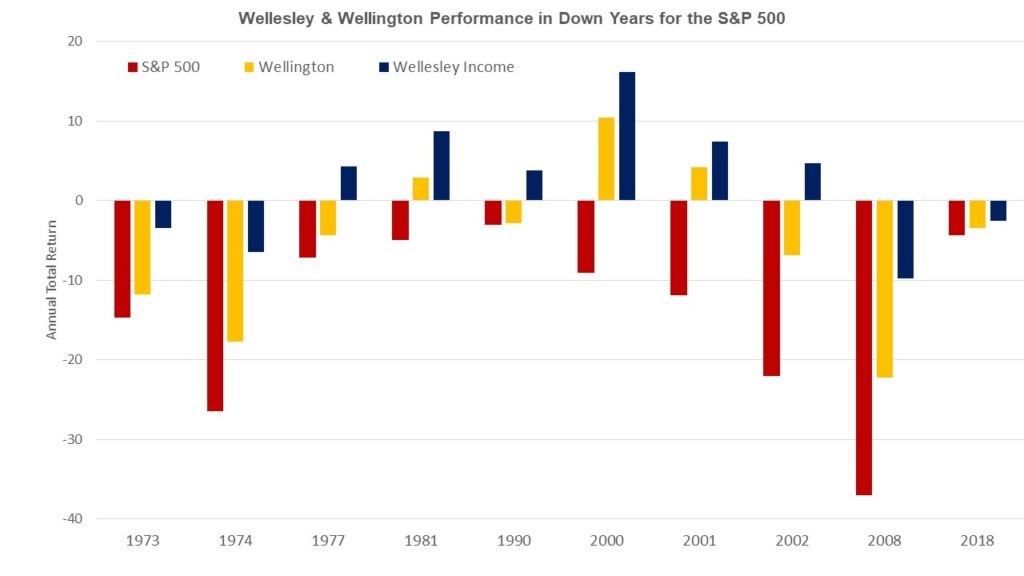
Since the balanced Wellesley’s first full year in operation, the 65/35 (bonds/stocks) fund declined in only seven years. That’s a .857 batting average. The best hitters in major league baseball rarely hit .400.

With the exception of 1973, in each year following a Wellesley annual decline, balanced Wellesley has been up double digits.

Here is a scary Wellington liquidity fact. In order to maintain a passive stake in a purchased stock of no more than 3% of the outstanding shares, Wellington today is confined to stocks with a market value of at least $73 billion. That’s a minuscule field. Formerly suitable funds have today become too big for their own good.

Today, in 2020, there are just 80 U.S. companies with a market value of $73 billion or more. This mini group compares to the more than 5,000 U.S. companies with a market value over $100 million.

I am retired from the newsletter writing business. As chairman of our 100% family-owned Investment counseling firm, Richard C. Young & Co, Ltd., I now work full time (yup) on global investment strategies. Ltd. has been in business for over three decades and our company works personally with families and small businesses across America.

Today I concentrate on individual stocks and bonds as building blocks for my own portfolio, as well as for clients. During the coronavirus disruptions, I am fast on the trail of investing in exactly the type of big blue chips I have advised through the decades for my strategy report subscribers. Looking to the future, these individual blue chips will be the focus of my own personal investing, as well as that of our company.

I’d like you to join me and my family. Balance, patience, and compounding (BPC) offer so much.

Investment counseling is as deeply personal as it is private. And solid relationships, as you probably know from your life’s endeavors, count for much. Why not let us take the load of day to day investing decision making off your shoulders.

Richard C. Young & Co, Ltd. is but a phone call away. Call (888) 456-5444 today while the matter is fresh on your mind. You’ll be glad you did.

Warm regards,

Dick Young
Filed Under: Investing Strategies

Trump Cavalcade Drives America Back to Business

June 8, 2020 By Richard Young

Debbie and I have traveled up the East Coast countless times over the last many decades. On every trip, we take inventory of the health of America’s small-town Main Streets, pedestrian activity in towns, and truck activity on the highways, among many other inference reading signals.

Last Friday we were traveling again. That day, news dropped of the record-setting job gains in May. The stock market soared, with the Dow Jones Industrial Average closing up 829.16 points.

While liberal economists like Paul Krugman wrote the report off as a conspiracy theory, the evidence of America’s jobs resurgence was right in front of Debbie and me. As we drove on the highway, we witnessed far more truck traffic than on any trip we had ever taken. It was the Trump cavalcade, driving America back to business. Especially noticeable was the vast number of trucks carrying lumber to mills and job sites.

The pictures below represent a fraction of the trucking activity we witnessed through Pennsylvania and beyond.


This slideshow requires JavaScript.


Kate Andrews reported on the record-breaking numbers for Spectator USA, writing:

The US economy created 2.5 million jobs last month — the biggest monthly jobs gain since records began a century ago, albeit only a partial recovery from 22 million jobs lost during lockdown. These figures have blown expectations out of the water. Economists were expecting yet more unemployment: the consensus was an 8.3 million rise in unemployment hitting 20 percent in May, up from 14.7 percent in April. Defying the odds, unemployment actually fell to 13 percent, signaling an unexpectedly early start of the rebound of the US economy. The biggest winners were workers in hospitality, who made up almost half of the new jobs, followed by construction. ‘This is a mind-blowing number and shows that the economy is improving,’ said Naeem Aslam, chief market strategist at AvaTrade.

US unemployment still stands at 13 percent, but a recovery of this scale had not been expected. ‘It seems the damage to the nationwide lockdown was not as severe or as lasting as we feared a month ago,’ said Scott Clemons, chief investment strategist at Brown Brothers Harriman. For some time now, the stock market has looked as if it was expecting a V-shaped recovery, the likes of which started today with the FTSE100 up 100 points. Its future looks brighter still, as the new jobs data has indicated an ‘open of nearly 600 points higher for the Dow Jones Industrial Average’. It seems in America, the jobs recovery could be V-shaped too.

For more on the COVID-19 economic crisis and recovery, read here:

  • Dividend “Suspensions” Not Dividend Cuts Coming Fast
  • Working Seven Days a Week in Sunny Key West

Filed Under: Investing Strategies

Here’s How Tiny Sweden Beat China

June 4, 2020 By Richard Young

Tiny remote Sweden, partially sitting in the polar region, is home to only a little over 10 million souls. China, meanwhile, is a massive country, home to nearly 1.4 billion. You may not think Sweden would have the wherewithal to defeat China in any theater of competition, but in one growing industry, Sweden is prepared to dominate its Chinese rival.

In the race for 5G technology leadership, Sweden’s Ericsson may be about to best China’s Huawei. Or, more accurately, Huawei’s ties to China’s Communist Party government are about to blow the technology company’s chances of a worldwide 5G expansion.

Stu Woo reports for the Wall Street Journal:

The Trump administration’s increasingly aggressive effort to cripple China’s Huawei Technologies Co. has presented Ericsson AB the opportunity to lead the rollout of 5G technology around the world.

The Swedish company is emerging as the steadiest player in the $80-billion-a-year cellular-equipment industry, telecommunications executives and analysts say, because it makes a technically advanced product that one rival, Nokia Corp., was late to develop and that Huawei may not be able to make in the future because of recent U.S. measures.

While its competitors try to recover, Ericsson is moving forward after a costly years-long restructuring has returned it to profitability. “The first step is for sure accomplished,” Chief Executive Börje Ekholm said. “The next step is to find longer-term growth for the company.”

The question for Ericsson is figuring out which technologies of tomorrow to bet on. Ericsson is testing equipment in several fields that 5G’s superfast wireless speeds promise to unlock, such as driverless cars and remote-control mining machinery.

Washington is lobbying foreign countries to ban Huawei, saying Beijing could direct the company to spy on or sabotage communications. 

I have followed Ericsson on and off for decades. I wrote in late 2011:

Sweden is a global telecommunications giant. EWD owns shares of Ericsson and TeliaSonera, both telecom powerhouses in their own right. Ericsson’s networks are the conduit for 40% of the world’s mobile traffic, serving over two billion subscriptions. Ericsson has built a technology portfolio of over 27,000 patents.

Today Ericsson has the largest portfolio of patents in the industry, with 54,000 granted patents. It is a global 5G competitor with or without sanctions on Huawei. But with the U.S. campaign against Huawei, Ericsson is set for much easier expansion.

I’m not suggesting you invest in Ericsson today, but I am suggesting that you pay attention to the geopolitical risks an investment in a company like Huawei might produce. Companies wrapped up in the affairs of their country’s government are often affected by the political dramas surrounding them. That’s why, in this case, Ericsson, from tiny, mostly neutral Sweden, can compete with Huawei, which hails from the world’s most populous and second-largest economy.

At Richard C. Young & Co., Ltd., my family-run investment counseling firm, preference is given to investments in companies from countries with free markets and governments that help business by getting out of the way, not by trying to control it.

If you would like to learn more about our investment philosophy, please sign up for our monthly client letter by clicking here or schedule a free no-obligation appointment with an investment specialist by clicking here. We look forward to speaking with you.

Filed Under: Investing Strategies

Harley-Davidson in Transition, Probably a Takeover Target

June 1, 2020 By Richard Young

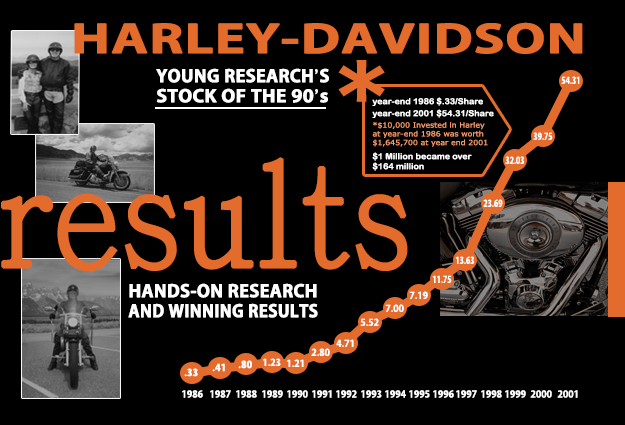
Debbie and I have put over 100,000 miles on our Harleys riding across the United States and Canada. My riding days are behind me, but as a devotee, I keep an eye on Harley’s business, as I have for years. If you’re one of my long-time readers, you know Harley was Young Research’s stock of the decade in the 1990s.

In June 1998, I and millions of Harley-Davidson fans celebrated the company’s 95tht anniversary. I wrote then:

For about $18,000, you can be astride a classic American cruiser, the Harley-Davidson Road King—if you can get one. This summer Debbie and I will ride our Harleys from Key West to Nova Scotia before our trip to Glacier National Park and back to Sturgis, South Dakota, for the world’s biggest annual gathering of the Harley faithful. At Milwaukee’s Summerfest grounds on June 13, Harley-Davidson (NYSE: HDI) will have its 95th anniversary celebration reunion. Once again, there is a lot to celebrate. Over the last year, Harley’s stock has nearly doubled. Over the last five years, as my most recommended stock, Harley-Davidson has provided an average annual total return of nearly 30% per year.

As both an investor and rider, I have a long history with Harley-Davidson. Harley’s core market peaked years ago, and so did bike shipments, but management continued to chase the prospect of growth.

That strategy failed.

Harley is now scaling back production and focusing on its bestselling models.

 The WSJ reports:

On an earnings call last month, Mr. Zeitz said expanding the motorcycle lineup and chasing new markets diverted attention from Harley’s more profitable models and made factories too complex. He said the production revamp is warranted by deteriorating demand for motorcycles. New models that would have made their debut this summer will roll out early next year instead, he said, on a new schedule of releases before the peak spring buying season begins.

By having fewer motorcycles in the market, Harley said it is trying to appeal to customers of premium-priced brands with limited availability. That approach is common among makers of sports cars and some luxury products that keep manufacturing volumes well below demand for them.

“Our strategy to limit motorcycle product in the showroom is purposefully designed to drive exclusivity,” Ms. Truett said in her memo.

Harley is reopening its plants in Wisconsin and Pennsylvania this week and said it would accelerate production in phases. The motorcycles that Harley will start making again this month will be limited to bestselling models in a limited palette of colors and without customizable features for the remainder of the year, Ms. Truett wrote.

The future for Harley is as a niche player with a shrinking but dedicated consumer base. That strategy may work in the public markets, but would be much more suited as a subsidiary of another firm. Polaris seems like a natural fit.

Filed Under: Investing Strategies

Happy Memorial Day!

May 30, 2020 By Richard Young

Filed Under: Breaking News

An Alternative Approach to Investing when Markets are Down

May 12, 2020 By Richard Young

In 2008, when investing seemed like an exercise in futility to many investors, I explained an alternative approach. This approach has worked for me now for over five decades. I learned this method from the teachings of Ben Graham, and have successfully employed it my entire career. Here’s what I wrote:

Concentrate on Shares, Not Price…

The stocks and funds you own pay you dividends based on the number of shares you own, not on the price of those shares. Unless you are fortunate enough to be Gandalf redux, it is likely that the price of most of the shares you own in 2008 is down hard, to be kind. I sure know I’m in that boat. The number of shares I own, however, is not down. In fact, the dividends I will be paid in 2008 (despite Depression-era pricing) will be up. And if you have invested along with me, the number of shares you own and your flow of dividend cash will be up as well.

All Pay Interest—No Defaults

As for my fixed-income investments (advised for you monthly in these strategy reports), each (100%) continues to pay interest at just the level promised and on time. I own no defaulted issues, nor do you—if you have followed my advice to a T.

Invest for Dividends & Interest

I invest—as should you—to receive dividends and interest for compounding. I do not invest to sell my shares to someone else at a higher price, nor should you. If you invest to finance a comfortable retirement cash flow, your 100% concentration must be on dividends and interest, not on price action. My baseline advice for conservative, retired and soon-to-be retired baby boomers is 50% intermediate and short fixed income (investment-grade only), 45% dividend-paying blue-chip equities and/or funds, and 5% gold (NYSE-listed ETF GLD). I do not offer advice for non-conservative investors and those with a trading or speculative mentality.

Today investors around the world are again facing a struggle to preserve their lifelong accumulated wealth. A dividend-centric portfolio focused on income is still my preferred strategy for conservative, retired, or soon-to-be-retired investors.

In April, I explained that I see some dividend suspensions coming, but that the coronavirus-assisted drop in stock prices may be a great time to accumulate stable long-term dividend payers. I also explained my recent three-week-long investing program.

For those looking for a more in-depth view of some strategies my family-run investment counsel firm is using, I encourage you to read the latest client letter from my son Matt, President and CEO of Richard C. Young & Co., Ltd.

If you would like to receive an alert every time the new Richard C. Young & Co., Ltd. client letter is published, please click here to sign up. Delivery is free, even for non-clients.

Filed Under: Dividends

The Fed Has a 100% Error Rate

April 27, 2020 By Richard Young

Much like the terrorist attacks of September 11, 2001, the coronavirus has revealed an overvalued market to investors. The blame for this overvaluation lies with a Federal Reserve that has so distorted interest rates, the view of risk has become clouded. A few years ago, I wrote:

In End the Fed, Ron Paul writes, “The essence of the Federal Reserve Act was largely unchanged from when it was first hatched years earlier. With a vote by Congress, the government would confer legal legitimacy on a cartel of the largest bankers and permit them to inflate the money supply at will, providing for themselves and the financial system liquidity in times of need, while insulating themselves against the consequences of bad loans and overextension of credit.”

Congress’ Most Tragic Blunder

Paul continues, “Hans Sennholz [Money and Freedom] has called the creation of the Fed ‘the most tragic blunder ever committed by Congress. The day it was passed, old America died and a new era began. A new institution was born that was to cause, or greatly contribute to, the unprecedented economic instability in the decades to come.’…

“In 1912, Ludwig von Mises wrote a book called The Theory of Money and Credit that was widely acclaimed all over Europe. In it he warned that the creation of central banks would worsen and spread business cycles rather than eliminate them.”

The Fed Has a 100% Error Rate

John A. Allison is president and CEO of the Cato Institute and former chairman and CEO of BB&T. During his BB&T tenure, John was the longest-serving CEO of a top-25 financial institution. In The Financial Crisis and the Free Market Cure, John explains that the primary sources of the massive misallocations of resources regarding the recent financial crisis are (1) the Federal Reserve, (2) FDIC, (3) Government housing policy, and (4) the SEC. As John points out, “In 1913, the monetary system of the United States was nationalized. The federal government owns the monetary system. We do not have a private monetary system in the United States.” John Allison continues, “In my career, the Fed has a 100% error rate in predicting and reacting to important economic turns.”

My friend John Allison’s words carry a special urgency today. The Fed has a “100% error rate.” It’s true. Every time the Fed sees a problem, it ladles out more monetary stimulus, driving asset prices upward and exaggerating the next meltdown.

The Fed’s wild responses to the slightest declines in stock market prices have become a real risk for which investors must account.

My family-run investment counsel firm has developed its own strategy for responding to the Federal Reserve’s recent actions. To read about them in detail, click here for the latest monthly client letter written by my son Matt, President and CEO of Richard C. Young & Co., Ltd.

Each month, Matt covers the strategies we employ at Richard C. Young & Co., Ltd. If you would like to be alerted each time a new letter is released, please click here to sign up. The letter is free, even for non-clients.

Filed Under: Investing Strategies

How to Deal with a Crisis You Can’t Predict

April 17, 2020 By Richard Young

Do you consider yourself well-prepared? There’s no predicting some scenarios— the so-called Black Swans. Below is a troubling illustration I wrote some time ago of just how bad facing the unexpected can feel:

Knock, Knock

It’s 1:30 a.m.—pitch black on your suburban porch. A woman whom you do not recognize is at your front door, while an unfamiliar car idles in your driveway. Peeking out, you talk through a side window to the interloper, who explains that you had called her, and here she is.

Your 1911 Handgun

You, of course, had not called her, and, as a phone call goes into the police, you—somewhat dazed and alarmed—consider the feasibility of reaching for your 1911 handgun. Not long back, in broad daylight and only a couple of miles from your house, there had been a raft of break-ins featuring families immobilized withduct tape (while robbers searched through belongings). Residents of the general area are on heightened alert.

Sweaty Palms

I don’t know about you, and I consider myself well-prepared and well-defended, but this type of “awakened out of a sound sleep” early a.m. door-knocking scenario makes my palms sweat. This is a true story relayed to me just days ago.

Is This Your Blueprint?

So we are looking at risk preparation here—no advance prep, no handy 1911, no nothing. Kids asleep upstairs, a terrified wife nearby, and you, with a blank stare, have a big goose egg on your preparation ledger. Is this the blueprint for you and your family? I know for a fact that this condition exists for a lot more families than not.

Black Swans

I write to you about financial and personal security, with the emphasis on risk analysis for both. For any given scenario, the first step is a complete understanding of all the elements of risk. Unfortunately, the game breakers are all Black Swan events that you cannot time accurately in advance. Nonetheless, preparation is warranted to cover the unexpected.

A home invasion is one of the most frightening and surprising events a family can endure. Also on the list of the terrifying and unexpected is the current global pandemic.

Few, if any, could have predicted today’s coronavirus and the economic turmoil it would cause.  But that doesn’t mean nothing could be done to prepare.

Investors especially had the chance to prepare themselves for the unexpected. Minimizing risk in portfolios with diversification is the best way to prepare your investments for uncertain times.

Each month at my family-run investment counseling firm, Richard C. Young & Co., Ltd., my son Matt explains our strategies for diversification and minimizing investment risk in our client letter. If you want to understand the methods used by one of America’s top-ranked investment advisors to address risk, sign up for a monthly alert for the client letter by clicking here. It’s free, even for non-clients, and loaded with information you can use to help achieve your investing goals.

Prepare, even for those crises you can’t predict.

Filed Under: Investing Strategies

Dividend “Suspensions” Not Dividend Cuts Coming Fast

April 2, 2020 By Richard Young

Dick Young, Paris, France

The liberal electronic and print media will shortly be howling – with cartoon-size bold headlines – about dividend cuts.

We just began the second quarter of the year. Third-quarter earnings reports will, thanks to the lying Chinese, be breathtakingly ugly. And the media will be out in full force glomming on to disruption.

Words like recession and depression will fill the media channels. Greedy and grasping stockbrokers will be out, in full-scale hyena mode, yelling, “sell, sell, sell.”

Serious, long-term, compound interest focused mavens will follow my lead by engaging in a quiet, month-long reallocation of assets.

Dick Young – a Compound Interest Maven

During the month of March, I positioned myself to accumulate assets others were eschewing or dumping en masse. Included on my watch list are stable long-term dividend payers temporarily placing their dividend payouts on holiday. Makes good sense to me. Business conditions are easily weak enough to make such a short-term stabilizing strategy a wise move.

Make it as good a day as you can.

Thanks to Donald Trump’s foresight on the scourge that is China, the folly of open borders, the mathematical naiveté of free trade, and the “America Last” fraud of globalization, America will snap back like a catapulted Navy Super Hornet off a carrier deck.

You can count it.

U.S. Navy photo by Mass Communication Specialist Seaman Apprentice Ignacio D. Perez/Released) 130424-N-TC437-663

Filed Under: Dividends

My Three-Week-Long Investing Program

April 1, 2020 By Richard Young

In my personal portfolio, I am ramping it up over the month of April into May.

My own largest fixed income holding (individual bonds, while clearly a superior option are not ideal for me as I am on the road and out of touch at annoying times) a full-faith-and-credit-pledge GNMA’s-centric fund is ahead by 3.0%, or an annualized 12.0%. I am happy with this.

GLD, one of my gold proxies is ahead by 6.5%, or an annualized 26%.

My Swiss currency proxy (I have been investing in Switzerland since the early seventies. Click to the Swiss Way) is up 1.4% YTD. Encouraging.

All in all, I am pleased and have recently been concentrating on the energy sector where Russia, Iran and the Saudi’s are getting killed and American shale assets and big energy dividend payers are a steal.

Let’s see where prices are in just five years and who the proven winners will have been.

My own buying program will continue at least into the summer.

Filed Under: Investing Strategies Tagged With: comp

  • « Previous Page
  • 1
  • …
  • 9
  • 10
  • 11
  • 12
  • 13
  • …
  • 29
  • Next Page »

Compensation was paid to utilize rankings. Click here to read full disclosure.


RSS New From Young Research & Publishing

  • Are You Getting Out There: Portugal or PEI?
  • 65 Years of Compounding: No Changes
  • Eroding Production: Russia’s Oil Industry Enters a New Era
  • U.S. Retail Sales Rise 5% From Year Ago Despite July Dip
  • Trump Looks to Squeeze Iran’s Economy Once Again
  • National Laboratories Set for Major Operational Reforms
  • Your Survival Guy’s RAGE Gauge: The Tables Are Full
  • Blue Moon Builds Out in Critical Minerals
  • Falling Energy Prices Keep U.S. Producer Inflation in Check
  • America’s Natural Gas Boom Hits New Record

RSS New From Your Survival Guy

  • Are You Getting Out There: Portugal or PEI?
  • Your Survival Guy’s RAGE Gauge: The Tables Are Full
  • CAUGHT IN A VICE: Private Equity Is the Next Big Thing Coming for YOU: Part XXIII
  • Delinquencies Rising: Concerning but Not Yet an Emergency
  • The Reliability of Nuclear
  • Market Volatility Giving You the Summer Blues?
  • Judge Blocks Mamdani’s Tax, for Now
  • WALK AWAY: Private Equity Is the Next Big Thing Coming for YOU: Part XXII
  • LIQUIDITY: Is Private Credit Liquid Enough for Retirement Investors?
  • The Value of Diversification

Search Our Site

Richard C. Young & Co., Ltd.

–Client Letter Sign Up–

Sign up to receive email alerts when our latest client letter is posted on our website.

Disclaimer:

The information contained here is for informational and educational purposes only. It is not intended nor should it be considered investment advice or a recommendation of securities. Past performance is not a guarantee of future results. It is possible to lose money by investing. You should carefully consider your investment objectives and risk tolerance before investing.

Copyright © 2026 · About Dick Young · Terms & Conditions


Loading Comments...