• ABOUT – DICK YOUNG
  • YWMF – ARCHIVES

Young's World Money Forecast

Since 1978 With a 32 Year Vacation

  • DICK YOUNG
    • FROM RICHARD C. YOUNG
    • THE FINAL INTELLIGENCE REPORT
  • INVESTING STRATEGIES
    • RETIREMENT COMPOUNDERS®
    • GOLD & SILVER
  • DIVIDENDS & COMPOUNDING
    • MIRACLE OF COMPOUNDING
    • DIVIDENDS
  • GRAHAM & RUSSELL
    • BEN GRAHAM
    • RICHARD RUSSELL
  • THE DOW AND THE LEADERS
    • DOW vs. S&P 500
    • DOW vs. DOW DIVIDEND PER SHARE
  • WELLINGTON MANAGEMENT COMPANY
  • YOUR SURVIVAL GUY
  • BANK CREDIT & MONEY
  • THE PRUDENT MAN

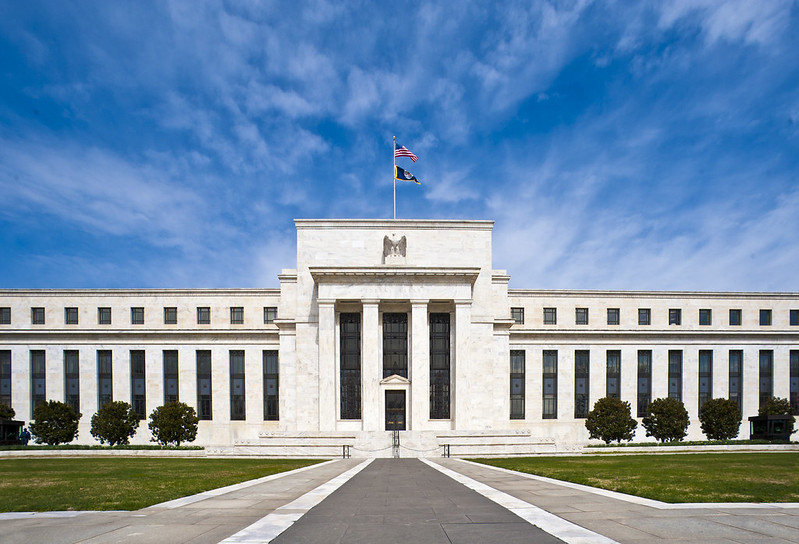
The Fed Should Be Careful with Lower Rates

January 7, 2026 By Richard Young

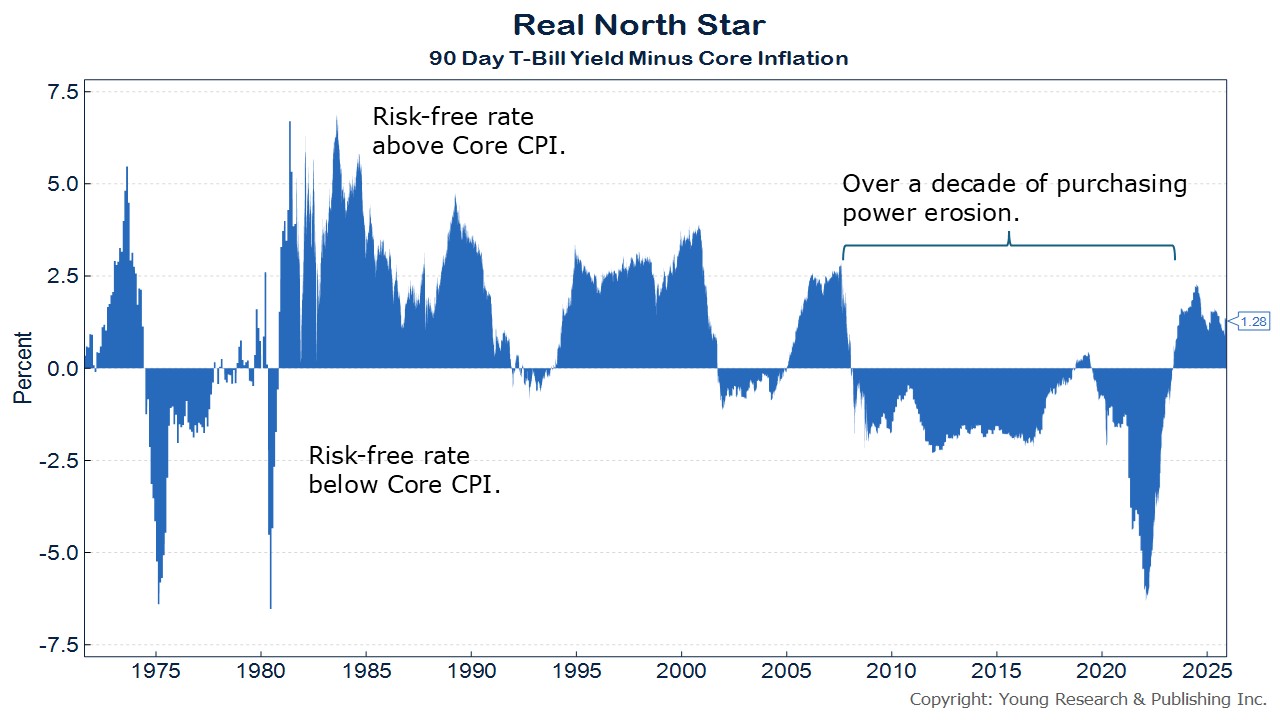
From August 15, 1971, the day President Nixon officially took America off the gold standard (the system had been breaking down for years beforehand) to September 17, 2007, the day before the Ben Bernanke-led Federal Reserve began what would be an unprecedented economic intervention in the face of the Financial Crisis, the mean interest rate of 3-month T-bills was 6.08%. For the 18 years following Bernanke’s intrusion on markets, it’s been 1.39%.

For decades, I have called the 90-day T-bill the investor’s “North Star.” The T-bill is the risk-free rate of return you can use to chart your course among other investments. The “Real North Star” is the risk-free rate of return with inflation taken out. It’s a measure of the growth or decline in Americans’ purchasing power.

During the pre-Bernanke era, the yields on T-bills rarely fell below the rate of core CPI inflation, and then only for brief periods. Since Bernanke’s response to the Financial Crisis, yields on T-bills have spent more time below the rate of core inflation than above.

Low rates are harmful for savers. When the Fed pushes short rates below 4%, investors should be wary. Here’s how I explained it in 2003:

The 90-day T-bill is often referred to as the risk-free rate of return. Here we are looking at ultimate safety. In retirement, I advise you to draw no more than 4%. When T-bills are 4%, and ideally 4% plus the current inflation rate, you can invest defensively with ultimate safety and a satisfactory, if not munificent, return. When the T-bill rate is below 4%, you cannot make your draw. As such, you are knocked out of the box with the ultimate safety investment. That’s a big deal, no way around it. Aggressive investors and know-it-alls eschew T-bills as dull and boring and certain to produce modest results. Well, all of that is true, but you know what? So what? You can win the day with (1) no credit risk, (2) no interest rate-cycle risk, (3) no stock market risk. You’ll sleep well at night. No, you won’t get rich on your investments, but when you already have your nest egg, you just may not need to get a whole lot richer. With the North Star today at 1.1%, red lights are flashing in a really big way.

The recent release of minutes from the last meeting of the Federal Open Market Committee showed that Federal Reserve officials are internally debating the efficacy of future interest rate cuts. The Federal Reserve should be cautious about lowering rates further than it already has. The Real North Star is still in positive territory, but every cut brings investors closer to losing purchasing power on the risk-free rate. The last thing Americans need after years of Bidenflation is further erosion of their purchasing power.

Filed Under: Feature

The Singularity Is Nearer: Ray Kurzweil

December 9, 2025 By Richard Young

Originally posted May 28, 2025.

Ray Kurzweil has been a leading developer of artificial intelligence for 61 years, longer than any other living human. I am reading his most recent book, The Singularity is Nearer: When We Merge with AI. The implications of artificial intelligence are immense, and Kurzweil is viewing the technology from the forefront in his position as Principal Researcher and AI Visionary at Google. The book’s website explains:

The world’s most renowned oracle of technological change shows how human minds will merge with AI within the next two decades and what this momentous transformation will mean for us all.

One of the greatest inventors of our time, futurist Ray Kurzweil published his landmark book The Singularity Is Near in 2005 and dozens of his predictions about technological advancements have come true—with concepts like AI, intelligent machines, and biotechnology now widely familiar to the public.

In this visionary and fundamentally optimistic new book, Kurzweil brings a fresh perspective to advances toward the Singularity. Kurzweil predicts that by the end of this decade, AI will exceed human levels of intelligence and by 2045, we’ll be able to enhance our intelligence a millionfold, expanding our consciousness in ways we can barely imagine by connecting our brains directly to the cloud. Human life will be changed forever once we live free from the limits of biology—and this eventuality is drawing ever nearer.

Topics touched on by Kurzweil in the book are:

  • Rebuilding the world, atom by atom with devices like nanobots
  • Radical life extension beyond the current age limit of 120
  • Reinventing intelligence by connecting our brains to the cloud
  • How exponential technologies are propelling innovation and improving all aspects of our well-being
  • The growth of renewable energy and 3D printing, which can be applied to everything from clothes to building materials to growing human organs
  • Addressing potential perils of biotechnology, nanotechnology, and artificial intelligence
  • AI’s impact employment and human safety
  • “After Life” technology to reanimate those who have passed away through a combination of data and DNA
  • How this next stage of humanity’s evolution can and will transform life on earth profoundly for the better

Kurzweil discusses his vision of AI in the video below:

Filed Under: Feature

Would the Pat Buchanan Plan Work Today?

July 9, 2025 By Richard Young

By Ksu_Sha @ Adobe Stock

In July 2014, I outlined for readers a plan by Pat Buchanan to end the corporate income tax. Pat’s plan, or one like it, could revolutionize the American economy. I wrote:

Pat Buchanan suggests abolishing the corporate income tax and replacing it with a revenue-neutral 10% tariff on imports. Pat maintains that imports kill U.S. jobs and subtract from GDP. What, laments Pat, has our political class done to our once self-sufficient American Republic? Pat’s idea would give a huge boost to our economy. A flat 10% tax on corporate profits, personal income, and retail sales might face less severe headwinds in passing muster in Congress. Either concept would prove a valued tonic that all Americans could warmly embrace.

The tariff plan released by President Trump, with a 10% tariff on most countries and higher tariffs on countries with the largest trade deficits, is substantially similar to Pat’s plan from all those years ago.

President Trump has said a number of times that he’d like to replace the income tax with tariffs, but according to the Tax Foundation, that probably isn’t possible. Erica York and Huaqun Li write:

Even eliminating income taxes for a subset of taxpayers, such as those earning $200,000 or less, would require significantly higher replacement revenues than tariffs could generate. We simulated zeroing out positive tax liability for taxpayers earning under $200,000 without making any changes to tax credits (so, taxpayers could still qualify for refundable portions of tax credits but many would not benefit from non-refundable tax credits as they have zero tax liability to offset). We estimate it would reduce federal tax revenue by $737.5 billion in 2025 on a conventional basis. Over the 10-year budget window, it would reduce federal tax revenue by nearly $8.5 trillion on a conventional basis.

The tariffs Trump has imposed and scheduled as of April 2025 would generate nearly $167 billion in new tax revenue for the federal government in 2025 on a conventional basis, or less than 25 percent of the cost of eliminating income taxes for people earning below $200,000.

The Tax Foundation’s prediction of $167 billion in new revenue from tariffs suggests about $14 billion per month, on top of what was about $7 billion per month of tariff duties collected regularly. In May, the United States collected a total of $22 billion in customs duties (tariffs). Pulling out the $7 billion that was normal before Trump’s tariffs, that’s an additional $15 billion per month, or $180 billion per year. That’s already more than the Tax Foundation’s projection, and Trump hasn’t even instituted full tariffs on most countries. But this week, he announced that more tariffs are coming fast for countries that refuse to make trade deals. On August 1, tariffs on a number of countries will be raised from 10% to 25% or higher. Those countries include:

  • Japan 25%
  • South Korea 25%
  • Malaysia 25%
  • Kazakhstan 25%
  • Tunisia 25%
  • South Africa 30%
  • Bosnia and Herzegovina 30%
  • Indonesia 32%
  • Bangladesh 35%
  • Serbia 35%
  • Cambodia 36%
  • Thailand 36%
  • Laos 45%

It remains to be seen just how high American tariffs on imports will be, and if trade deals are signed between Trump’s administration and foreign nations, perhaps there won’t be many tariffs at all. But it appears that revenues could be significantly higher than the original Tax Foundation prediction. And while probably not high enough to eliminate the individual income tax, perhaps, as Pat suggested, the corporate tax could be reduced drastically or even eliminated altogether.

In 2024, the United States collected just under $490 billion in corporate tax receipts. The annualized 12-month moving average of imports to America in May was $4.16 trillion.  

So, how much would Trump have to charge on all those imports to generate enough to cover the corporate tax? First, I’ll back out $7 billion a month, so it’s only “new” customs duties being used. Once that’s factored in, replacing corporate taxes with tariff revenues would demand a 13.8% effective rate on all imports.

These are static numbers in a dynamic world, but as a thought experiment, it’s compelling. The idea of bringing the corporate tax rate to zero creates a host of new possibilities for job creation and innovation in the United States. Imagine how competitive American corporations could be when paying no taxes on their profits. The rate is slightly higher than Pat Buchanan was hoping for, but if he reads this, I don’t think he’ll grumble too much.

Pat wrote in one of his most read columns, in May 2019, titled Tariffs: The Taxes That Made America Great, “Of the nations that have risen to economic preeminence in recent centuries — the British before 1850, the United States between 1789 and 1914, post-war Japan, China in recent decades — how many did so through free trade? None. All practiced economic nationalism.”

Perhaps the elimination of the corporate tax rate could make American business great again.


Filed Under: Feature

Happy Thanksgiving!

November 28, 2024 By Richard Young

By Alexander Raths @ Adobe Stock

Filed Under: Feature

Compensation was paid to utilize rankings. Click here to read full disclosure.

RSS New From Young Research & Publishing

  • The Fed Should Be Careful with Lower Rates
  • When You Read Rich Man, Poor Man by Richard Russell
  • Michigan’s Auto Industry Faces Critical Crossroads in 2026
  • Don’t Leave Your Family Locked Out of Your Life
  • OnePay Buyback Highlights Rapid Rise of Walmart-Backed Firm
  • “It Is All About Compound Interest, Brother”
  • Regulatory Realignment Set to Supercharge US Energy Exports
  • Are You Missing an Opportunity with Incremental Retirement?
  • US Pressures Venezuela to Cut China and Russia Ties in Oil Standoff
  • Samsung and Thales Bring Quantum-Resistant Security to Device Edge

RSS New From Your Survival Guy

  • When You Read Rich Man, Poor Man by Richard Russell
  • AI Doesn’t Just Demand Power
  • Your Survival Guy’s RAGE Gauge: Know Thyself
  • Don’t Leave Your Family Locked Out of Your Life
  • If You Want to Go to Paris, Start Planning
  • “It Is All About Compound Interest, Brother”
  • How Meta Did It Right
  • My Favorite Three Letters in Investing Are…
  • Are You Missing an Opportunity with Incremental Retirement?
  • The Politics of Energy Distribution

Search Our Site

Richard C. Young & Co., Ltd.

–Client Letter Sign Up–

Sign up to receive email alerts when our latest client letter is posted on our website.

Disclaimer:

The information contained here is for informational and educational purposes only. It is not intended nor should it be considered investment advice or a recommendation of securities. Past performance is not a guarantee of future results. It is possible to lose money by investing. You should carefully consider your investment objectives and risk tolerance before investing.

Copyright © 2026 · About Dick Young · Terms & Conditions


Loading Comments...