• ABOUT – DICK YOUNG
  • YWMF – ARCHIVES

Young's World Money Forecast

Since 1978 With a 32 Year Vacation

  • DICK YOUNG
    • FROM RICHARD C. YOUNG
    • THE FINAL INTELLIGENCE REPORT
  • INVESTING STRATEGIES
    • RETIREMENT COMPOUNDERS®
    • GOLD & SILVER
  • DIVIDENDS & COMPOUNDING
    • MIRACLE OF COMPOUNDING
    • DIVIDENDS
  • GRAHAM & RUSSELL
    • BEN GRAHAM
    • RICHARD RUSSELL
  • THE DOW AND THE LEADERS
    • DOW vs. S&P 500
    • DOW vs. DOW DIVIDEND PER SHARE
  • WELLINGTON MANAGEMENT COMPANY
  • YOUR SURVIVAL GUY
  • BANK CREDIT & MONEY
  • THE PRUDENT MAN

DeSantis Calls CBDC Central Authority an Obvious “Wolf”

June 22, 2023 By Richard Young

In a recent interview with John Stossel, Gov. Ron DeSantis explained that some wolves come dressed in sheep’s clothing, so you don’t see them until it’s too late. Others are obvious. DeSantis says the problems with the central authority granted by central bank digital currencies (CBDCs) are obvious. In his words, “This is a wolf coming as a wolf.” Stossel reports:

President Joe Biden and the media are excited about something new: a Central Bank Digital Currency, or CBDC. It’s a currency like Bitcoin, except controlled by the federal government.

Not everyone is a fan.

“Sometimes government does things that may appear to be benevolent but really are kind of like a wolf in sheep’s clothing,” says Florida Gov. Ron DeSantis in my new video. “This is a wolf coming as a wolf.”

For months, I’ve tried to get DeSantis to sit down for an interview. What finally got him to agree was government’s plan for digital money.

“If you don’t trust central authority,” DeSantis says, “then you should see this immediately as something that is very problematic.”

Of course, a lot of people do trust central authority. The Biden administration says a CBDC will “protect consumers, investors … and the environment.”

“That last one’s a tell,” laughs DeSantis, “they would impose ideology certain criteria … ‘You’re filling up too much (with gas). Wait a minute — climate change. You can’t be doing that! You bought another firearm? No, no, no.'”

Canada’s government used its banking system to control people when truckers protested vaccine rules. The government blocked their bank accounts. That stopped the protests.

DeSantis is so upset about the Fed’s and Biden’s plan for a CBDC he just got Florida’s legislature to ban its use in their state.

I ask, “This will be a national issue. Why is it the business of a governor?”

“This is part of our role,” he responds, citing federalism. “There’s a back and forth between the federal government and the states. We’re pushing back about things we don’t think are good.”

DeSantis questions the CBDC’s legality. “The Federal Reserve has come out and said, We would only do it after ‘consulting with the legislative and executive branches. Ideally, we’d get specific congressional authorization.’ Wait a minute! It’s not ideal that you get Congress. That’s what the Constitution requires!”

Of course, the media is enthusiastic about a government-controlled CBDC.

CNBC says it will be “as trusted as cash, as convenient as a payment app, yet also benefit from the same blockchain technology which underpins cryptocurrencies.”

“When I started talking about some of the dangers from privacy,” DeSantis tells me, “the corporate press … all of a sudden (said) ‘DeSantis is trying to promote conspiracy theories!'” MSNBC even called it “unhinged conspiracy theory.”

DeSantis wonders why the media even care. “Is it really because they are really that invested in cross-border transactions?” he asks. “Of course not. It’s because this is something that could help them advance their ideology of having more central authority … over the average American.”

I push him, “America’s going to fall behind!” The Wall Street Journal says America’s financial system is outdated and CBDCs will modernize it.

“Oh, please,” DeSantis sneers. “They want to move to a cashless society, which would basically mean the Federal Reserve, Treasury Department would have supervisory jurisdiction over all of your transactions.”

“Cash is independence,” adds DeSantis. “You have the cash in your wallet … It’s not dependent on somebody else.”

In other words, cash is private. So is cryptocurrency, like Bitcoin. People can buy gas and guns without using government money at all.

Advocates of government digital money don’t like that.
Filed Under: Investing Strategies

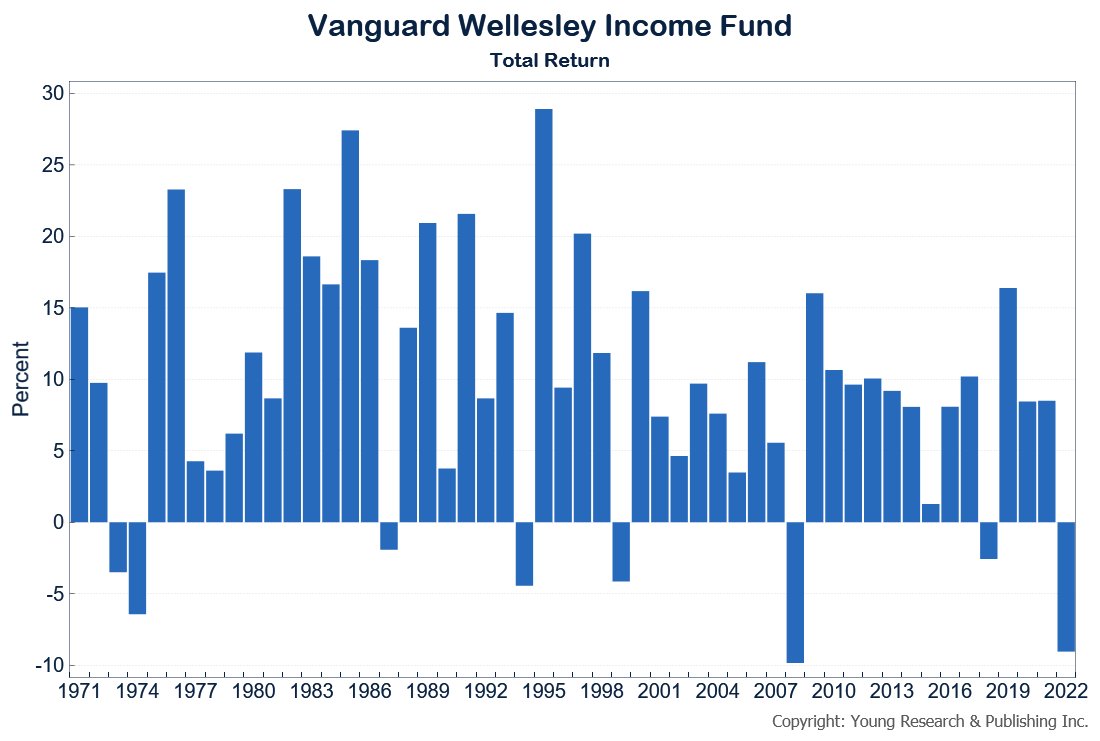
What Do You Know About Vanguard’s Wellesley Income Fund?

June 7, 2023 By Richard Young

I was recently asked some questions about Vanguard’s Wellesley Income Fund by a business associate. Below is a short summary of the questions and my answers. 

The first question was, “Who manages Wellesley Income Fund?”

The answer is Wellington Management Company, which I have had dealings with from my earliest days in the industry at Model Roland & Co. on Federal St. in Boston, where I began work in August of 1971. Wellington was founded in 1928 in Boston, and is one of America’s oldest institutional money managers. The two Wellington managers currently tasked with managing the Wellesley Income Fund are Loren L. Moran, who has been with the fund for six years, and Matthew C. Hand, who has worked on Wellesley for two years. 

The second question about the Wellesley Fund was about how the fund is organized and diversified.

The fund is organized into bond and stock components, with 60%-65% of the fund allocated to bonds, and 35%-40% allocated to stocks. Wellington invests the bond component in “short-, intermediate, and long-term investment-grade corporate bonds, while seeking to maintain an aggregate intermediate duration.” The stock component is invested in “large-company value stocks with above-average dividends and potential for income growth.” The portfolio usually holds fewer than 100 stocks.

The final question from my associate was about Morningstar’s rating for the Wellesley Income Fund.

Morningstar has assigned a rating of five stars to the Vanguard Wellesley Income Fund. That’s the highest rating Morningstar assigns to mutual funds. 


Filed Under: Investing Strategies

CBDCs Not “Just Another Form of Money”

June 6, 2023 By Richard Young

At the Cato Institute, Norbert Michel and Nicholas Anthony explain that a “CBDC (central bank digital currency) is not ‘just another form of money,’ as some of its supporters have claimed.” No other form of money gives governments the ability to control what you spend your money on, how much you spend, or even to take money back out of your account at a moment’s notice. Michel and Anthony slam the recent defense of CBDCs by Paul Krugman. They write:

This April Forbes column describes why central bank digital currencies (CBDCs) are a fundamental issue related to Americans’ freedom and much bigger than just politics. It argues that New York Times columnist Paul Krugman, famous for being wrong about the Internet, was wrong for claiming presidential hopeful Ron DeSantis was merely playing politics with CBDCs.

Nonetheless, Krugman has doubled down. As Crowdfund Insider explains, now he’s taken to Twitter to re‐​promote his original opinion piece and to liken DeSantis’s warnings about CBDCs to former presidential candidate Rick Santorum’s fight against the National Weather Service.

Contrary to Krugman’s framing, DeSantis’s claims about the risks of CBDCs have merit. As the Forbes piece demonstrated, proponents of CBDCs, even some government officials who would be in charge of implementing CBDCs, have openly discussed using CBDCs for exactly the purposes DeSantis claimed. (Nick and I have a longer list here.)

A CBDC is not “just another form of money,” as some of its supporters have claimed. A fully implemented CBDC is a complete government takeover of money and payments. As the experience in China and Nigeria have shown, the introduction of a CBDC comes with the removal of people’s freedom to choose their methods of payment.

CBDCs mark a fundamental threat to both economic and political freedom. But it should surprise no one that Krugman is wrong on this issue.


Filed Under: Investing Strategies

Successful Investing Is a Mindset

June 5, 2023 By Richard Young

By maxsattana @ Shutterstock.com


I wrote in the October 2015 issue of Intelligence Report:

As you know, I do not check the prices of my investments daily, weekly, or even monthly. I do an annual checkup only at tax time. When I make a significant investment, I have no intention of liquidation anytime soon. I am in for the long haul. Thus, short- or even medium-term volatility is of zero concern to me, beyond keeping an eye out for a name on my watch list that may have taken a temporary beating due to no particular fault of its own. So, then, successful investing is a mindset based upon a master plan that allows an investor to find comfort through thick or thin.

Filed Under: Investing Strategies

June Is Retirement Compounders Month

June 2, 2023 By Richard Young

I designed the Retirement Compounders (RCs) using the dividend and interest model explained in Ben Graham’s books while still a student at Babson College. The RCs went on to form the basis of my two decades long Young’s World Money Forecast and Richard C. Young’s Intelligence Report. Using my research, I spoke around the country at investment management conferences. In 1978, in Newport, RI, I started what became the award-winning Richard C. Young & Co. Ltd. (Barron’s (2012-2022) and CNBC (2019-2022) Disclosure). My son Matt has now run our family business for nearly three decades, and Debbie’s and my daughter, Becky, is CFO.  

Our son-in-law, E.J. Smith, has become known in the investment community as Your Survival Guy and has staked out a position as our face with investing families and small business organizations around America. Debbie and I still research and write seven days a week for our clients and multiple websites, and this June, as I headed above, we will be concentrating on the dividends and interest-centric Retirement Compounders.    

Young Research’s Retirement Compounders® Investment Program

When we developed Young Research’s Retirement Compounders® investment program, our goal was to help investors like you achieve investment success especially during bad times. Our strategy was to accept underperformance during speculative market runs, with the potential trade-off of better results during down markets.

The idea was never to beat the market over time or on a consistent basis. Rather, we fully expected the Retirement Compounders® program (both price risk and business risk) to trail the major market averages.

Why would we design a program to underperform?

The ugly reality of investing that nobody likes to talk about is that the average equity investor vastly underperforms the market and the funds he invests in. This is true even for investors who own market-beating mutual funds.

Dalbar, an investment analytics firm, is the authority here. Dalbar’s data shows that the average equity investor regularly underperforms the S&P 500 by 3-5% over long periods of time.

Volatility and Emotionalism

High volatility and emotionalism are to blame. When stock market volatility rises, many investors panic and sell near the lows, only to add to their stock positions once again in the dying days of a bull market.

Young Research’s Retirement Compounders® program is comprised of dividend paying common stocks selected from the over 40,000 global publicly traded companies. The Retirement Compounders® program favors high dividend payers, those with a history of dividend payments, and companies with a long record of consecutive dividend increases.

Some of the companies included in Young Research’s Retirement Compounders® program have paid a dividend every year for over a century. Others can boast a more than five decade record of annual dividend increases. The combination of high dividend payments today and dividend growth tomorrow can help you become a more confident, comfortable, successful long-term investor.

Retirement Compounders® Investment Program Helps You Stay the Course

Young Research’s Retirement Compounders® seeks to help investors avoid the emotionally charged investment decisions that can sabotage returns. Investing in high-quality businesses with long records of regular dividend payments may  offer the comfort necessary to stay the course when financial and economic stress arise.

For investors looking to pass on the burden of daily portfolio management, Richard C. Young & Co., Ltd. crafts dividend-focused common stock portfolios that are based on Young Research’s Retirement Compounders® program. You can sign up for Richard C. Young & Co., Ltd.’s monthly client letter (free, even for non-clients) here.

Filed Under: Investing Strategies

Smaller Airports Soaking Up Freight Traffic

January 26, 2023 By Richard Young

By Dushlik @ Shutterstock.com

With air travel once again growing rapidly, air freight companies are looking to avoid clogged major airports by flying into smaller regional airports. Paul Berger reports for The Wall Street Journal:

Freight forwarders are increasingly looking to fly around America’s congested air hubs.

A combination of shifting manufacturing supply chains and bottlenecks at big airports is leading the freight middlemen to hire their own aircraft and seek alternative gateways, establishing operations that are boosting business at smaller, regional sites like Greenville-Spartanburg International Airport in South Carolina and Chicago Rockford International Airport. 

Forwarders say they can move cargo through the smaller airports more quickly, cheaply and reliably than they can through the big gateways that handle millions of tons of freight a year. 

To do so, the logistics operators are departing from their traditional strategy of booking space in the bellies of passenger planes or on scheduled freighters, and instead chartering aircraft to run routes through alternate sites, often on schedules that suit their customers. In some cases they bring in their own equipment and take control of loading and unloading operations that are usually managed by third-party ground handlers at major airports. 

Dave Edwards, the chief executive at Greenville-Spartanburg, said just over a decade ago his airport had no international air cargo operations. It spent about $1.5 million to install its own cargo-handling equipment and lured German luxury car maker BMW AG , which has a large plant nearby, as a first customer. 

BMW today accounts for about a quarter of Greenville-Spartanburg’s roughly 15 international cargo flights a week. Mr. Edwards said other companies such as Volvo Car AB, Volkswagen AG and Siemens AG , which also have plants within trucking distance, are regular users of the airport.

“The efficiency of the operation has really caught the attention of many freight forwarders, and some of the manufacturers as well who like the fact the product is coming into an airport nearby,” Mr. Edwards said.

Air cargo volumes fell through most of last year as manufacturers and retailers pulled back on orders because of slowing consumer spending. Falling freight demand doesn’t appear to be dampening enthusiasm for secondary hubs, said consultant Doug Bañez, managing director at Charlotte, N.C.-based Hubpoint Strategic Advisors.

Supply-chain disruptions during the pandemic led many companies “to consider alternatives and they learned that these alternatives work,” Mr. Bañez said.

Filed Under: Investing Strategies

GE Continues Spinoffs as Profits Rise

January 26, 2023 By Richard Young

ATLANTIC OCEAN (July 16, 2011) Aviation Machinist’s Mate Airman Matthew Kephart observes an F404-GE-402 jet engine on a test cell as it is fired up on the fantail aboard the aircraft carrier USS Dwight D. Eisenhower (CVN 69). Dwight D. Eisenhower is underway conducting carrier qualifications.(U.S. Navy photo by Mass Communication Specialist 3rd Class Nathan Parde/Released) 110716-N-AU622-029

Profits are rising at GE as demand for its jet engines and power equipment remain strong. The company’s CEO Larry Culp, has planned a number of spinoffs to what was once America’s most renowned conglomerate. Thomas Gryta reports in The Wall Street Journal:

General Electric Co. GE 0.52%increase; green up pointing triangle reported strong demand for its jet engines and power equipment in the fourth quarter, lifting the manufacturer to a quarterly profit and higher revenue than a year ago.

The final quarter of the year is typically the strongest for the company, which generated cash flow of $4.3 billion in the period, bringing its total to $4.8 billion for the year. The latest results include GE HealthCare Technologies Inc., GEHC 0.52%increase; green up pointing triangle which it spun off in early January.

The company had a fourth-quarter profit of $2.1 billion on a 7% increase in total revenue to $21.8 billion. The earnings results topped Wall Street’s expectations. GE forecast higher revenue for 2023 but set a cash flow target for the year below some expectations after the healthcare spinoff. GE shares ended Tuesday up 1.2% at $80.70.

Inflation continues to be a challenge across the businesses, Chief Executive Larry Culp said in an interview, and isn’t expected to go away in 2023. Pricing has caught up to cost increases, he said, and will be about neutral for the year. “That is more of a function of us doing a better job of combating it than inflation going away,” he said.

The company is laying off about 2,000 workers from its onshore wind business, it has previously said, but is hiring elsewhere in the company. The aerospace division cut 25% of its workforce in 2020 as pandemic lockdowns hit the aviation industry but is now searching for workers as growth increases.

“If you know any welders or machinists, send them my way,” said Mr. Culp, who is also the CEO of the aerospace division.

GE began the year by splitting off its healthcare unit, completing a key step in the breakup of the American icon which is now focused on GE Aerospace, its jet engine division, and a portfolio of energy businesses that will become a separate company called GE Vernova in 2024.

GE projected free cash flow between $3.4 billion to $4.2 billion for 2023, an estimate that may adjust over the year. In the middle of 2022, GE cut its projections by about $1 billion from the $5.5 billion to $6.5 billion it had previously predicted.

The company expects operating profit of $5.3 billion to $5.7 billion for GE Aerospace for the year and an operating loss of $600 million to $200 million for GE Vernova.

The spinoffs are designed to simplify GE’s operations and make the assets more attractive to investors. Mr. Culp has said the breakup will bring more focus and accountability to the business he has revamped since 2018.

Filed Under: Investing Strategies

What You’ll Hear When You Call My Office

September 1, 2022 By Richard Young

When you call the office of Richard C. Young & Co., Ltd. during business hours, what you’ll hear first is the voice of a real human being working at an American small business that values its clients. You won’t hear a recorded phone tree directing you to a no man’s land of extensions and recordings. You won’t be answered by someone in a far-off place. Whoever answers the phone will pick up in either of our Naples, Florida, or Newport, Rhode Island offices. The personal touch you get from the folks you’ll talk to is part of what has earned Richard C. Young & Co., Ltd. a ranking in the top 5 of CNBC’s 100 Financial Advisors (2021), and what has earned my son, Matt Young, President and CEO of Richard C. Young & Co., Ltd., an induction into the Barron’s Hall of Fame Advisors (2021). Disclosure

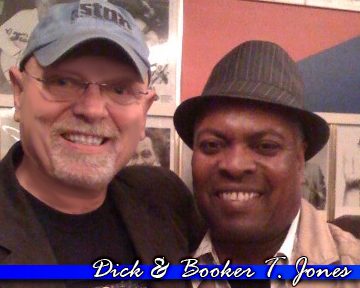
While you are being transferred to your advisor by the helpful reception staff, you may be put on hold for a brief moment. That’s when you’ll be treated to something I have picked out for you personally. The hold music you’ll hear is a recording of Booker T. and the MGs playing “Green Onions.” Booker T. Jones, recorded his first version of “Green Onions” with the MGs in 1962 after he began composing it two years earlier while still attending high school. “Green Onions” peaked at number 3 on the Billboard Hot 100 in August of 1962 and spent four nonconsecutive weeks at the top of the R&B singles chart.

The first MGs consisted of Lewie Steinberg on bass, Steve Cropper on guitar (a Telecaster), and Al Jackson Jr. on drums. Jones played a Hammond M3 organ on the track. Many will tell you he played a B3, but I have seen the organ with my own eyes at the Stax Museum of American Soul Music in Memphis and can assure you it’s an M3 in the building. This point confuses many because Jones is so well known as a B3 player.

I have followed Booker T. Jones’s career for decades, and I have met him multiple times at venues around the country. When he was inducted into the Musicians Hall of Fame in Nashville in 2008, I was there in the center of the eighth row. I own all of Jones’s original 45s, including multiple versions of “Green Onions,” and play them regularly on my Wurlitzer jukebox at home. The various versions include;

  • The original on Stax’s sister label, Volt, released in May 1962, on which Green Onions was the B-side to Behave Yourself.
  • A September 1962 release on Stax, with Behave Yourself as the B-side
  • And a March 1967 UK-only release on Atlantic Records that included Boot-Leg on the B-Side

The song you hear while you briefly hold during a call to Richard C. Young & Co., Ltd. is not some random muzak assigned to such moments by the telephone company. I picked it out specifically for clients in order to connect them to my lifelong interest in jazz, instrumental R&B, and Southern soul music. There are many versions of “Green Onions,” both by Booker T. himself and others, including an outstanding version by Mike Bloomfield and Al Kooper live at the Fillmore West in 1968. Harry James also recorded a respectable version in 1965.

If you’re looking for investment advice, please call in at 888-456-5444. Enjoy the service you’ll receive, and if you do find yourself on hold, please know that I personally selected the music for you.

Dick Young

P.S. When markets get hit by a hurricane, Young’s World Money Forecast is your port in a storm. Click here to sign up for my free email alert. I’ll never share your information with anyone. 

Filed Under: Investing Strategies Tagged With: comp

My Battle-Hardened Stock Market Strategy for the Worst of Times

July 26, 2022 By Richard Young

UPDATE 7.26.22: Have the worst of times come? It’s hard to say, but many investors who were feeling great about the market only six months ago are now terrified. If investors had employed the Ben Graham-inspired, battle-hardened strategy of conservation of principal and a defensive portfolio, they may not be so unsure of themselves today.

Originally posted on August 14, 2019.

In September of 2014, I explained to readers my battle-hardened strategy for dealing with the worst of times in the stock market. My strategy was inspired by Ben Graham, and I have used it throughout my 55-year career in investing. Here’s how it goes:

Ben Graham’s The Intelligent Investor was first published in 1949. I came in a little late in the game with my 1973 edition, which I have in front of me as I write. It is important to me that you and all of our management clients are able to sleep well, even during the periodic stock market busts that we all have to ride through from time to time. I never get out of the market; thus, I require a battle-hardened strategy to stay the course during even the worst of times. Ben Graham wrote, “An investment operation is one which, upon thorough analysis, promises safety of principal and an adequate return. Operations not meeting these requirements are speculative.” From day one, I have stuck to Ben’s foundation principle to the benefit of all our subs and clients.

Primary Concern: Conserve Principal

Ben built on his foundation principle by writing that truly professional investment advisors are quite modest in their promises and pretensions. As he noted, “The leading investment-counsel firms make no claim to being brilliant, but they do pride themselves on being careful, conservative, and competent. The primary aim is to conserve the principal value over the years and to produce a conservatively acceptable rate of return. Any accomplishment beyond that—and they do strive to better the goal— they regard in the nature of extra service rendered. Perhaps the chief value to clients lies in shielding them from costly mistakes.”

The Defensive Investor

I like to think that it is just this approach that allows our subscribers and clients to sleep well and remain comfortable that we are all on the same team. Part of the complete program is your portfolio balance. Ben Graham wrote, “We have already outlined in briefest form the portfolio policy of the defensive investor. He should divide his funds between high-grade bonds and high-grade common stocks. We have suggested as a fundamental guiding rule that the investor should never have less than 25% or more than 75% of his funds in common stocks, with a consequent inverse range of between 75% and 25% in bonds.”

With market volatility increasing, it’s time you reviewed your own strategy. You should consider a battle-hardened strategy that will protect you in the “worst of times.”

Filed Under: Investing Strategies

A Cashless Society Is A Debacle for Americans

June 30, 2022 By Richard Young

UPDATE 6/30/22: Alarm bells should be going off for Americans who want a dependable currency. The push for a “digital dollar” is intensifying, and now Congressman Jim Himes (D-CT), the chairman of Congress’s Select Committee on Economic Disparity, is pushing hard for digitizing your dollars. Why is it important that he’s the chairman of the Select Committee on Economic Disparity? A digital dollar will make manipulation of your money via negative interest rates a snap. And if all your money is digitized, wealth taxation becomes easy as the push of a button.

Of course, Himes isn’t advertising digital dollars that way. Instead, he’s using the troubles of cryptocurrencies to set up a digital dollar as a White Knight that can Americans from them. Though most Americans have never owned the speculative assets.

Himes recently released a document laying out his vision of a central bank digital currency for America. You can read his entire proposal paper here. He sets up the digitalization of the dollar as a race the U.S. must win or else, what? Or else the country maintain the strength of its currency and savers and investors maintain their independence from wealth taxation? A cashless society would be a debacle for Americans. No thanks.

Originally posted on May 2, 2022.

A cashless society will allow the elites of society to “monitor, control and tax every transaction,” explains Lewellyn H. Rockwell at LewRockwell.com. The aim, explains Rockwell, is the ability to “cut [Americans] off entirely,” if they resist. He writes (abridged):

The elites have been aiming to eliminate hand-to-hand cash for decades, as it will allow them to monitor, control and tax every transaction.

A story in The New York Times exposes what brain-dead Biden and the gang of neo-cons that controls him have in store for us.

According to an item that was published April 26, “When Defense Secretary Lloyd J. Austin III declared Monday at the end of a stealth visit to Ukraine that America’s goal is to see Russia so ‘weakened’ that it would no longer have the power to invade a neighboring state, he was acknowledging a transformation of the conflict, from a battle over control of Ukraine to one that pits Washington more directly against Moscow. . . in word and deed, the United States has been gradually pushing in the direction of undercutting the Russian military.

Why is the US following this policy? Dr. Ron Paul has an important part of the answer. Just as in World War I, the “merchants of death” have a lot to gain financially. “One group of special interests profiting massively on the war is the US military-industrial complex. Raytheon CEO Greg Hayes recently told a meeting of shareholders that, ‘Everything that’s being shipped into Ukraine today, of course, is coming out of stockpiles, either at DOD or from our NATO allies, and that’s all great news. Eventually we’ll have to replenish it and we will see a benefit to the business’.”

The advocates of a New World Order don’t care about risking nuclear war. They aim to control us all so that there is no escape for anybody. This is a vast subject, but let’s look at just one more issue. Our “masters” in Washington want to take away our cash so they can keep tabs on all our transactions and, if we resist, cut us off entirely.

We don’t have much time left. Let’s do all we can to protest against the New World Order.

Llewellyn H. Rockwell, Jr. former editorial assistant to Ludwig von Mises and congressional chief of staff to Ron Paul, is founder and chairman of the Mises Institute, executor for the estate of Murray N. Rothbard, and editor of LewRockwell.com. He is the author of Against the State and Against the Left.

Read more here.

Filed Under: Investing Strategies

  • « Previous Page
  • 1
  • 2
  • 3
  • 4
  • 5
  • …
  • 20
  • Next Page »

Compensation was paid to utilize rankings. Click here to read full disclosure.

RSS New From Young Research & Publishing

  • There’s Nothing Wrong with Making Money Slowly (Part 12)
  • After Years Offline, Japan Restarts Major Nuclear Reactor
  • Expansion Makes Corpus Christi 2nd-Largest US LNG Exporter
  • Iraq Cuts Output at Rumaila as Storage Fills
  • Will Washington Kill the Golden Goose?
  • Montana Tech Visit Highlights Critical Mineral Plans
  • Conflict Near Hormuz Slows Oil Exports, Tankers Hold Position
  • There’s Nothing Wrong with Making Money Slowly (Part 11)
  • Service Sector Drives Latest Producer Price Increase
  • Argentina’s $40 Billion Copper Bet Hinges on Glacier Law Reform

RSS New From Your Survival Guy

  • There’s Nothing Wrong with Making Money Slowly (Part 12)
  • Gold Up After Iran Strikes
  • There’s Nothing Wrong with Making Money Slowly (Part 11)
  • BYOP: Bring Your Own Power
  • Private Equity Is the Next Big Thing Coming for YOU: Part VII
  • The Value of Balance
  • Enjoy the Great Outdoors
  • Your Retirement Life Should Be a Safe One
  • The Trump Economy So Far
  • There’s Nothing Wrong with Making Money Slowly (Part 10)

Search Our Site

Richard C. Young & Co., Ltd.

–Client Letter Sign Up–

Sign up to receive email alerts when our latest client letter is posted on our website.

Disclaimer:

The information contained here is for informational and educational purposes only. It is not intended nor should it be considered investment advice or a recommendation of securities. Past performance is not a guarantee of future results. It is possible to lose money by investing. You should carefully consider your investment objectives and risk tolerance before investing.

Copyright © 2026 · About Dick Young · Terms & Conditions


Loading Comments...