• ABOUT – DICK YOUNG
  • YWMF – ARCHIVES

Young's World Money Forecast

Since 1978 With a 32 Year Vacation

  • DICK YOUNG
    • FROM RICHARD C. YOUNG
    • THE FINAL INTELLIGENCE REPORT
  • INVESTING STRATEGIES
    • RETIREMENT COMPOUNDERS®
    • GOLD & SILVER
  • DIVIDENDS & COMPOUNDING
    • MIRACLE OF COMPOUNDING
    • DIVIDENDS
  • GRAHAM & RUSSELL
    • BEN GRAHAM
    • RICHARD RUSSELL
  • THE DOW AND THE LEADERS
    • DOW vs. S&P 500
    • DOW vs. DOW DIVIDEND PER SHARE
  • WELLINGTON MANAGEMENT COMPANY
  • YOUR SURVIVAL GUY
  • BANK CREDIT & MONEY
  • THE PRUDENT MAN

Bessent: The Fed Must Change Course, but No Mention of Gold

September 8, 2025 By Richard Young

Secretary of the Treasury Scott Bessent looks on as President Donald Trump and President Ferdinand Marcos Jr. of the Philippines participate in a bilateral meeting, Tuesday, July 22, 2025, in the Oval Office. (Official White House Photo by Daniel Torok)

On Friday, Treasury Secretary Scott Bessent explained in an op-ed in The Wall Street Journal the dangers of the expanding responsibilities and power of the Federal Reserve. He noted the Fed’s expanded powers granted in the Dodd-Frank Act, and that fifteen years afterward, the results of granting the central bank those extra powers have been disappointing. He wrote:

Regulatory overreach compounds the problem. The Dodd-Frank Act dramatically enlarged the Fed’s supervisory footprint, transforming it into the dominant regulator of U.S. finance. Fifteen years on, the results are disappointing. The 2023 failure of Silicon Valley Bank illustrates the dangers of combining supervision and monetary policy. The Fed now regulates, lends to and sets the profitability calculus for the banks it oversees, an unavoidable conflict that blurs accountability and jeopardizes independence. A more coherent framework would restore specialization: empowering the Federal Deposit Insurance Corp. and Office of the Comptroller of the Currency to lead bank supervision, while leaving the Fed to macro surveillance, lender-of-last-resort liquidity and monetary policy.

At the heart of independence lies credibility and political legitimacy. Both have been jeopardized by the Fed’s expansion beyond its mandate. Heavy intervention has produced severe distributional outcomes, undermined credibility and threatened independence. Looking ahead, the Fed must scale back the distortions it causes in the economy. Unconventional policies such as quantitative easing should be used only in true emergencies, in coordination with the rest of the federal government. There must also be an honest, independent, nonpartisan review of the entire institution, including monetary policy, regulation, communications, staffing and research.

The U.S. faces short- and medium-term economic challenges, along with the long-term consequences of a central bank that has placed its own independence in jeopardy. The Fed’s independence comes from public trust. The central bank must recommit to maintaining the confidence of the American people. To safeguard its future and the stability of the U.S. economy, the Fed must re-establish its credibility as an independent institution focused solely on its statutory mandate of maximum employment, stable prices and moderate long-term interest rates.

Responding to Bessent’s op-ed in The New York Sun, former economic advisor to President Trump, Larry Kudlow, celebrates the coming “takeover” of the Fed by President Trump’s appointed governors. He writes:

As I have suggested, the economy, both present and future, is stronger than folks may think.

Unsurprisingly, President Trump responded with a brief post on Truth Social, saying, “Jerome ‘Too Late’ Powell should have lowered rates long ago.” Mr. Trump exclaimed: “As usual, he’s ‘Too Late.’”

Hopefully Mr. “Too Late” Powell will get the Fed’s fund target rate down to 3 percent from its current 4.5 percent by the end of this year.

Yet the bigger story is perhaps best summarized in a Wall Street Journal headline, “Trump Is Making Strides In His Takeover of the Fed,” as the Council of Economic Advisers chairman, Stephen Miran, is taking a leave of absence in order to temporarily fill a Fed seat on the central bank’s board of governors.

The New York Sun’s editors further riffed on Kudlow’s response with another editorial on September 7, wondering why Bessent hadn’t mentioned gold, and wondering why the administration hadn’t made more of the issue.

The first thing we did when we saw Mr. Bessent’s column was to scan it for the word “gold.” The monetary metal was unmentioned. That strikes us as odd. On that very day, after all, the value in terms of gold at which greenbacks were trading was about to set a new low of less than a 3,558th of an ounce of the monetary metal. When graphed it’s at the bottom of a decades-long slide. It’s the lowest value in terms of gold ever recorded for the greenback.

We understand that, in the age of fiat money, the legislated value of the dollar is not supposed to matter. In 1971, Nixon closed the gold window at which foreign governments could redeem dollars they held at a 35th of an ounce of gold. In 1973, Congress set the value of the dollar at a 42.22nd of an ounce of gold. Yet Uncle Sam hasn’t enforced that. It is amazing just how loath is our leadership at the Treasury and the Federal Reserve to open up this issue.

What’s so startling about the official silence on the collapse of the dollar is that Mr. Bessent and, above him, President Trump would be — or so it seems to us — a promising pair to take on the issue of fiat money. In the 2016 Republican primaries, moreover, Mr. Trump was widely quoted as saying, per NPR, “Bringing back the gold standard would be very hard to do, but, boy, would it be wonderful. We’d have a standard on which to base our money.”

It doesn’t appear likely that Trump or Bessent will lead a push for a return to the gold standard. The immediate effects of such a move would be counter to the greater priorities Trump has signalled in increasing American manufacturing. If a gold standard were introduced, the value of a dollar would likely soar in comparison to international fiat currencies, and imports could become cheaper relative to American manufactured goods, driving up imports and driving down American manufacturing jobs. Those looking for America to return to the gold standard will likely be waiting for another president.

Filed Under: Gold

What Is Gold Telling Investors? And the Dow 30?

April 17, 2025 By Richard Young

By saritwat @ Adobe Stock

Take a good look at my chart below of the Dow Jones Industrial Average (Dow 30) and the price of gold. You can see gold hitting new highs at $3,342/troy ounce, while the DJIA Index has fallen to 39,669 points, or a drop of about 11.9% since peaking on December 4, 2024. 

Gold is in a secular bull market, and it will remain in a secular bull market until the world’s central banks stop printing excessive amounts of money and governments stop issuing excessive amounts of debt. One indicator of prospective returns in gold is the ratio of the Dow Jones Industrial Average to the price of gold. When the ratio is falling, gold is outperforming the Dow. Over the last 124 years, as portrayed in the chart below, there have been three completed secular bull markets in gold versus the Dow. The current bull market is the fourth.


In each of the previous bull markets, the ratio of the Dow to gold dropped below six. Today, the Dow is trading at 12X gold. How much further it will fall is anyone’s guess. Don’t put yourself in the prediction business. Understand, though, that as the ratio falls, the relative affordability of the Dow is rising. 

Can you own too much gold? For most investors, 10% is probably the max. You buy gold as an insurance policy. Gold offers protection against inflation, currency debasement, and political and geopolitical turmoil. I buy gold and hope it goes down, because when gold is falling, it is often true that everything else in your portfolio is rising. 

The Dow 30 today consists of these companies:

Symbol Company Yield %

AMZN

Amazon.com Inc 0

AXP

American Express Co 1.30

AMGN

Amgen Inc 3.37

AAPL

Apple Inc 0.51

BA

Boeing Co 0.00

CAT

Caterpillar Inc 1.94

CSCO

Cisco Systems Inc 2.94

CVX

Chevron Corp 5.05

GS

Goldman Sachs Group Inc 2.40

HD

Home Depot Inc 2.66

HON

Honeywell International Inc 2.34

IBM

International Business Machines Corp 2.80

JNJ

Johnson & Johnson 3.38

KO

Coca-Cola Co 2.85

JPM

JPMorgan Chase & Co 2.44

MCD

McDonald’s Corp 2.29

MMM

3M Co 2.24

MRK

Merck & Co Inc 4.24

MSFT

Microsoft Corp 0.89

NKE

Nike Inc 2.99

PG

Procter & Gamble Co 2.54

SHW

Sherwin-Williams Co 0.95

TRV

Travelers Companies Inc 1.74

UNH

UnitedHealth Group Inc 1.44

CRM

Salesforce Inc 0.67

NVDA

NVIDIA Corp 0.04

VZ

Verizon Communications Inc 6.21

V

Visa Inc 0.71

WMT

Walmart Inc 1.03

DIS

Walt Disney Co 1.21

If you follow the Dogs of the Dow strategy, you’ll quickly notice a few yields over 4%, with a few more in the 3% range. Historically, though, the yield on the Dow Jones Industrial Average is still low at 1.84% today.

What are gold and the Dow telling investors today? Diversity can benefit a portfolio. I have always recommended diversification and patience built on a foundation of value and compound interest.

Click here to find your port in a storm. 

Filed Under: Dow Stocks, Gold

The Power of Gold

March 14, 2025 By Richard Young

By monsitj @ Adobe Stock

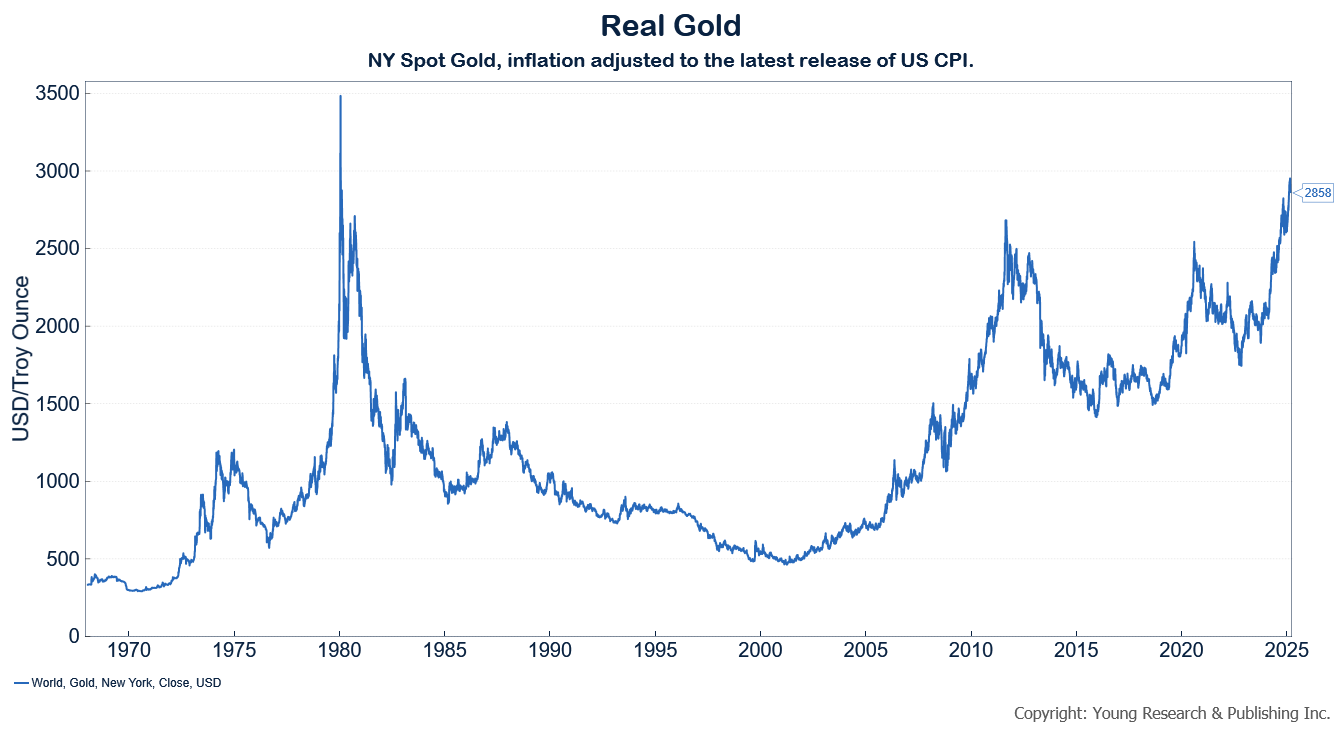
As the purchasing power of the American dollar has declined steadily since gold convertibility ended in 1971, the purchasing power of an ounce of gold is strong. The spot price of gold closed at an all-time high of $2,989 yesterday and crossed over $3,000 an ounce in trading today. 

The purchasing power of gold is also near record highs, though it hasn’t quite exceeded its peak during the hyperinflation of the 1980s. 

Since 1913, the year the Federal Reserve was created, the purchasing power of the U.S. dollar has fallen by 96%. The purchasing power of a single ounce of gold over that same time period has more than doubled. That is no coincidence. Gold is a store of value—a wealth preservation vehicle. Gold won’t make you rich, but it also won’t make you poor. Gold is a currency. It can’t go bankrupt or lose its value because of poor management, accounting fraud, world war, or hyperinflation. Investors who truly understand gold recognize that gold should be counted in ounces, not in dollars. Because while the dollar value of gold may fluctuate from year to year, it will be worth many times its current value during the next generation and in those that follow.

Markets are stormy. Find your port in the storm by clicking here to subscribe to the Young’s World Money Forecast email alert. 

Filed Under: Gold

Good as Gold: Will Ron Paul Audit the Fed?

February 12, 2025 By Richard Young

Generated with Grok 2 via X.com

The price of gold has reached new highs. In 2017 I wrote to subscribers:

Since 1913, the year the Federal Reserve was created, the purchasing power of the U.S. dollar has fallen 96%. The purchasing power of a single ounce of gold over that same time period has more than doubled. That is no coincidence. Gold is a store of value—a wealth preservation vehicle. Gold won’t make you rich, but it also won’t make you poor. Gold is a currency. It can’t go bankrupt, lose its value because of poor management, accounting fraud, world war, or hyper-inflation. Investors who truly understand gold recognize that gold should be counted in ounces, not in dollars. Because while the dollar value of gold may fluctuate from year-to-year, it will be worth many times its current value during the next generation and in those that follow.

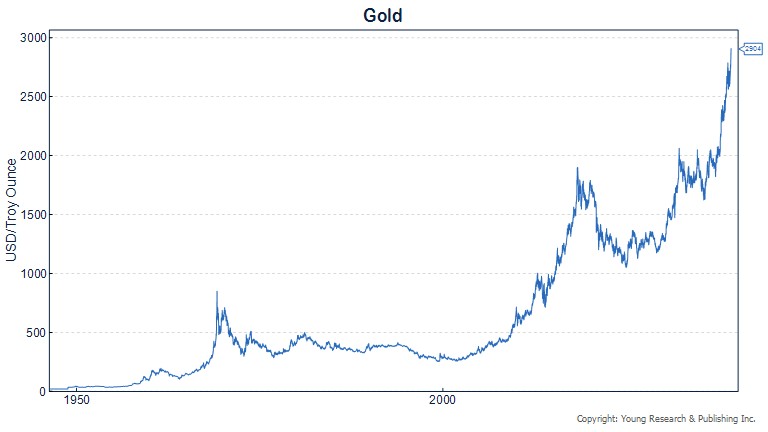
As you can see on my chart below, gold is now at all time highs of over $2,900/ounce.

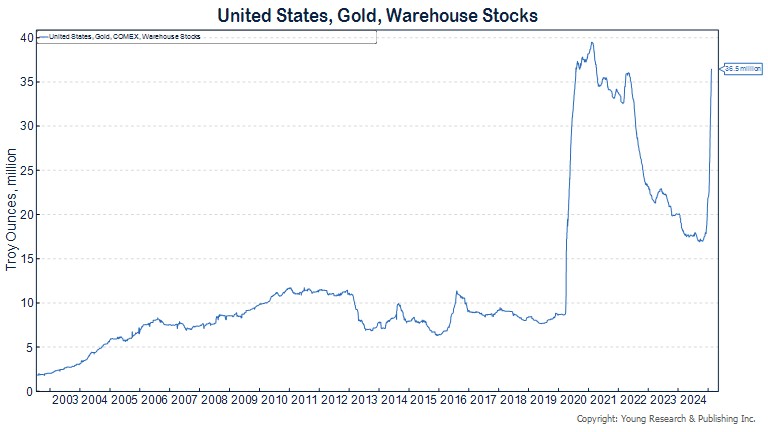
Demand for gold has caused inventory spikes at Comex warehouses:

But annual gold production growth in 2024 was only 1.5%, the same as it has been on a compound annual growth basis since 1969.

Demand for gold seems to be increasing, and production of gold has not been able to grow rapidly for some time and even sits today at slightly less than that of 2018. Silver production, too, has fallen, though the dynamics of that metal are somewhat different.

Another piece I wrote back in 2010 seems relevant today as DOGE rips into the operations of the bloated federal government and finds waste, fraud, and abuse throughout. I wrote:

The Great Money Flood

Inflation is a disease. After WWI, hyperinflation—when prices sometimes doubled and more than doubled from one day to the next—prepared the ground for Communism in Russia and Nazism in Germany. The story is told in Milton and Rose Friedman’s Free to Choose. As the Friedmans correctly point out, no government is willing to accept responsibility for producing inflation. The Friedmans present readers five simple truths that embody most of what we know about inflation. First, inflation is a monetary phenomenon arising from a more rapid increase in the quantity of money than in the output. Second, government determines or can determine the quantity of money. Third, there is only one cure for inflation: a slower increase in the quantity of money. Fourth, it takes time, measured in years not months, for inflation to develop; it takes time for inflation to be cured. Fifth, unpleasant side effects of the cure are unavoidable

The Problem Starts With Government

Milton and Rose point the bony finger of blame at government. I have agreed with the Friedmans for decades. In 1978, I began Young’s World Money Forecast to write about inflation and inflation’s cousin: gold and currency debasement. In 1987, I wrote a book, Young’s Financial Armadillo Strategy, to further the discussion of inflation, gold and currency debasement in terms of investment portfolios. In the years since, I have found no reason to change or adapt my original approach to portfolio management based on the basic Friedman conclusions on government and inflation.

Government is where the problems start. And the bigger, more intrusive the central (as opposed to state) government becomes, the greater my concern for your and my welfare in both financial and personal security terms. An ongoing study and appraisal of central government is the only place to begin analysis of the climate for investing, business in general, and certainly your family’s personal security. An incorrect appraisal of the intentions of those charged with governing our country makes proper action regarding financial and personal security impossible. It’s just that simple.

There’s talk of putting former Congressman Dr. Ron Paul in charge of an audit of the Federal Reserve. That would be a great start in healing America’s broken monetary and fiscal systems. I’ll be watching, and writing about the developments surrounding gold, Ron Paul, the Fed, and your dollar. Click here to subscribe to Young’s World Money Forecast, your port in a storm.

Filed Under: Gold

Compensation was paid to utilize rankings. Click here to read full disclosure.

RSS New From Young Research & Publishing

  • 77% of Americans Reported This…Part 4
  • Fed Poised for Split Decision as Another Rate Cut Looms
  • Feta Cheese Supply at Risk After Half a Million Goats and Sheep Culled
  • Trucking Crisis: How Foreign Drivers Are Eroding Rates and Safety
  • Trump Administration Moves Toward Major National Robotics Initiative
  • 77% of Americans Reported This…Part 3
  • US Gas Prices Fall Below $3 per Gallon for First Time Since 2021
  • CAFE Reset Aims to Save American Families $109 Billion Over Five Years
  • Amazon Reconsiders USPS Partnership as Contract Nears 2026 Expiration
  • US and UK Reach Historic Pharmaceutical Pricing Agreement

RSS New From Your Survival Guy

  • 77% of Americans Reported This…Part 4
  • Concerns: Interview with New Vanguard CEO Salim Ramji
  • Crying and Buying
  • 77% of Americans Reported This…Part 3
  • What’s in Your 401(k)?
  • Americans Can’t Escape Bidenflation
  • 77% of Americans Reported This…Part 2
  • You Were Warned about Annuities at Vanguard
  • IPOs Going Up in Flames
  • Are You One of the 77% Who Reported…

Search Our Site

Richard C. Young & Co., Ltd.

–Client Letter Sign Up–

Sign up to receive email alerts when our latest client letter is posted on our website.

Disclaimer:

The information contained here is for informational and educational purposes only. It is not intended nor should it be considered investment advice or a recommendation of securities. Past performance is not a guarantee of future results. It is possible to lose money by investing. You should carefully consider your investment objectives and risk tolerance before investing.

Copyright © 2025 · About Dick Young · Terms & Conditions


Loading Comments...