• ABOUT – DICK YOUNG
  • YWMF – ARCHIVES

Young's World Money Forecast

Since 1978 With a 32 Year Vacation

  • DICK YOUNG
    • FROM RICHARD C. YOUNG
    • THE FINAL INTELLIGENCE REPORT
  • INVESTING STRATEGIES
    • RETIREMENT COMPOUNDERS®
    • GOLD & SILVER
  • DIVIDENDS & COMPOUNDING
    • MIRACLE OF COMPOUNDING
    • DIVIDENDS
  • GRAHAM & RUSSELL
    • BEN GRAHAM
    • RICHARD RUSSELL
  • THE DOW AND THE LEADERS
    • DOW vs. S&P 500
    • DOW vs. DOW DIVIDEND PER SHARE
  • WELLINGTON MANAGEMENT COMPANY
  • YOUR SURVIVAL GUY
  • BANK CREDIT & MONEY
  • THE PRUDENT MAN

Archives for July 2026

How Bad Is the Chinese Economy?

July 17, 2026 By Richard Young

By Dilok @ Adobe Stock

In The Wall Street Journal, Joseph Sternberg makes the case that the Chinese economy “is in worse shape than you think.” Sternberg notes that China’s economic growth missed the Communist Party’s target. He writes:

You know something is awry in China’s economy when not even the Communist Party can claim things are going according to plan. Witness this week’s economic-growth data for the most recent quarter, which on closer inspection are shockingly bad.

Beijing’s statisticians on Wednesday said the gross domestic product grew 4.3% year-on-year in inflation-adjusted terms in the April through June quarter. China’s economic data are notoriously prone to fiddling for political purposes. And only this March, the Communist Party set a GDP growth target range of 4.5% to 5% for the year, its most pessimistic since the 1990s.

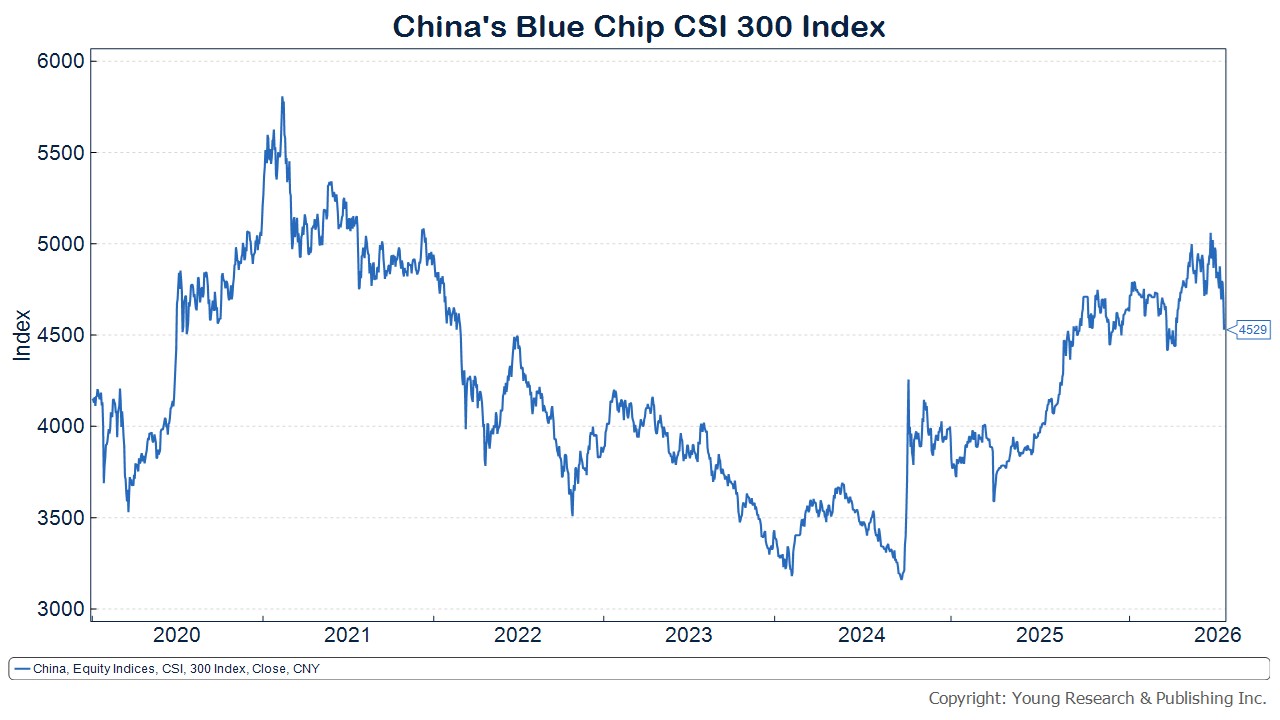
Certainly, the markets are displaying some level of apprehension about Chinese equities. The country’s blue chip CSI 300 Index is down over 10% since its recent peak on June 22.
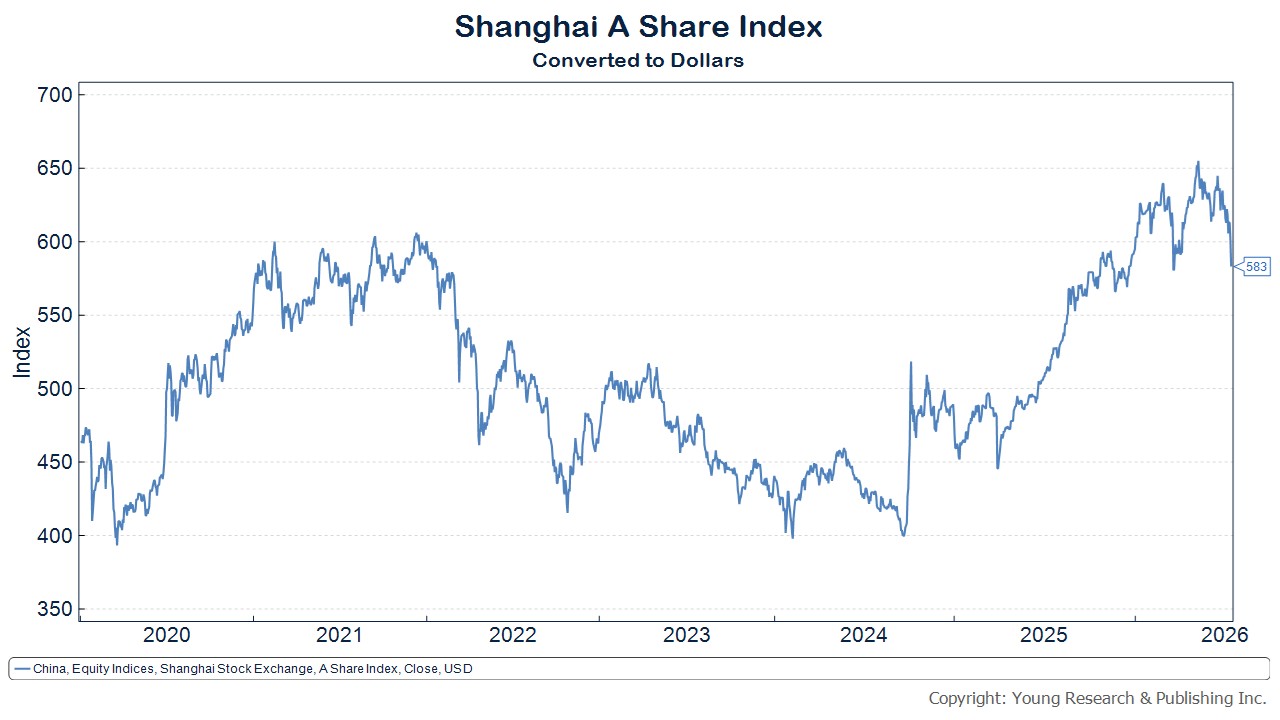
And the broader Shanghai A Shares Index is down 11% since peaking on May 13th.
Michael Pettis, a Senior Fellow at the Carnegie Endowment, has reported on X.com that Li Daokui, whom Pettis describes as “one of China’s most prominent economists,” is calling for an urgent response to the country’s economic troubles. Pettis writes:

Tsinghua’s Li Daokui, one of China’s most prominent economists, calls for an increasingly urgent response to problems in the Chinese economy, focusing mainly on policies to unleash constraints on the ability of local governments to continue to power growth: “Specifically, after completing major infrastructure projects, local governments have become preoccupied with repaying their debts. Because interest rates remain high, the more debt they repay, the greater the total debt burden becomes. This process absorbs enormous amounts of economic and financial energy without converting that energy into actual output or productivity.”

His proposed response is to reduce what he calls “blockage” at the local-government level by exploiting the relatively clean balance sheet of the central government. He mostly asks, in other words, for a shift in the locus of debt creation from local-government balance sheets to the central government.

If you believe that there remain a lot of productive investment opportunities that local governments are unable to access because of their bloated balance sheets, and that only local governments can take on these projects, this would certainly make sense.

But I think it has been many years since this has been true, in which case it seems to me that his proposed policy response is to accelerate debt creation even further, partly, he says, to fund local-government repurchases of empty apartments and partly to improve benefits to migrant workers.

My worry is that not enough people see China’s extremely high and rapidly-rising debt burden as the main medium-term problem facing China, perhaps because the only way to address the debt burden requires much slower growth, and as of now this is still politically unacceptable, especially if real Chinese unemployment is closer to the 10.2% Li believes it to be than the 5.0% official rate published earlier today.

It’s good that Chinese economists are becoming increasingly vocal about the deep difficulties the very-unbalanced Chinese economy faces.

But I worry that they are still not willing to acknowledge just how difficult it will be to address these imbalances, nor to recognize that the longer Beijing postpones the adjustment, the more disruptive it is likely to be. On these last two points the historical precedents are pretty clear.

The implications for the rest of the world in response to a sustained bout of slow growth or recession in China are unknown. China hasn’t faced a year of declining GDP since 1976, according to IMF figures. Officially, growth slowed to 2.34% in 2020.


 

Filed Under: Feature

China Loses Two Decades of Real Estate Gains

July 8, 2026 By Richard Young

By Adam @ Adobe Stock

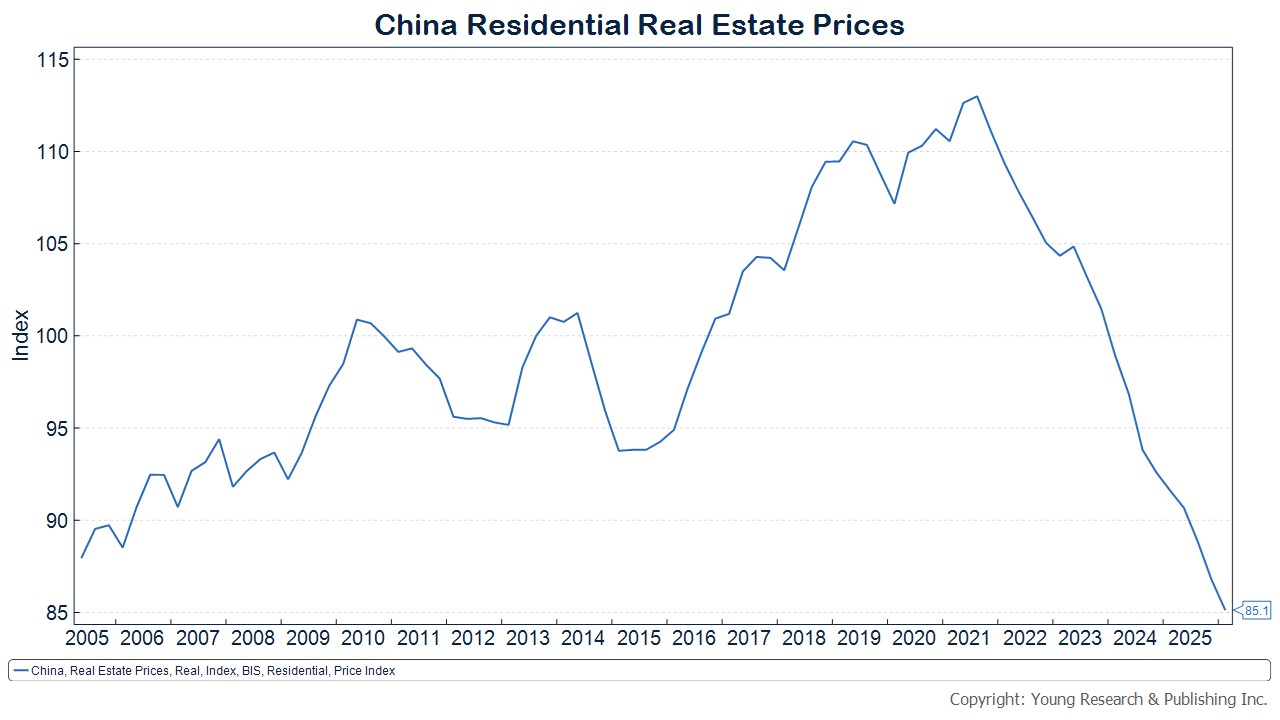
You may remember my warnings in 2012 against direct investment in China. I thought then that the country’s numbers looked funny, and that it didn’t play by the rules. One issue I singled out in particular was China’s investments in “Ghost Cities,” which seemed like a real scam. Since then, Evergrande, one of China’s largest developers, has been dissolved, and prices for Chinese residential properties have fallen back below 2005 levels (in real terms). 

I wrote back in 2012:

I have long advised against direct investment in China. Among the many reasons I am bearish on China is the country’s vastly distorted economy. China is a command style economy run by an unelected political party—the Communist Party of China (CPC). The CPC’s policies have resulted in a grand misallocation of capital. A mercantilist cur rency policy, perverse incentives for provincial gov ernment officials, and crude monetary policy tools have helped inflate a fixed asset and real estate bub ble that puts the U.S. real estate bubble to shame.

A Quality Problem

It should be obvious to most that things are not as they seem in China. China has reported GDP growth of 9% or more in every quarter over the last two years, but the Shanghai Composite Stock Index has plunged more than 30% during that time. If China’s economy were truly booming, Chinese shares would most likely be trending up. China suffers not from a quantity of economic growth problem, but a quality growth problem. China’s GDP statistics are being propped up by unproduc tive fixed asset investment. The real estate sector is the most obvious example. To prop up GDP growth rates the Chinese are building entire cities, but they are virtually empty. For more on these ghost cities, be sure to check out the China’s Empty Cities video at www.youngresearch.com.

It is perplexing that the world has allowed a command style economy run by an unelected politi cal party to become such an important player in the global economy. China is now the world’s second largest economy and America’s second-largest trad ing partner. If China heads into the tank, the world economy will suffer.

China doesn’t play by the same rules or have the same motives as the world’s other large economies. China has consistently manipulated its currency to gain export market share and it has subsidized favored industries through its financial system to the detriment of non-Chinese companies. Take the rare earths industry as an example. China now has an effective monopoly on rare earths production. Not because of the country’s low labor costs or a lack of reserves in other countries, but because Chinese rare earths companies were provided with subsidized loans. Rare earths companies ramped up produc tion in the ’80s and ’90s and drove prices down to unprofitable levels. The Chinese government was more interested in maintaining stability through high employment then, as they are today. Low prices pushed rare earths producers in the U.S., Australia, and elsewhere out of business. With the support of subsidized loans, China’s rare earths companies were the only companies able to remain in business at such low prices. Now the U.S. relies on China (at least temporarily) for a supply of metals vital to the defense industry and other high-technology industries. Sound like a smart strategy to you?


Filed Under: Feature Tagged With: china

Celebrating 250 Years of American Independence

July 3, 2026 By Richard Young

By Cealv @ Adobe Stock

Filed Under: Feature

Compensation was paid to utilize rankings. Click here to read full disclosure.


RSS New From Young Research & Publishing

  • When I Think about Fidelity Investments and YOU
  • Inside China’s Race to Catch Up With US AI Chip Technology
  • GE Vernova Sees Strong Demand Despite Weak Wind Business
  • Constitution Pipeline Seeks Long-Term Gas Buyers
  • Mexico’s Energia Costa Azul Begins LNG Exports
  • Your Survival Guy and the Largest Great White
  • Global Energy Supplies Hold Steady Despite Middle East Disruptions
  • US Unemployment Claims Decline as Labor Market Remains Stable
  • Refinery Operations Remain Strong as US Petroleum Inventories Increase
  • US and Saudi Arabia Sign Peaceful Nuclear Cooperation Agreement

RSS New From Your Survival Guy

  • When I Think about Fidelity Investments and YOU
  • Ned Johnson: Passionately Curious
  • More Can Be Done for American Nuclear
  • ZOMBIE FUNDS: Remember When Private Equity was Hot?
  • The Unpredictable Oil Roller Coaster
  • There Are Miracles After You Turn 65
  • Buffett “The Trick Is to Have a Very Long Hill”
  • Free Money: When You’re New to the Workforce
  • Find the Right Match
  • Start Saving Early

Search Our Site

Richard C. Young & Co., Ltd.

–Client Letter Sign Up–

Sign up to receive email alerts when our latest client letter is posted on our website.

Disclaimer:

The information contained here is for informational and educational purposes only. It is not intended nor should it be considered investment advice or a recommendation of securities. Past performance is not a guarantee of future results. It is possible to lose money by investing. You should carefully consider your investment objectives and risk tolerance before investing.

Copyright © 2026 · About Dick Young · Terms & Conditions


Loading Comments...