• ABOUT – DICK YOUNG
  • YWMF – ARCHIVES

Young's World Money Forecast

Since 1978 With a 32 Year Vacation

  • DICK YOUNG
    • FROM RICHARD C. YOUNG
    • THE FINAL INTELLIGENCE REPORT
  • INVESTING STRATEGIES
    • RETIREMENT COMPOUNDERS®
    • GOLD & SILVER
  • DIVIDENDS & COMPOUNDING
    • MIRACLE OF COMPOUNDING
    • DIVIDENDS
  • GRAHAM & RUSSELL
    • BEN GRAHAM
    • RICHARD RUSSELL
  • THE DOW AND THE LEADERS
    • DOW vs. S&P 500
    • DOW vs. DOW DIVIDEND PER SHARE
  • WELLINGTON MANAGEMENT COMPANY
  • YOUR SURVIVAL GUY
  • BANK CREDIT & MONEY
  • THE PRUDENT MAN

Archives for December 2018

In 2019, Give Me Cash

December 28, 2018 By Richard Young

That’s my investment creed. I don’t mind when markets are down as long as I’m still getting paid. Regular dividends and interest are succor to any investor when capital appreciation is wiped out at the whim of the markets.

In January of 2012, I explained my investment creed, writing:

So the investment environment today is cloudy and laced with sinkholes and other entrapments. Your mandate is armadillo-like self-protection both on the portfolio front and the personal security front. I invest a substantial portion of my personal wealth in liquid portfolio assets I can jockey around at a moment’s notice. I have, what are for me, huge positions in blue-chip stocks, fixed income, gold, and foreign currencies. I will continue to add to these positions. I care about asset protection and purchasing power protection—period. If some pleasing capital appreciation comes my way, great, but I do not invest with price appreciation as anything but an afterthought. Give me my interest and dividends and protect my capital and leave me alone. That’s my investment creed.

Make “Give Me Cash” your New Year’s resolution. Set your portfolio on course for dividends and interest payments you can use to fund your retirement, or to unlock the power of compounding through reinvestment.

Happy New Year!
Filed Under: Investing Strategies

The Winning Investment Technique Used by Queen Elizabeth I

December 21, 2018 By Richard Young

Two years ago I told readers the story of John Maynard Keynes’ lectures on compound interest in the late 20s. Keynes told the story then of Queen Elizabeth I and her impetuous and insightful use of compounding to build the British Empire. I wrote:

Compound Interest, the Foundation of an Empire

In a series of lectures and papers in 1928, John Maynard Keynes traced England’s success from the late 16th century, starting with a treasure Francis Drake had stolen from the Spaniards in 1580. Keynes was writing at the height of the British Empire, and he chalked England’s success up to compounding. He wrote, “In that year he [Drake] returned to England bringing with him the prodigious spoils of the Golden Hind. Queen Elizabeth was a considerable shareholder in the syndicate which had financed the expedition. Out of her share she paid off the whole of England’s foreign debt, balanced her Budget, and found herself with about £40,000 in hand. This she invested in the Levant Company—which prospered. Out of the profits of the Levant Company, the East India Company was founded; and the profits of this great enterprise were the foundation of England’s subsequent foreign investment. Now it happens that £40,000 accumulating at 3.25 per cent compound interest approximately corresponds to the actual volume of England’s foreign investments at various dates, and would actually amount today to the total of £4,000,000,000 which I have already quoted as being what our foreign investments now are. Thus, every £1 which Drake brought home in 1580 has now become £100,000. Such is the power of compound interest!”

Keynes opined “the power of compound interest over two hundred years is such as to stagger the imagination.” You, like me, may not be a fan of the great body of Keynes’ work, but on compound interest, there is no doubt he was correct.


Filed Under: Dividends & Compounding

Can You Afford a 50% Loss?

December 19, 2018 By Richard Young

Can You Afford a 50% Loss? That’s the question I asked readers in March 2014. I wrote:

Can You Afford a 50% Loss?

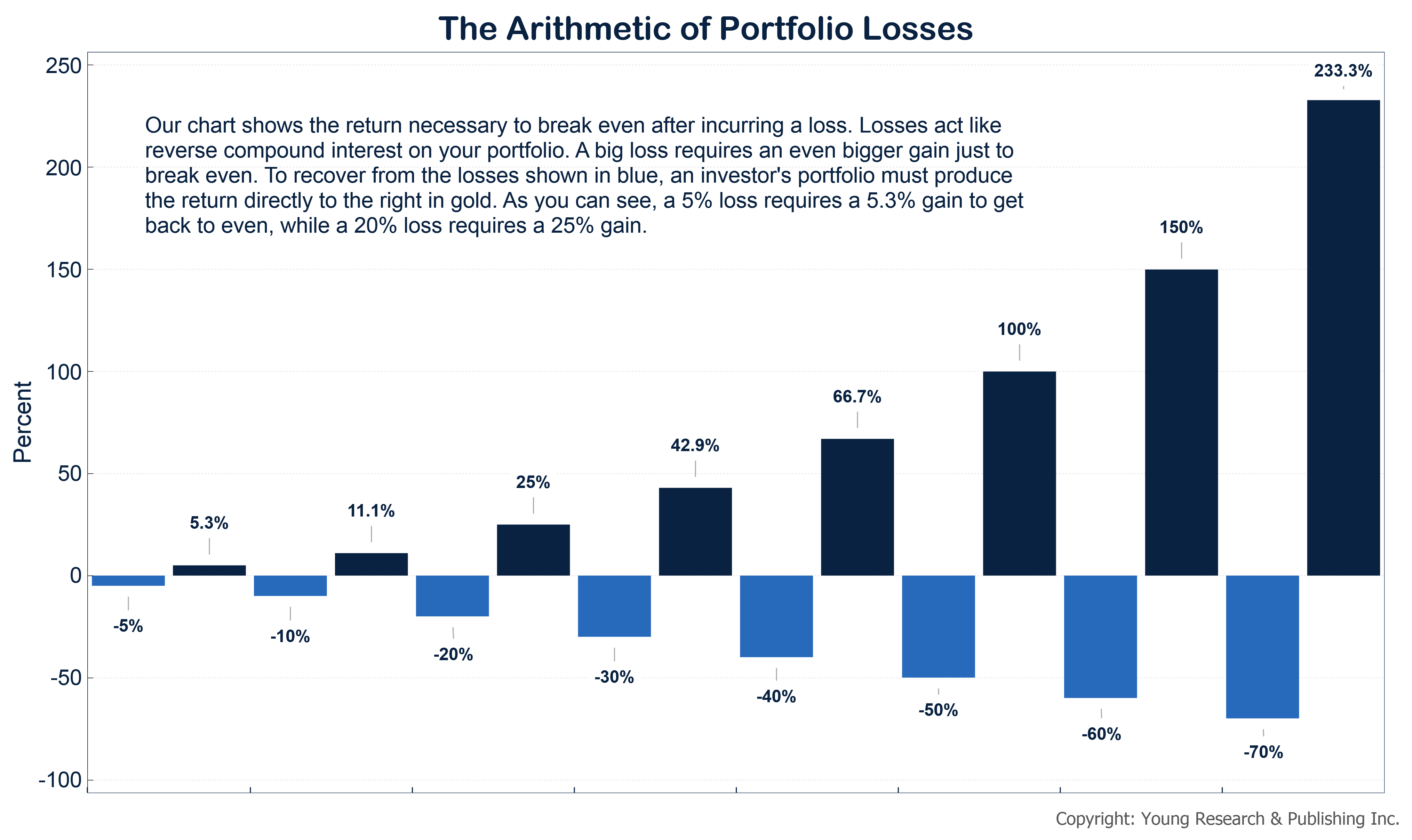
It’s impossible to have it all ways. In order to craft an investment portfolio that can act as an all-weather armadillo, you must be willing to forgo potentially substantial upside rewards to balance against the horror of a downside wipeout. If you are retired or saving for retirement in the not-too-distant future, you can easily get a knot in your stomach when you look at the basic math of downside portfolio protection. By example, when you lose 50% on an investment, you must make 100% the next trip to the plate just to get back even. And that’s without considering the negative drag of expenses and taxes on your gain, as well as the fact that you have not earned enough net-net to make my mandated 1% quarterly draw. I cannot impress upon you enough how ugly things can get—and fast. For a big percentage of investors, the mindset to take a deliberate and laser-focused armadillo-like approach is never achieved. For this unfortunate crowd, the ticking time bomb has already been set. What awaits is the explosion and ensuing financial carnage for the sad family.

The tragedy of big losses in an investment portfolio is felt most by those with the least time to recover. That includes retirees and those about to retire. You don’t have the luxury of a steady paycheck to rebuild savings, or the time to wait for markets to recover. Your livelihood in retirement is your portfolio. You can see the pickle investment losers find themselves in on my chart of the arithmetic of portfolio losses below. Each light blue loss has a corresponding dark blue gain that must be generated in order to simply get a portfolio back to even. If you’re entering retirement soon, or you’re already enjoying life after work, it’s no longer the time to take chances. Invest with prudence.

Filed Under: Investing Strategies

Here’s the Minimum You Should Invest in Fixed-Income

December 14, 2018 By Richard Young

Back in May of 2002 I warned readers of the dangers of market timing, and of investing too much of their portfolio in equities. I wrote:

Your Focus: Dividends & Interest

In this issue, I re-emphasize why I think conservative investors must focus laser-like on fixed-income interest and dividends from common stocks. No matter what hype you read in the media or hear from brokers, stocks in general are not cheap—far from it. When all you get from the average big company stock is a 1.5% yield and you pay nearly 30 times earnings in the process, you are not looking at bargains. As you know, I do not invest for my own account on where I think the market is going, nor do I advise market prognostication for you. If Warren Buffett or Charlie Munger or Martin Whitman or Mike Holland or Jack Bogle don’t do it, and Ben Graham never did it, I sure as heck am not advising market timing for you.

Counterbalancing Is King

Instead, I invest a minimum 30% in fixed-income securities and the balance (70%) primarily in value-oriented equity securities. And I emphasize dividends. That is the exact strategy I insist you adopt if you want to retire in comfort. If, instead, you and your spouse are comfortable with gut-wrenching volatility, sweat-soaked sheets, and the raw nerves and foul disposition that come with sleep deprivation, just take a pass on my value-based diversification strategy.

A substantial counterbalancing fixed income position is still right for investors today. Diversification among asset classes is one of the most consistently effective ways to minimize losses in a market downturn. If you are unsure about the diversification in your portfolio, evaluate your holdings today and make the necessary adjustments.

Filed Under: Investing Strategies

How Can You Spot a Loser in Investing?

December 12, 2018 By Richard Young

Back in July 1994, I wrote:

You Has It or You Don’t.

Dressed in snakeskin, feathers, grease paint and radiant colors, New Orleans gris-gris musician, Dr. John, delivers his musical message. Funky, gumbo-tinged rhythms spiced with a Bayou flavor makes for a perennial Mardi Gras atmosphere when delivered by Crescent City favorites like Jessie Hill, Cyril Neville, Chuck Carbo, Allen Toussaint, and the eclectic Night Tripper, Dr. John.

When asked what makes the whole musical gumbo of New Orleans come together, Dr. John explains that it’s the groove of the thing, a pulse, an inner self sort of thing. Notes the Doctor, “You either has it or you don’t.”

The Rhythm of Investing

Why is it that some investors you know seem to get it right most of the time, while many more do not? No rhythm, that’s why. It’s not hard to spot a loser in the financial markets. A loser has no plan, little perspective and less understanding of the risk/reward trade-off. There’s no beat.

A winner in the financial markets, by contrast, always has a plan, has great perspective and is a keen student of the risk/reward ratio. It’s the backbeat that lays down the rhythm for the foundation of New Orleans R&B as well as for successful investing. You need the foundation.

So, to spot an investing loser, look for someone with “no plan, little perspective and less understanding of the risk/reward trade-off.” If you haven’t developed these three critical elements of a winning investment strategy, get started today. Here are three small steps you can take today towards investment success.

  1. Get a plan. If that means hiring an advisor, do so.
  2. Get some perspective. A good start can be made by signing up for the Richard C. Young & Co., Ltd. monthly client letter (free even for non-clients) at younginvestments.com.
  3. Get a better understanding of the risk/reward tradeoff by picking up a copy of The Intelligent Investor by Benjamin Graham. And if you have managed to spot an investing loser among your friends or family, the book makes a great stocking stuffer too.

Dr. John – Full Concert – 08/13/06 – Newport Jazz Festival (OFFICIAL)

Filed Under: Investing Strategies

Can Politics Predict the Markets in 2019?

December 7, 2018 By Richard Young

I have written in the past that politics can have a great effect on market performance. Today America is enduring one of the most contentious political climates in memory, and at the same time the stock market has become volatile.

The best year in the four-year presidential election cycle is the year before the election. In this cycle that’s 2019. Since 1875, the average performance of the S&P 500 in the calendar year before a presidential election has been 14.3%. The presidential election year itself comes in next with an average of 10.9%, and midterm election years and the year after the presidential election produced averages of 9% and 8.9% respectively.

So does that mean a roaring bull market is guaranteed in 2019? Of course not, there are no promises, no tricks, and no shortcuts in investing.

I wrote this back in 2006 (charts have been updated to reflect the subsequent years):

Politics & Stock Prices from 1959 On

The stock market likes good times. Until just recently in 2005, most investors (not you, I trust) have not had much about which to cheer. Much of the trauma this year has related to the foul media coverage President Bush has received regarding Hurricane Katrina and the Iraq war. Just how much does the political landscape affect stock prices? A whole lot. In fact, few variables rate higher on my list of stock market influences. To make my point, I have put together four historical displays starting with the year I got started with the stock market—1959. The displays depict stock market gains and losses in each of the four years of the presidential cycle.

Display #1—Election-Year Power

Anyone who tells you to pay no attention to politics as it relates to the stock market is smoking something funny. Politicians of all stripes will say just about anything to get elected, and the vote-getting bribery of politics provides a good-time feeling in almost every election year. Since 1959, a presidential election year has brought with it higher stock prices in 10 of 12 years.

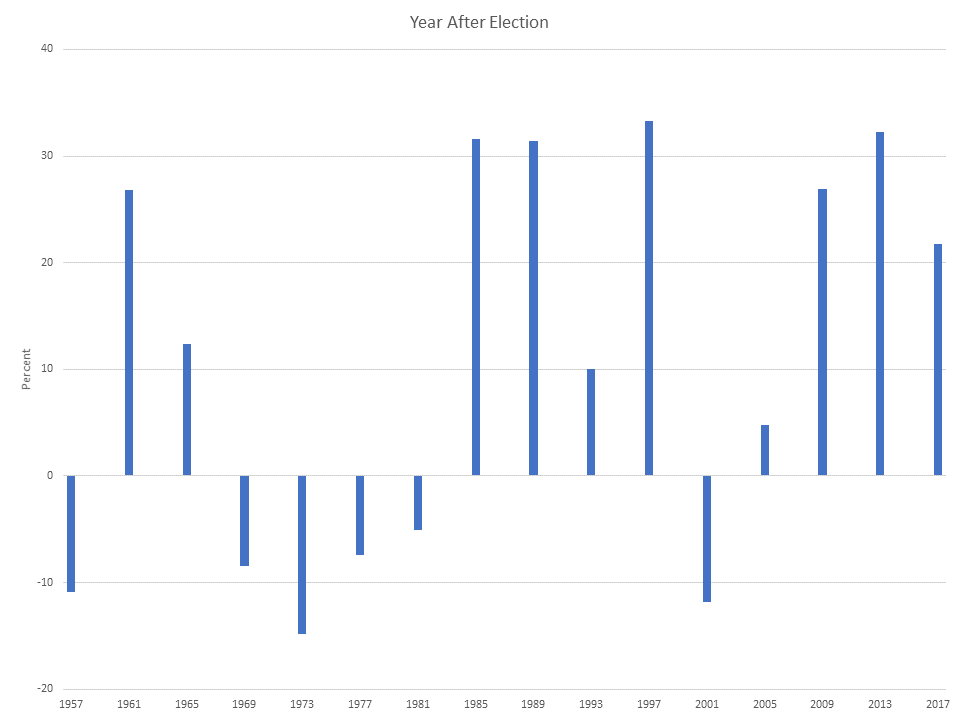
Display #2—The Year After a Presidential Election

The rubber hits the road as the incoming president attempts to back up all those over-the-top campaign promises. The results are often short of the mark, and the stock market has an in-and-out time of it. The stock market results in 2005—an after-election year—have been pretty predictable.

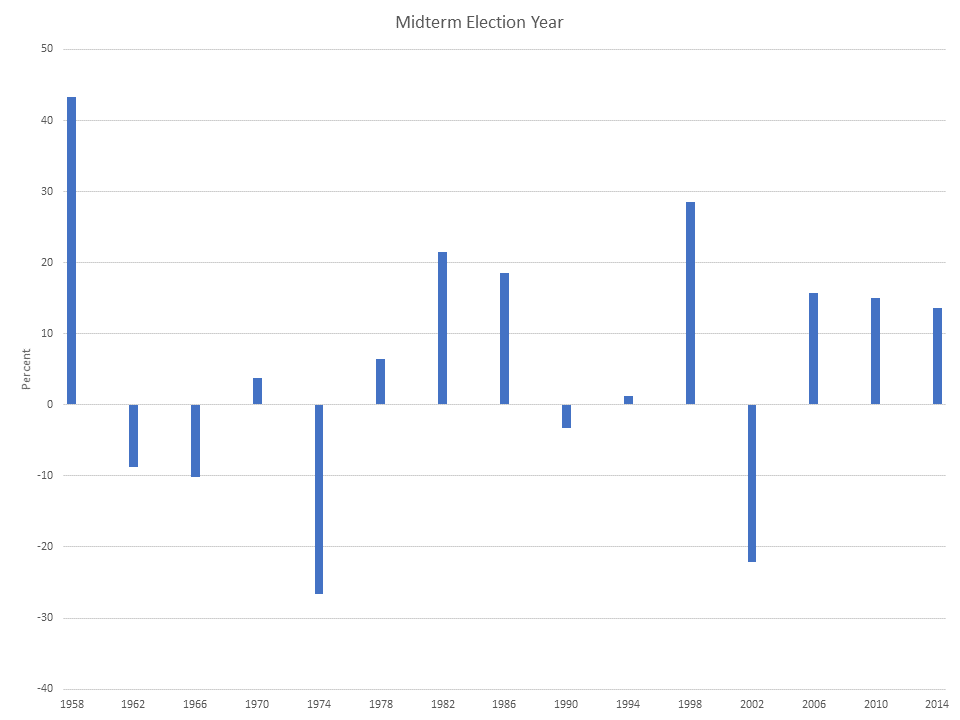
Display #3—Two Years After a Presidential Election

This is also an in-and-out year, as electioneering is not front and center. Furthermore, tough and often unwelcome presidential decisions must be made.

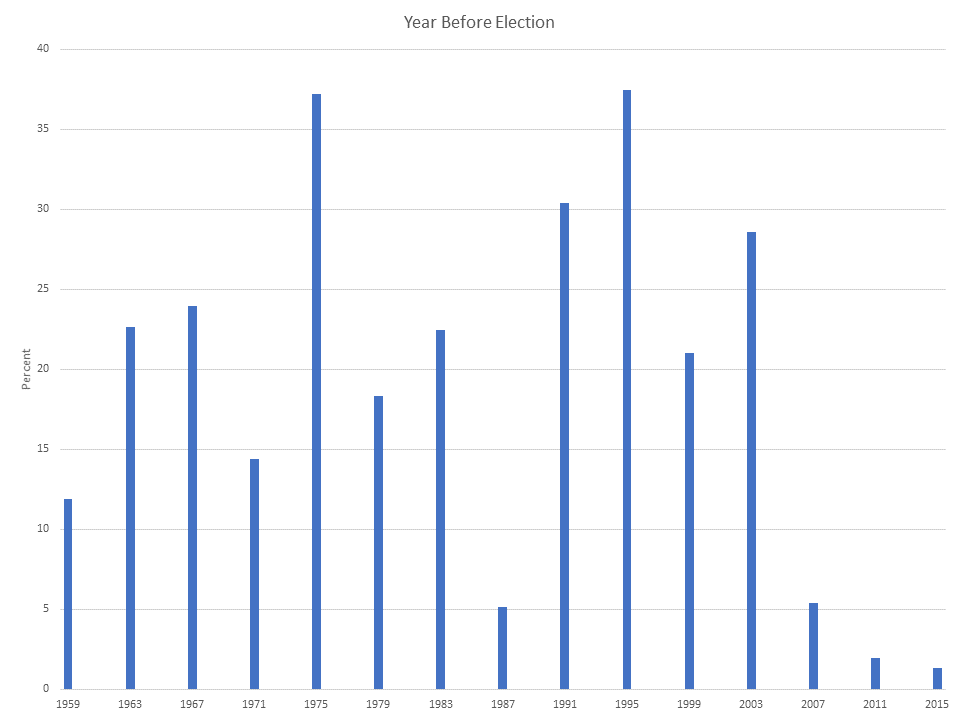
Display #4—The Year Before a Presidential Election

Since the banner year of 1959, there has not been a single stock market downer in the year leading up to a presidential election. Furthermore, stocks make big gains more so than in any other year in the presidential election cycle. Since 1959, you get a 22-and-2 record of ups and downs when you pair the year before a presidential election with the election year. By contrast, pairing the two years following a presidential election gives you a not-so-hot 11-and-11 record.

Looking Ahead and Cringing

In terms of the presidential election cycle, next year has the lowest odds of success of any of the four years in the cycle. Worse yet, the year coming up, 2006 (two years following the presidential election), has the fewest number of big years.

Filed Under: Investing Strategies

Are You Investing in the Armored Truck of Financial Markets?

December 5, 2018 By Richard Young

Are your investments characterized by the flash and speed of a supercar, or the reliability and protection of a Brinks truck?

There’s nothing wrong with a super powered automobile made to take on curves at maximum speed, but the power that makes those machines exciting, is also what breaks their parts. All that torque can be hard on an automobile.

Meanwhile, the massive diesel engines and reinforced steel protective bodies of armored trucks make sure its cargo reaches the destination.

Back in 1990 I called Treasuries “the armored Brinks truck of financial markets.” I was responding to a subscriber’s comment, here:

Subscriber Joan Howell recently contributed a nifty note on the wisdom of Treasuries. Joan writes, “I began to see a similarity in the selling of mutual funds, stocks and automobiles—a constant turnover of whatever is the fanciest, flashiest, or sexiest mode. Not that the ones at the top of the list are that bad, they just never stay permanently at number one. Then I thought of Treasuries as an armored Brinks truck: gray, square, solid, authoritative, weighing tons; no need to be ‘in fashion’ but always there, reliable, very profitable.”

Joan’s illustration is a beauty and adroitly defines the comfort level that Treasuries provide.

My family owned advisory firm, purchases treasuries for clients as a component of a balanced portfolio. If you are a retired or soon to be retired investor with $500,000 or more to invest looking to ease the burden of portfolio management to spend more time with your family and would like to discuss our treasury strategy during a free, no-obligation portfolio review with a seasoned member of our investment team, please fill out the form below.

Filed Under: Investing Strategies

Compensation was paid to utilize rankings. Click here to read full disclosure.

RSS New From Young Research & Publishing

  • The Question: To Be Invested or Not to Be
  • US Expands Nuclear Fuel Capacity to Cut Reliance on Russia
  • Trump Eases Some Metals Tariffs to Boost US Industry
  • Greek Tanker Owner Bets on Hormuz Reopening
  • Survive and Thrive May 2026: Will You Have Enough?
  • Oil Prices Jump on News of Iranian Withdrawal from Peace Talks
  • Are You Invested to Stay Invested?
  • Who Swoops in When There’s Blood in the Streets?
  • EIA Forecasts Record Summer Natural Gas Use by 2027
  • BEA Reports Modest Acceleration in US GDP Growth for Early 2026

RSS New From Your Survival Guy

  • The Question: To Be Invested or Not to Be
  • Don’t Miss the Best Days in the Market
  • Market Timing Could Be Hazardous to Your Portfolio
  • Are You Invested to Stay Invested?
  • Which Inflation Are You Talking About?
  • Who Swoops in When There’s Blood in the Streets?
  • Building Money from the Ground Up
  • You Can’t Be Too Rich, or Too Skinny
  • Survival Guy: An All-Weather Balanced Portfolio
  • “Affiliated:” Private Equity Is the Next Big Thing Coming for YOU: Part XVII

Search Our Site

Richard C. Young & Co., Ltd.

–Client Letter Sign Up–

Sign up to receive email alerts when our latest client letter is posted on our website.

Disclaimer:

The information contained here is for informational and educational purposes only. It is not intended nor should it be considered investment advice or a recommendation of securities. Past performance is not a guarantee of future results. It is possible to lose money by investing. You should carefully consider your investment objectives and risk tolerance before investing.

Copyright © 2026 · About Dick Young · Terms & Conditions


Loading Comments...