• ABOUT – DICK YOUNG
  • YWMF – ARCHIVES

Young's World Money Forecast

Since 1978 With a 32 Year Vacation

  • DICK YOUNG
    • FROM RICHARD C. YOUNG
    • THE FINAL INTELLIGENCE REPORT
  • INVESTING STRATEGIES
    • RETIREMENT COMPOUNDERS®
    • GOLD & SILVER
  • DIVIDENDS & COMPOUNDING
    • MIRACLE OF COMPOUNDING
    • DIVIDENDS
  • GRAHAM & RUSSELL
    • BEN GRAHAM
    • RICHARD RUSSELL
  • THE DOW AND THE LEADERS
    • DOW vs. S&P 500
    • DOW vs. DOW DIVIDEND PER SHARE
  • WELLINGTON MANAGEMENT COMPANY
  • YOUR SURVIVAL GUY
  • BANK CREDIT & MONEY
  • THE PRUDENT MAN

Avalanche! It Is Astonishing How Your Money will Pile Up

May 10, 2019 By Richard Young

There is little as satisfying as the long-term gratification felt after planning ahead, saving, and reaping the rewards of your efforts. The best way to achieve that euphoria is to harness the power of compound interest by purchasing stocks and bonds that pay you a steady stream of income. Then put that income to use by compounding it, over and over again like an avalanche. In June of 2016 I encouraged investors to harness this “avalanche of return.” I wrote:

An Avalanche of Return

The most important aspect of investing for the long term is—without a doubt—compound interest. The act of compounding your investment over time creates an avalanche of returns that turns a small initial investment into a cascade of cash payments your family can rely on during good times and bad. And there’s no better time to get started than today. Like an avalanche, high initial dividends—once reinvested—will accelerate the profit generation of your portfolio.

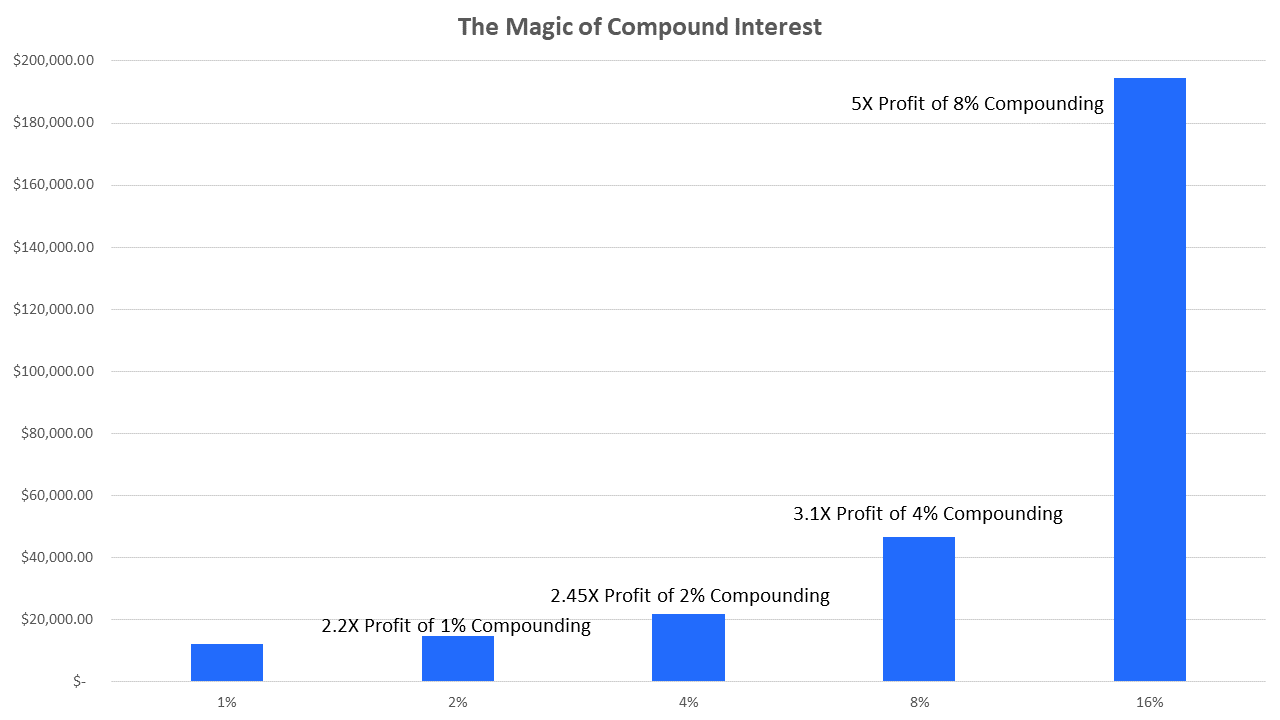
At www.youngresearch.com, we post regularly on the awesome power of compound interest. In our latest compound interest post, we illustrate for readers the exponential increase in profits that compounding can deliver to you. Here’s an excerpt: “As each rate of return doubles, your profit more than doubles. When you compound at 2% for 20 years, your profit is 2.2X your profit when compounding at 1%. And when you compound at 8% for 20 years, you have more than 3X the profit that you do when you compound at 4%. Double your return again, which is admittedly unrealistic over a 20-year period, and your profit is 5X your profit when compounding for 20 years at 8%.”

That logic doesn’t only apply to dividends, but it illustrates well the benefits of higher yields. On the chart below, you can see the differences in profit as returns move from 2% to 4%, and from 4% to 8%. It is astonishing how your money will pile up when given time to compound.
Related

Filed Under: Dividends & Compounding

Compensation was paid to utilize rankings. Click here to read full disclosure.


RSS New From Young Research & Publishing

  • Are You Getting Out There: Portugal or PEI?
  • 65 Years of Compounding: No Changes
  • Eroding Production: Russia’s Oil Industry Enters a New Era
  • U.S. Retail Sales Rise 5% From Year Ago Despite July Dip
  • Trump Looks to Squeeze Iran’s Economy Once Again
  • National Laboratories Set for Major Operational Reforms
  • Your Survival Guy’s RAGE Gauge: The Tables Are Full
  • Blue Moon Builds Out in Critical Minerals
  • Falling Energy Prices Keep U.S. Producer Inflation in Check
  • America’s Natural Gas Boom Hits New Record

RSS New From Your Survival Guy

  • Are You Getting Out There: Portugal or PEI?
  • Your Survival Guy’s RAGE Gauge: The Tables Are Full
  • CAUGHT IN A VICE: Private Equity Is the Next Big Thing Coming for YOU: Part XXIII
  • Delinquencies Rising: Concerning but Not Yet an Emergency
  • The Reliability of Nuclear
  • Market Volatility Giving You the Summer Blues?
  • Judge Blocks Mamdani’s Tax, for Now
  • WALK AWAY: Private Equity Is the Next Big Thing Coming for YOU: Part XXII
  • LIQUIDITY: Is Private Credit Liquid Enough for Retirement Investors?
  • The Value of Diversification

Search Our Site

Richard C. Young & Co., Ltd.

–Client Letter Sign Up–

Sign up to receive email alerts when our latest client letter is posted on our website.

Disclaimer:

The information contained here is for informational and educational purposes only. It is not intended nor should it be considered investment advice or a recommendation of securities. Past performance is not a guarantee of future results. It is possible to lose money by investing. You should carefully consider your investment objectives and risk tolerance before investing.

Copyright © 2026 · About Dick Young · Terms & Conditions


Loading Comments...