• ABOUT – DICK YOUNG
  • YWMF – ARCHIVES

Young's World Money Forecast

Since 1978 With a 32 Year Vacation

  • DICK YOUNG
    • FROM RICHARD C. YOUNG
    • THE FINAL INTELLIGENCE REPORT
  • INVESTING STRATEGIES
    • RETIREMENT COMPOUNDERS®
    • GOLD & SILVER
  • DIVIDENDS & COMPOUNDING
    • MIRACLE OF COMPOUNDING
    • DIVIDENDS
  • GRAHAM & RUSSELL
    • BEN GRAHAM
    • RICHARD RUSSELL
  • THE DOW AND THE LEADERS
    • DOW vs. S&P 500
    • DOW vs. DOW DIVIDEND PER SHARE
  • WELLINGTON MANAGEMENT COMPANY
  • YOUR SURVIVAL GUY
  • BANK CREDIT & MONEY
  • THE PRUDENT MAN

Are You a Shepherd or a Gunfighter?

November 23, 2018 By Richard Young

Before you answer, remember that at least 50% of gunfighters end up dead.

Are you the type of person who will dutifully grow your investment portfolio over the years by shepherding it in the right direction?

Or will you risk it all in one high risk gunfight after another until your number is called?

Consider what I wrote here, thirty years ago in December of 1988. It’s a comparison of some high-level shepherding vs. some inexperienced gun slinging.

Do you know the two most powerful words in investing? If you’ve been with me through the years, you know the answer. But for all of my new subscribers, the two magic words are COMPOUND INTEREST. Let me show you their importance and suggest an exclusive menu of high-yield winners perfect for your portfolio.

The name Joseph Rosenberg may not mean anything to you. Joe’s a money manager for Loews Corp. How much does Joe shepherd? Over $1 billion. A few years ago I made a presentation to Loews’ top management. The group included CEO Laurence Tisch, now also head man at CBS. Rarely if ever have I been more impressed with the composite investment knowledge of a small management team. It’s, of course, not for lack of acuity that you’ll find Laurence and Preston Tisch listed among the Forbes “Four-Hundred Richest Americans” at a staggering $1.7 billion.

“The Most Important Thing in Investing”

You can imagine my interest when I opened my 1989 Fortune “Investors Guide” and saw staring at me a near-full page color photo of Joe Rosenberg in his mountain climbing clothes. Joe is an adventurer at heart, but when it comes to investing, listen to Fortune tells readers:

“Joseph Rosenberg, who manages more than $1 billion for Loews Corp., believes so fervently in the awesome power of compounding that he carries a compound interest table in his pocket at all times…even to the peaks of Yosemite. His faith is simple and absolute.” Says Joe of the powers of compounding: “It is the most important thing in investing.”

About the same time I was enjoying Fortune’s neat picture of Joe sitting high atop a peak at Yosemite, I read an article on a young woman referred to by the Wall Street Journal as “the new Wall Street guru.” The Journal informed us that this young lady had enjoyed a single-day media coronation, “while some legendary investors [including Joe and the Tisch brothers, I might add] have built their records over decades.”

And how is the “new guru” doing? Not so well, I’m afraid. Her fund ranked dead last in its category in the 1988 period annualized by the Wall Street Journal. So much for new gurus.

Think about it. Do you want to become wealthy by following my policies of compound interest performance, or do you want to draw to an inside straight, pan for fool’s gold, or perhaps relive the financial equivalent of the gunfight at the OK Corral? As Joe Rosenberg told Fortune readers, “It’s foolish to undermine the power of compounding by taking big risks that could kick you out of the game.”

To harness the power of compounding you must be a shepherd, not a gunfighter.
Filed Under: Investing Strategies

My Concentration Is on Full Faith & Credit Pledge U.S. Treasuries

November 20, 2018 By Richard Young

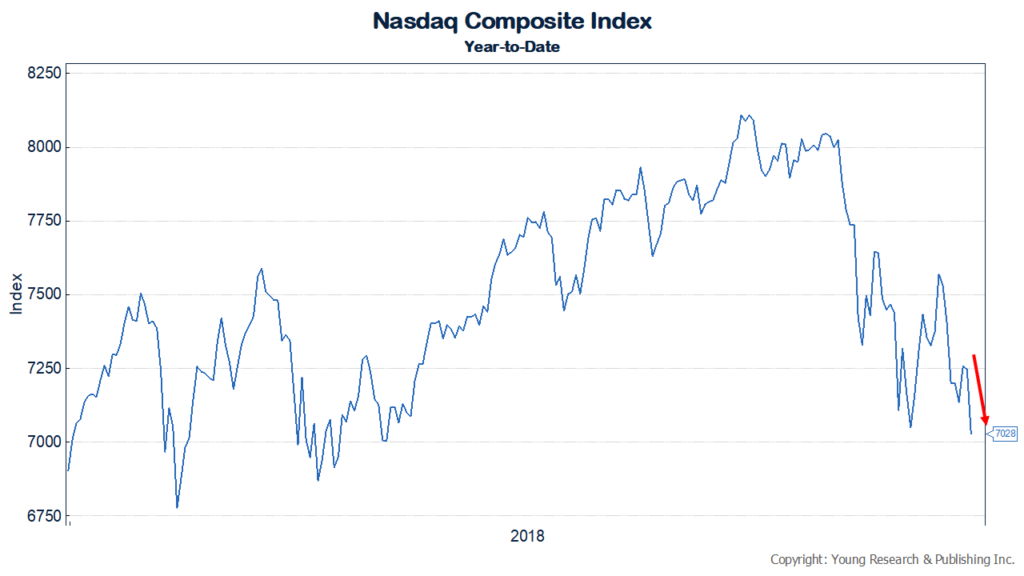
As Wall Street tumbles, my concentration is on full faith and credit pledge U.S. treasuries. Reuters‘ Caroline Valetkevitch reports on the market:

The Nasdaq fell 3 percent on Monday as investors dumped Apple, internet and other technology shares.

Shares of Apple Inc fell after the Wall Street Journal reported the company had cut production orders in recent weeks for all three iPhone models launched in September.

The iPhone maker’s stock dropped 4.0 percent to $185.86 and is now down 19.9 percent from its Oct. 3 record closing high in the wake of a disappointing holiday quarter sales forecast.

Other market leaders – including the ‘FANG’ stocks – also fell sharply. Shares of Facebook were down 5.7 percent, Amazon.com was down 5.1 percent, Netflix fell 5.5 percent.

Read more here.


Filed Under: Investing Strategies

Are You About to Retire Broke?

November 16, 2018 By Richard Young

Most Americans are simply not saving enough. GOBankingRates released a survey this week showing that 42% of Americans will retire broke. Hopefully, that doesn’t include you, but even if you have been saving, it’s a good bet you could do more.

In July 2014, I explained to readers why they should boost savings.

Boost Your Savings

The strategy implication of a low-return environment is that savings must play a greater role in your investment plan. The stock and bond markets aren’t going to bail you out. To secure a prosperous financial future, today’s low-return environment demands that you boost your savings rate. And not just by a little, but by a lot.

Consider a hypothetical investor who we will call Joe. Joe is 50 years old and he plans to retire in 15 years. Joe has $1.2 million in retirement savings. He has an annual income of $150,000 and he thinks he can retire comfortably with $100,000 in income. Since Joe doesn’t plan to retire for another 15 years, we have to adjust his $100,000 income need for future inflation. Assuming a 3% inflation rate, Joe will need to take $155,000 in income when he retires.

Using my maximum advised 4% withdrawal rate, Joe shouldn’t retire until he has a $3.9 million portfolio ($155,000 is 4% of $3.9 million). Since Joe already has $1.2 million invested in a 50-50 mix of stocks and bonds, his savings goal is within reach. But only if he makes regular contributions to his portfolio. How much does he have to contribute to his portfolio to achieve his savings goal?

A lot more than he would if he could count on a 7% return. At a 7% return, Joe would be able to put away $2,000 per month, or about 16% of his income, and easily achieve his retirement savings goal. But at a 4% return, Joe will have to save about $84,000 per year to reach his $3.9 million target in 15 years—that’s more than half of his annual income.

The ugly reality of the Fed’s aggressive monetary policy is that many Americans are going to have to save more and work longer in order to retire comfortably. I am not suggesting that you boost your savings rate to 50% of your annual income, but I am suggesting that you reassess your retirement savings plan in light of today’s low prospective return environment.

Filed Under: Investing Strategies

Here’s How You Should Approach Investing in China

November 9, 2018 By Richard Young

The China Household Finance Survey run by Gan Li at Chengdu’s Southwestern University of Finance and Economics, recently found that one fifth–that’s 20%–of Chinese homes do not have occupants. Instead these homes are owned as investments in what could be one of the world’s most distorted markets ever.

Back in February of 2012, I wrote about China’s “ghost cities,” and the dangers of investing in a command economy. Government subsidies, capital controls, and excessive regulations distort the Chinese economy, making analysis of normal economic signals difficult.

With Chinese shares already down over 20% (in yuan terms) in 2018, and Trump administration tariffs threatening to take a bigger bite out of the Chinese economy in the future, I urge all investors to read my analysis on investing in China here.

China

I have long advised against direct investment in China. Among the many reasons I am bearish on China is the country’s vastly distorted economy. China is a command style economy run by an unelected political party—the Communist Party of China (CPC). The CPC’s policies have resulted in a grand misallocation of capital. A mercantilist currency policy, perverse incentives for provincial government officials, and crude monetary policy tools have helped inflate a fixed asset and real estate bubble that puts the U.S. real estate bubble to shame.

A Quality Problem

It should be obvious to most that things are not as they seem in China. China has reported GDP growth of 9% or more in every quarter over the last two years, but the Shanghai Composite Stock Index has plunged more than 30% during that time. If China’s economy were truly booming, Chinese shares would most likely be trending up. China suffers not from a quantity of economic growth problem, but a quality growth problem. China’s GDP statistics are being propped up by unproductive fixed asset investment. The real estate sector is the most obvious example. To prop up GDP growth rates the Chinese are building entire cities, but they are virtually empty. For more on these ghost cities, be sure to check out the China’s Empty Cities video at www.youngresearch.com. It is perplexing that the world has allowed a command style economy run by an unelected political party to become such an important player in the global economy. China is now the world’s second largest economy and America’s second-largest trading partner. If China heads into the tank, the world economy will suffer.

No Profit Motive

China doesn’t play by the same rules or have the same motives as the world’s other large economies. China has consistently manipulated its currency to gain export market share and it has subsidized favored industries through its financial system to the detriment of non-Chinese companies. Take the rare earths industry as an example. China now has an effective monopoly on rare earths production. Not because of the country’s low labor costs or a lack of reserves in other countries, but because Chinese rare earths companies were provided with subsidized loans. Rare earths companies ramped up production in the ’80s and ’90s and drove prices down to unprofitable levels. The Chinese government was more interested in maintaining stability through high employment then, as they are today. Low prices pushed rare earths producers in the U.S., Australia, and elsewhere out of business. With the support of subsidized loans, China’s rare earths companies were the only companies able to remain in business at such low prices. Now the U.S. relies on China (at least temporarily) for a supply of metals vital to the defense industry and other high-technology industries. Sound like a smart strategy to you?

Filed Under: Investing Strategies

How Does Your Retirement Portfolio Look?

November 2, 2018 By Richard Young

How does your retirement portfolio look?

  • Do you actually have any idea what you are doing? Do you feel like you are over your head and investing with a crap-shoot mentality?
  • Are you subsisting on outmoded, far-too-big mutual funds or, worse yet, those ghastly oversized index funds?
  • Are you a total neophyte on bond investing and pretty much devoid of understanding the miracle of interest, patience, and compounding?

If your answer is yes to any of these questions, you may require a whole new battle plan to strengthen your investment strategy.

Since 1978 Young Research has developed strategies for conservatives like you.

My son Matt Young, CEO of our family investment counseling firm, writes our monthly client letter to level the playing field for concerned conservatives.

After four decades of writing my monthly subscription-based strategy reports, I have retired. Now, I concentrate 100% on international research that supports the efforts of Matt and his senior leadership team at our family investment counseling business. My research is a fundamental component of Matt’s monthly client letters.

Why not stay in touch with Matt and me monthly. If you are not yet signed up, simply add your name to our inquiry register below.


My family looks forward to welcoming you and your family to a whole new world of compounding, consistency, and comfort.

Warm regards,

Dick

Filed Under: Investing Strategies Tagged With: comp

The 3 Components of Investor Success You Should Care About

October 31, 2018 By Richard Young

On Wall Street, traders and speculators are closing their doors. The Wall Street Journal’s Rachael Levy recently reported:

Boston-based hedge fund Frontlight Capital LP is shutting after fewer than three years in operation, people familiar with the matter said.

Four other hedge funds earlier this month announced they were closing, as investors re-evaluate a once-highflying industry plagued by weak returns.

Through September of this year, Frontlight’s fund, Frontlight Enhanced Macro Master Fund I, LP, lost 4.17%, according to a document reviewed by The Wall Street Journal. The fund lost 5.6% last year. The firm managed about $280 million, the document said.

Such speculators have no use for the ONLY three components of investor success I care about, and you should care about too.

  1. Cash flow
  2. Compounding and
  3. Patience

Over the long term (patience) always leads to capital appreciation. ALWAYS.

Follow the cash, and compounding and time will allow the power of cash to steadily and relentlessly pull capital appreciation forward.

Stick with cash flow always.

Trading, and speculating that there will be a greater fool available to sell your shares to in the future is what has driven these hedge funds out of business. Don’t make the same mistake, focus on my three components for success.

Filed Under: Investing Strategies

The Right Attitude for Winning Investing

October 26, 2018 By Richard Young

Investing is all about attitude. Are you too eager to take on risk in good times? Too ready to cut and run in bad? Can’t commit to an investing plan? Don’t have the resolve to stick to a sustainable withdrawal rate?

In early 1999 I talked with the former American League MVP, Boog Powell about attitude. I wrote this that May:

I was talking to Baltimore Oriole baseball legend Boog Powell recently. During the baseball season, Boog runs Boog’s Barbecue at Camden Yards in Baltimore. Off-season, he is in Key West occasionally as “guest” barbecue celeb at his high-school buddy’s local spot. Boog will tell you that barbecue is an attitude. Well, successful investing is also all about an attitude. Your mental framework will go a long way in making you a successful investor. The primo way for you to have a winning attitude 100% of the time is to become a programmed investor. Operate on the premise that the economy grows over time, as do corporate earnings, and thus stock prices. Don’t trade in and out. Ride the long wave to prosperity in a risk adjusted way that reflects your age, investment acuity, financial resources, risk tolerance, and need for income from your investments.

Managing your attitude is the hardest part of successful investing. Keeping calm during market turbulence isn’t easy when you’re on your own. Working with a professional can make a difference in your comfort during difficult times. If the last week of market volatility has you looking for guidance, sign up for the Richard C. Young & Co., Ltd. monthly client letter (free even for non-clients). Take some time to read through older letters to understand our steady approach to investing.

Filed Under: Investing Strategies

Getting on the Map with Gold

October 19, 2018 By Richard Young

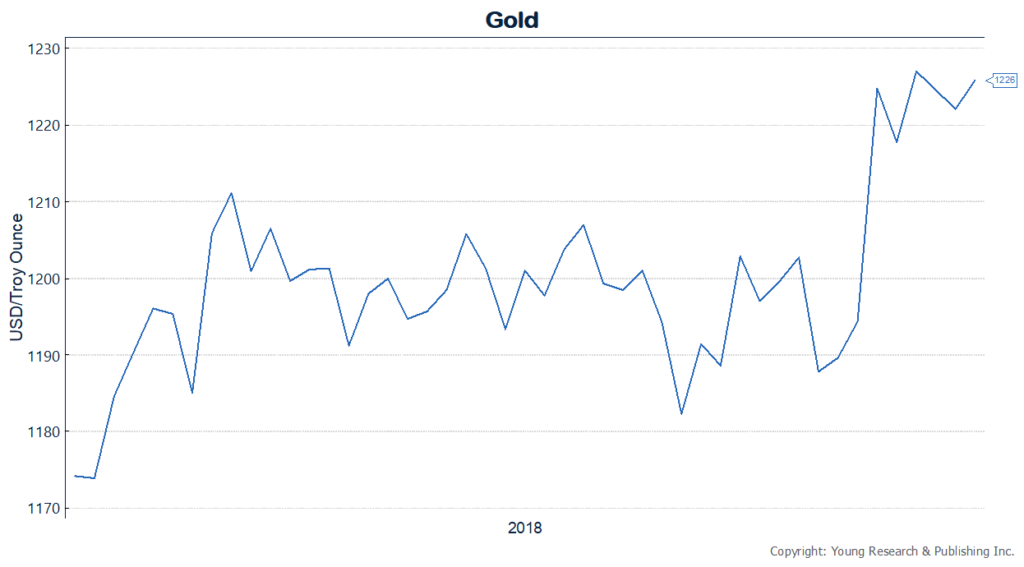
I have been a longtime supporter of including gold in diversified portfolios. Gold is a safe-haven asset, an inflation and currency hedge, and a hedge against geopolitical turmoil and general market turbulence.  It is an insurance policy of sorts. When everything else is down, gold is often up. Gold’s counterbalancing effects can dull the pain of a market rout.

We have seen shades of gold’s counterbalancing power over recent weeks as both stocks and bonds have sold-off while gold prices have risen.

I’ve long been an outspoken advocate of owning gold (I say owning because I buy gold and do not intend to sell). I’ve spoken on gold at conferences around the country, and I have researched and written about gold for nearly 50 years.

Becoming a reliable purveyor of gold insight was no easy trick. At 30 years old I was given a tough, international assignment, and then judged by some of the most demanding names in the business. In August of 2017, I told readers the story of the research breakthrough that put me on the gold map. Here it is for you:

London, 1971

Portfolio strategy discussions and strategizing with the world’s biggest institutional clients started for me with a mix of Boston, New York, and London research. My institutional research and trading days trace back to August 1971 with Model Roland & Co. The Boston offices were on Federal St. in the old financial district. I was 30 years old.

Gold Research for Leo Model

By the summer of 1972, I was off to London on a gold/gold-shares research trip. This eye-opening experience gave me access and exposure to the largest players in the international gold market. I met contacts and gained background that would be invaluable to me, and thus to my clients, for the ensuing 45 years. Meetings at Samuel Montague and Consolidated Gold Fields, for example, allowed me to craft a detailed report for Leo Model on gold as a commodity as well as a monetary asset.

E.M.B. Comes Through

Mr. Model thought enough of my report to put it into the hands of no less than America’s dean of international monetary experts, Edward M. Bernstein. This was a little unnerving for me as a 30-year old who was prepared for a sour outcome and a lecture from Herr Model, a demanding employer.

Well, much to my surprise, Mr. Model soon received a note from E.M.B., perhaps the #1 expert in the world on the intricacies of gold: “I think the collection of papers on gold is excellent. It seems objective and pointed. I have no suggestions. … Put me on the list to get what Model Roland puts out on gold.”

That did it for me. I was on the map.

Filed Under: Investing Strategies Tagged With: precious

Get Rich Slow with This Strategy

October 17, 2018 By Richard Young

Most “get rich quick” schemes end up turning into “get poor quick” schemes. Reach too deep into the risk pool and you’re likely to fall in. I knew that 30 years ago, and in 1988 I wrote:

I’m an ultra-conservative investor at heart…and by intent. I know my reputation in the industry puts me in the most cautious camp possible, and that’s just swell with me. My motto has always been, “Get rich slowly with compound interest.”

At even a 7% rate of return, money doubles in about ten years. In IRA, Keogh and other retirement accounts, over half of total return should come from dividends and growth of dividends.

Dividends are the foundation for any serious investment portfolio. I’ve told you many times that over the 50-year period, end 1986, the Dow Jones Industrial Average compounded at 4.8%. Dividends on average provide a yield of 4.5%. And then there is the 4.6% long-term dividend growth rate that combines with current yield to make dividends the focus consideration in any investment-grade portfolio. Look for a yield that is higher than the yield for the average Dow stock (currently 3.6%); look for dividend growth better than the Dow’s historical 4.6%; and look for a price earnings ratio (P/E) that is below the Dow P/E (currently 14.2x). If you make it your point to select stocks that meet these three initial tests, you will be well on your way to assembling a portfolio with excellent prospects for long-term total return. Don’t be overly anxious about capital appreciation. Let appreciation take care of itself. You want to lock in a relatively high yield and good dividend growth prospects.

The Dow yields have changed today, and buybacks are a bigger part of the investment picture than they were in those days, but the principle remains the same: get rich slowly with compounding.

Filed Under: Investing Strategies

Don’t Manage Your Money Like This

October 12, 2018 By Richard Young

In September of 1992, I outlined the tragic story of a MLB slugger, Jack Clark who had misspent his money and wound up in bankruptcy. I wrote:

It’s Time for Bankruptcy

Not for you of course. No, I’m writing to you about bankruptcy for Jack Clark, Boston Red Sox slugger, but this story carries a lesson for most of us.

Now here’s a guy—a good guy, too—with a three-year Red Sox contract worth $8.7 million. And yet Jack is bust. He has listed $11.5 million in debts, versus only $4.8 million in assets. Clark owns 18 automobiles, including a $717,000 Ferrari. He dumped over $1 million into the Jack Clark Racing Team and earned next to nothing on it. He owes American Express over $55,000 and Visa nearly $20,000. The guy’s monthly statements must look like a J. Crew catalogue. He owes state taxes. He owes Fed taxes. He owes his agents.

You Need to Protect Your Principal First

Here is a story of financial excess that is truly hard to imagine. Jack Clark is a young man who has earned millions. But he did not have a plan for his financial future. He did not even plan for today. And he did not protect his principal.

Remember last month when I wrote to you about not blowing your principal? For many investors, the accumulation of principal may be short-lived, like a professional athlete’s, or even a one-time shot, such as receiving an inheritance. That’s why it is so important to protect—not plunder—your principal. Jack Clark blew $8.7 million. Who knows what’s ahead for Jack Clark, but it will most likely include starting from scratch financially. Had Jack invested along the lines outlined monthly here, his wealth would have increased with consistency, and his financial worries would today be non-existent.

The lesson here is that whether you have $8 or $8 million, you must have a disciplined, consistent plan for your financial future with first priority given to protection of principal.

Clark’s story turned from bad to worse this year. At age 62, after earning what was estimated to be $15 million during his long baseball career and working for multiple television and radio sports broadcasters, Clark has filed for bankruptcy once again.

Instead of enjoying what should be a comfortable retirement, Clark is starting from scratch once again. He didn’t protect his principal, he spent it, twice.

Don’t make the same mistakes as Clark. Protect your principal with a disciplined, consistent plan for your financial future.

Filed Under: Investing Strategies

  • « Previous Page
  • 1
  • …
  • 14
  • 15
  • 16
  • 17
  • 18
  • …
  • 20
  • Next Page »

Compensation was paid to utilize rankings. Click here to read full disclosure.


RSS New From Young Research & Publishing

  • The Pickpocket of New York
  • Will Mamdani’s Grocery Stores Deliver Savings or Regret?
  • China’s Oil Imports Plunge as Higher Prices Hit Demand
  • Exxon, Chevron Ride Oil Surge to Strong Q2 Profits
  • China’s Factory Activity Unexpectedly Contracts in July
  • “Unlimited” AI Cash Drives Boom in Trades
  • US Economy Grows 1.5% in Second Quarter
  • Federal Reserve Signals Patience on Rate Cuts
  • Is HMM Seeing a Shipping Downturn Before Others Do?
  • Microsoft’s AI Bet Drives Fastest Azure Growth in Years

RSS New From Your Survival Guy

  • The Pickpocket of New York
  • Speed to Power: DOE Prioritizes Power Generation
  • Barometers on the Stock Market, Socialism, and YOU
  • “Unlimited” AI Cash Drives Boom in Trades
  • New Iran Worries Raise Oil Prices as Fed Deliberates
  • When Speaking the Word “Opportunity,” It Means This
  • Government Grocers: No Free Lunch
  • A Return to Normalcy at the Fed
  • Slay Inflation
  • Putting Some Power Away in the Pantry: Part 8

Search Our Site

Richard C. Young & Co., Ltd.

–Client Letter Sign Up–

Sign up to receive email alerts when our latest client letter is posted on our website.

Disclaimer:

The information contained here is for informational and educational purposes only. It is not intended nor should it be considered investment advice or a recommendation of securities. Past performance is not a guarantee of future results. It is possible to lose money by investing. You should carefully consider your investment objectives and risk tolerance before investing.

Copyright © 2026 · About Dick Young · Terms & Conditions


Loading Comments...